| Home : ITU News magazine | ||||||||||||||||||||||||||||||||||||||||||
Africa’s information and communication technology (ICT) landscape is undergoing a revolution that is bearing fruit. No longer merely flirting with market liberalization, more and more African nations are embracing full-scale regulatory reform. These new measures are designed to attract a surge of investment in the ICT sector and exploit the potential of low-cost technologies to provide affordable access to ICTs. Could it be that Africa’s long-anticipated renaissance has finally begun? A quick look at the ICT policy landscape across Africa shows real signs of pioneering and innovation. The door to market-based ICT development has opened. Many African policy-makers understand that market reform will take the leading role in the continent’s development. Africa is the fastest growing region for mobile communications and may well present one of the most fertile grounds for ICT investment anywhere in the world.
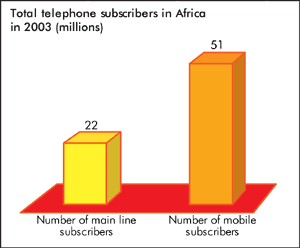
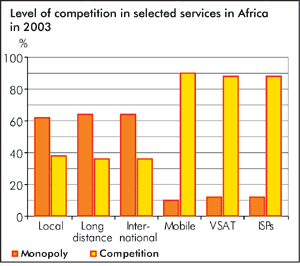
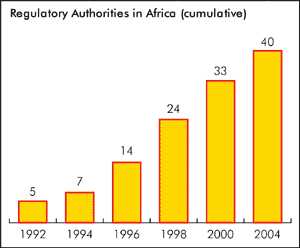
Upwardly mobileThe number of voice telephony subscribers (fixed and mobile cellular combined) in Africa has more than doubled in the last three years. In 2003, Africa had 73 million total voice telephony subscribers (22 million fixed and 51 million mobile as shown in Figure 1), up from a total of 35.4 million voice subscribers in 2000 (19.7 million fixed and 15.7 million mobile). Africa’s mobile growth rate from 2000 to 2003 was 225 per cent! Policy and regulatory reforms are the primary reason for this phenomenal growth that has been highest in the mobile sector, where 90 per cent of African nations authorize competition in the provision of mobile services according to ITU’s annual telecommunications regulatory survey (see Figure 2). However, only 73 per cent of the countries actually had competitive operators active in the mobile sector in 2003. Helping to ensure a level playing field for the new competitors, the number of African countries that have established a regulatory authority has risen from 33 in 2000 to 40 in 2004, up from a mere 5 in 1992 (see Figure 3). Despite the phenomenal gains in the mobile sector, there remains plenty of room for market growth. Only 73 million of Africa’s total population of 842 million inhabitants are voice telephony subscribers. And the number of Internet users is far smaller, making connecting Africa both a challenge and a great opportunity. If Africa were to reach the kind of mobile penetration rates enjoyed in some Western European countries, nearing 90 per cent, it would represent a potential market of over 690 million subscribers. While few experts would set this as a short-term goal, Africa may nevertheless be ripe for more ambitious ICT development goals than have been identified in the past. If Africa could replicate the kind of growth rates seen in India in 2003, where 2 million new subscribers were being added per month, it would reach 100 million total subscribers and achieve a continental teledensity rate of 12.5 per cent by 2005. Indeed, if Africa could replicate the kind of growth rates of the world’s largest mobile market, China, where 5 million new subscribers are added every month, there would be 60 million new mobile subscribers in a year’s time. This kind of vision could serve as a challenge to policy-makers and regulators across Africa. ICT policy and regulatory development
Increasingly, African policy-makers and regulators are implementing the kind of pro-growth practices that will enable these dreams to become reality. This article looks at some of the key champions for change in Africa ICT policy and regulatory development. These champions are striving to implement full-scale market liberalization to meet their national ICT development goals. Ernest Ndukwe, Executive Vice-Chairman of the Nigerian Communications Commission (NCC) is unabashedly pro-market, crediting regulatory reform with his country’s telecommunication successes in the past two years. “Africa must embrace market liberalization to prosper,” Nigeria’s maverick regulator said in a recent presentation published on NCC’s website. Mr Ndukwe outlined how the African policy and regulatory model has transformed over the years. Africa’s traditional policy model concerned itself only with telecommunications. Typically, a government ministry charged with telecommunication services oversaw a State-owned monopoly operator that received government funding to expand the basic telecommunications network. Much of the income earned from the national telecommunications network operator was folded into general government coffers, rather than dedicated to sector development. The result of this model is: slow network roll-out, a lack of competition, the inability of governments to attract investors, losses incurred in the local service segment, virtually no private sector involvement and a huge pent-up demand among the large number of underserved users — especially in rural areas. Those few telephone subscribers were largely fixed-line users living in major cities. This model led the Maitland Commission to recommend to developing countries, nearly twenty years ago, to strive for a meager teledensity goal of 1 main line per 100 inhabitants.
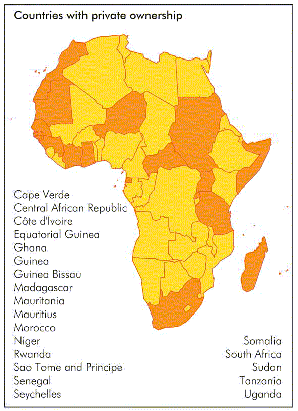
The new African policy and regulatory environment is dramatically different. First, the emphasis is no longer solely on telecommunications. Most countries are concerned about improving Internet access and joining the information society. Their policies now focus on ICT development. The government’s role, in a number of countries, is focused on policy development and sector regulation aimed at promoting competition and championing consumer interests. And the main service providers are no longer the government-sponsored fixed-line operators but the privately owned mobile operators. There are 121 African mobile operators active today. Forty-three African countries now have more mobile than fixed-line subscribers. What more needs to be done? Africa can build on these initial successes in the mobile sector to implement a range of policies to promote access to ICTs. Countries with three or more mobile operators generally experience greater growth in the number of subscribers and lower end-user prices than their counterparts with more limited competition. Today, however, most African countries remain mobile duopolies; some even maintain monopoly mobile operators. According to ITU market research, of the 55 African countries with mobile operators, 15 are still monopolies. Greater mobile competition will help to grow subscribers and attract investment. Likewise, business strategies designed by mobile operators for the African market are key to Africa’s mobile miracle. Regional roaming agreements will lead to greater affordability for cross-border communications. Prepaid cards and the use of mobile phones for public access will enable more Africans to access a phone. Public access has a variety of faces ranging from the informal resellers offering mobile services on the streets of Lagos to nomads in Mauritania selling services to other itinerants to postal workers carrying mobile phones and selling minutes when they deliver the mail. Local involvement in ICT development is also crucial. In Niger, for example, rural communities administer their own telephone booths and telecentres. In addition, village associations focus their efforts on developing content in local languages concerned with development issues including waste-water treatment, health and hygiene. More than growing the mobile sector, Africa is setting its sights on improved Internet access. What will this take? Liberalization of international gateways, creation of national and regional Internet Exchange Points (IXP) so that regional Internet traffic need not transit through Europe or North America, adoption of low-cost wireless broadband technologies and licensing practices designed to create a level playing field as well as attract both local and foreign investment. Progress on IXPs is being made, with national IXPs operational in the Democratic Republic of Congo, Egypt, Kenya, Mozambique, Nigeria, South Africa, Uganda, Tanzania and Zimbabwe. The Director of the ITU Telecommunication Development Bureau (BDT), Hamadoun I. Touré believes now is the time to push for a pan-African IXP to lower Africa’s Internet costs even further. Many African nations are torn between their need for revenue and their desire to join the information society. But this does not have to be an “either or” choice. It is possible to do both, given appropriate policies focused on ease of market entry, hardy competition and affordable end-user rates. These are exactly the kind of policies being implemented today in Nigeria, Mauritius and several other countries in the region. Nigeria is regarded as having a very liberal ICT policy and regulatory framework. The country’s regulatory body was originally created in 1992; but it is the new communications law passed in July 2003 that has significantly empowered NCC. Full liberalization commenced in 2000. Nigeria held an auction for GSM licences in January 2001 and licensed both fixed wireless access operators (to promote Internet access) and a second national carrier in 2002. Moreover, NCC is taking an innovative approach to consumer interests through its Consumer Parliament. Broadcast on national television from a studio situated in a former government building, NCC Executive Vice-Chairman Ndukwe holds court, allowing both consumers and operators to present their case on television before rendering a timely decision. A film clip of the Consumer Parliament was shown to participants in the ITU Global Symposium for Regulators in Geneva in December 2003. Mauritius is another of Africa’s policy and regulatory visionaries. Mauritius has set its sights on becoming a cyber-ready island, an information-based economy and a regional info-communications hub. Mauritius has already made great policy and regulatory strides, but is going further, preparing a Convergence Act this year to combine information technology, media, broadcasting and telecommunications. The ambitious targets Mauritius has set for itself include an:
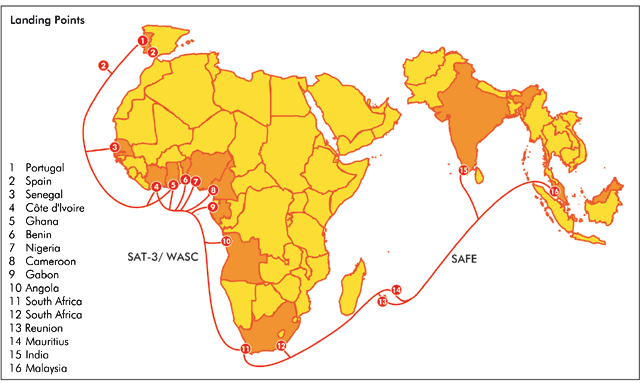
These targets are supported by the highest level of government and should also boost the Mauritian economy, which is export-oriented and requires efficiently and competitively priced telecommunication services. Moreover, as employment in traditional sectors such as sugar declines, employment in the ICT sector is expected to grow. Mauritius has also embraced these targets to support initiatives in e-education, e-health and e-government. To realize its ambitious targets, Mauritius has created a new regulatory body, the Information and Communications Technology Authority (ICTA). Its policies include plans to provide Internet access at each of the island nation’s post offices, providing access even after regular postal closing hours. Its new universal service fund will be used to fund access to basic telephony, as well as the Internet. The government provides loans for its employees to facilitate the purchase of home PCs and has launched the Computer in Every Home campaign. In June 2002, Mauritius connected to the South Africa-Far East (SAFE) fibre-optic submarine cable, providing the kind of bandwidth the country needs to meet its dream of transforming itself into a Cyber Island (see Figure 5). These are exactly the kind of policy visions and practices that will fuel Africa’s ICT development. More information about Mauritius’ ICT policies and practices may be found in the 2004 ITU case study “The Fifth Pillar: Republic of Mauritius ICT Case Study available at: http://www.itu.int/ITU-D/ict/cs/mauritius/index.html
Addressing interconnection disputesBotswana has long been recognized as a regulatory pioneer, as one of the first countries in Africa to have established a regulatory body to which it also gave the kind of independence that has led to market growth and investment. (See ITU Effective Regulation Case Study: Botswana 2001 available at http://www.itu.int/ITU-D/treg/.) In an effort to promote even greater competition and a more level playing field, the Botswana Telecommunication Authority (BTA) took a pioneering step of basing its interconnection rates on prices established in the European Union. In response to a dispute between two operators, BTA decided the time was ripe to review the revenue-sharing model in effect then. Based on this review, BTA decided to implement cost-based interconnection rates relying on long run incremental costs (LRIC). Why? Because it had come to the conclusion that revenue-sharing arrangements are based on negotiations reflecting the relative market power of the parties and that the model tended to give rise to discrimination and disputes among operators and was not conducive to vibrant competition for consumer tariffs. BTA further concluded that historical or backward looking costs did not reflect current technological trends and would not result in efficient pricing. Instead, it ruled that LRIC or long run average incremental costs (LRAIC) were surrogates reflective of costs in competitive markets. In turn, it reasoned that benchmarking could be a useful regulatory tool to the extent it was based on outcomes in countries with markets subject to substantial competition or where LRIC or LRAIC costing methodologies had been applied. BTA decided to use benchmark data only from countries that apply the calling party pays principle as does Botswana. The regulator reviewed the European Union’s approach to developing benchmarks for interconnection charges at various tiers of the network (local, single transit and double transit rates). While recognizing that European benchmark data could well result in charges below the efficient costs of Botswana’s operators, it accounted for this by creating a two-stage phase-in period for implementation. In addition, BTA did not opt for Europe’s lowest interconnection rates, but rather applied the mid-range national rates in effect in Europe. Botswana’s new interconnection regime is expected to lead to greater competition and lower prices for consumers. (More information on BTA’s interconnection ruling may be found in the ITU Botswana 2003 mini case study available on the TREG website.) Internet policy visionariesAfrica is pioneering a number of important Internet-related policies. Egypt is one of Africa’s Internet policy visionaries, subsidizing free Internet service provider (ISP) subscriptions to encourage greater Internet use. Egypt has also launched an initiative to provide low-cost PCs to home users through a loan programme in which subscribers pay off the cost of the PC through their monthly telephone bills (see article: Building the Egyptian Information Society). Uganda is partnering with ITU to test packet-based wireless IP technology to extend the services offered by the ITU/UNESCO/IDRC Multipurpose Community Telecentre to rural and remote areas. The project, funded by the ITU TELECOM Surplus Fund, is being undertaken in conjunction with the Ugandan Communications Commission (UCC). Now UCC seeks both to implement its rural communications policy and to test the use of voice over Internet Protocol (VoIP) — it is considering changes to its VoIP regulations. Senegal’s SONATEL is offering special e-rates to Senegalese schools and universities to enable low-cost Internet use among students. Regional Regulators’ AssociationsIncreasingly these policy and regulatory visionaries realize they need not work alone. Regulators across Africa are teaming up to share their experiences in regional regulatory organizations and through other international and regional organizations (see Table 1). The Common Market for Eastern and Southern Africa (COMESA), for example, has developed model ICT Policy and Legislation available on its website at http://www.comesa.int/ict/policy/view. COMESA is also supporting one of Africa’s most recent regional regulatory associations, ARICEA. The Telecommunications Regulators’ Association of Southern Africa (TRASA), one of the world’s first regional regulatory associations, has recently published a host of model regulations and guidelines, published on its website http://www.trasa.org.bw. A complete list of all the world’s regional regulatory associations is available on the ITU TREG website. ConclusionAfrica faces many challenges in achieving its ICT development goals. Many of these are linked to the larger challenges facing the world’s least developed continent: war, poverty, disease and the need for good governance. With visionaries leading the way in the ICT sector, hope for large-scale development is on the horizon. ITU is supporting many of these regulatory initiatives through its work in the BDT Regulatory Reform Unit (RRU). More information about the work of RRU may be found on the ITU TREG website. Table 1 — Regional Regulators’ Associations
|
||||||||||||||||||||||||||||||||||||||||||
 ICT policy visionaries leading African revolution
 If Africa could replicate the kind of growth rates of the world’s largest
mobile market, China, where 5 million new subscribers are added every month,
there would be 60 million new mobile subscribers in a year’s time
If Africa could replicate the kind of growth rates of the world’s largest
mobile market, China, where 5 million new subscribers are added every month,
there would be 60 million new mobile subscribers in a year’s time