


Page 225 - ITU-T Focus Group Digital Financial Services – Executive Summary
P. 225
Other cities like Barcelona offer more “on the go conveniences” for travellers like interactive bus shelters
that not only provide touristic information and bus arrival times but also have USB charging stations for
mobile devices. Other examples include the city of Amsterdam, which uses beacons to let tourist signs
translate themselves into different languages and Seoul which provides free Wi-Fi as well as smart phones to
tourists.
Despite such success stories, there are still no concerted efforts to develop a global framework for smart
tourism. While it is understandable that different cities, regions and countries may have varying
requirements, considering the differing perspectives on this concept, it is essential to develop a generic
framework as well as an internationally accepted definition for smart tourism which will help derive an in-
depth understanding of the concept and also help cater to regional requirements in this area.
2 Vision
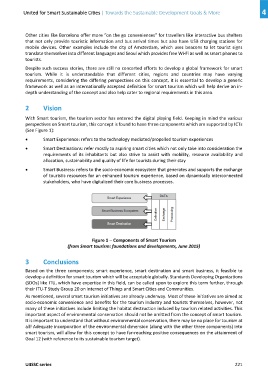
With Smart tourism, the tourism sector has entered the digital playing field. Keeping in mind the various
perspectives on Smart tourism, this concept is found to have three components which are supported by ICTs
(See Figure 1):
Smart Experience: refers to the technology mediated/propelled tourism experiences
Smart Destinations: refer mostly to aspiring smart cities which not only take into consideration the
requirements of its inhabitants but also strive to assist with mobility, resource availability and
allocation, sustainability and quality of life for tourists during their stay
Smart Business: refers to the socio-economic ecosystem that generates and supports the exchange
of touristic resources for an enhanced tourism experience, based on dynamically interconnected
stakeholders, who have digitalized their core business processes.
Figure 1 Components of Smart Tourism
(from Smart tourism: foundations and developments, June 2015)
3 Conclusions
Based on the three components; smart experience, smart destination and smart business, it feasible to
develop a definition for smart tourism which will be acceptable globally. Standards Developing Organizations
(SDOs) like ITU, which have expertise in this field, can be called upon to explore this term further, through
their ITU-T Study Group 20 on Internet of Things and Smart Cities and Communities.
As mentioned, several smart tourism initiatives are already underway. Most of these initiatives are aimed at
socio-economic convenience and benefits for the tourism industry and tourists themselves, however, not
many of these initiatives include limiting the habitat destruction induced by tourism related activities. This
important aspect of environmental conservation should not be omitted from the concept of smart tourism.
It is important to understand that without environmental conservation, there may be no place for tourism at
all! Adequate incorporation of the environmental dimension (along with the other three components) into
smart tourism, will allow for this concept to have far-reaching positive consequences on the attainment of
Goal 12 (with reference to its sustainable tourism target).
U4SSC series 221

