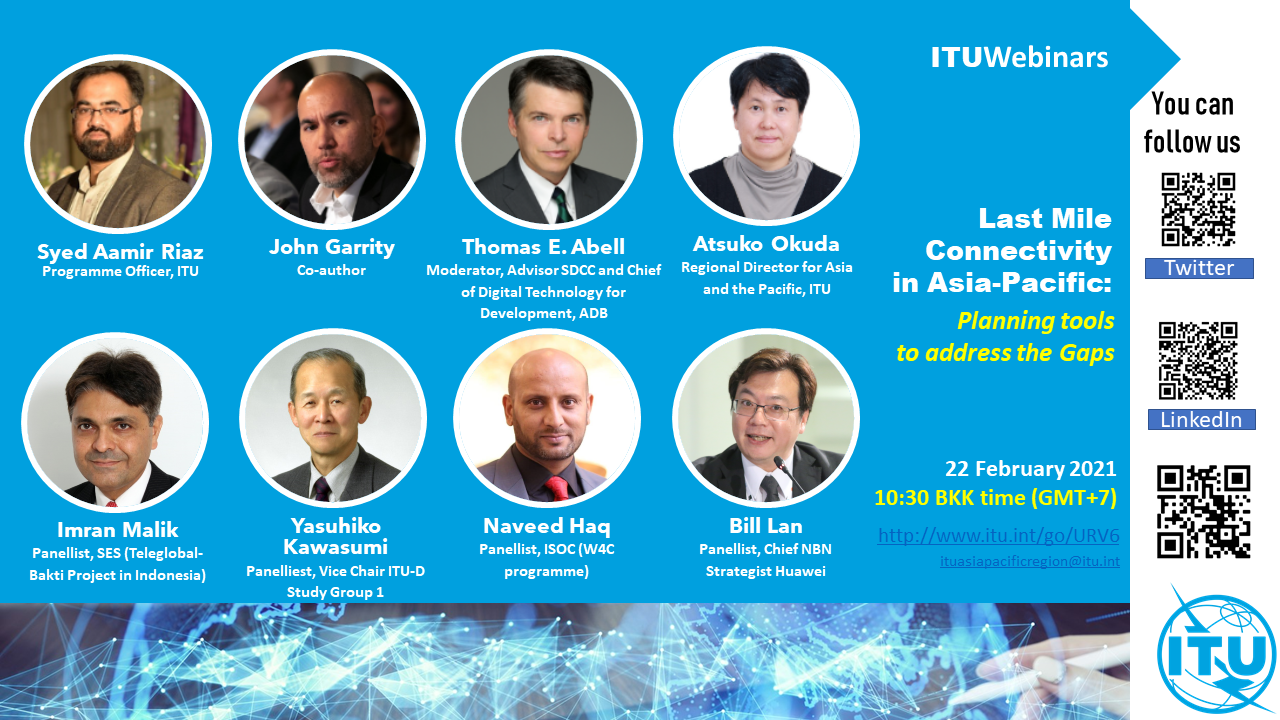
Last Mile Connectivity in Asia-Pacific: planning tools to address the Gaps
ITU
Session 221
Background
Equitable information and communications technology (ICT) connectivity around the Asia-Pacific region remains a development bottleneck and particular concern across the region. To connect the offline population excluded from the benefits of the global digital economy and accelerate digitalization trends, policy makers, development partners and investors are reviewing their strategies while considering their fiscal space and determining investment priorities.
Scope and Objectives
Webinar will feature the launch of ITU Last Mile Connectivity Solutions Guide which is designed to assist efforts to extend affordable and sustainable connectivity service to under-connected localities. The Guide also assists governments in their role of funding and implementing universal access to connectivity. This includes identifying the unconnected areas and selecting sustainable technical, financial and regulatory solutions to ensure affordability and accessibility to relevant connectivity services.
The event will provide an overview of solutions for last mile connectivity in rural and remote areas based upon successful implementations in countries around the world. Invited experts will discuss technical, business, and regulatory considerations for implementing last mile connectivity solutions to connect the unserved and underserved populations, especially in rural and remote areas.
Atsuko Okuda, Regional Director (Asia and the Pacific), ITU, will deliver introductory remarks.
Thomas Abell is the Chief of ADB’s Digital Technology for Development Unit, which promotes the effective use of digital technology across ADB programs to improve development impact. His team works with ADB member countries in supporting the transition to the digital economy and provides assistance across many areas, including eGovernment, Tech startup ecosystems, technology policy, and tech industry partnerships.
Thomas has over 30 years of professional experience in digital technology, including technology policy and strategy, software development, and systems architecture. During his 10+ years of experience in international development, he has worked extensively across Asia, Africa and Latin America, working with governments, development organizations, NGOs and corporations. He has authored many publications on technology innovation in development, focused mainly on education, financial inclusion and agriculture. Thomas has master’s degrees in engineerring and management and a bachelors in engineering from MIT.
Bill Lan is the Chief NBN Strategist of Huawei Technologies where he is responsible for industry regulatory policy, business strategic planning and business consulting. He is also a core member of the Huawei National Broadband Network team cooperating with ITU driving broadband business development and network deployment worldwide. Mr. Lan draws on his deep knowledge of telecommunications industry trends and global best practices to deliver successful business plans for operators in fields such as national broadband network, FBB, MBB and Internet applications.
Mr. Lan has more than 20 years of experience in the business consulting, telecommunications and ICT industries. He has held various positions in global renowned companies, including Deloitte Consulting, Lucent Technologies and China Development Investment Bank.
Naveed Ul Haq is the Asia-Pacific Regional Director for Infrastructure and Connectivity, leading technical, policy and advocacy work in Internet access, infrastructure and community development domains.
He is an experienced ICT practitioner, with more than 17 years’ experience working with governments, telecommunication operators, development partners, service providers, and civil society organizations.
Prior to joining Internet Society, Naveed was working with Pakistan Telecommunication Authority (PTA), Government of Pakistan, as Assistant Director, Information & Communication Technologies (ICT).
He is also an alumni member of ICANN’s fellowship, ISOC’s Next Generation leadership and Diplo Foundation’s Internet Governance capacity building program.
Naveed is based in Islamabad, Pakistan.
Imran Malik, heads the sales team of SES Networks which is responsible for sales in the Fixed Data segment around the world.
Imran has more than 20 years of experience in the field of Satellite Communications and has served in several senior level management positions during his distinguished career. Imran was the VP Sales APAC and Middle East for O3b Networks for five years. Prior to this assignment Imran was the CEO of Supernet Ltd., the leading data communications service provider in Pakistan, for six years. During his time in Pakistan he was also a Member of the Board of Directors of PAKSAT International which operates the PAKSAT-1R satellite and an Executive Director on the Board of Telecard Limited, a telecommunications service provider listed on the Karachi stock exchange. In 2005-6 Imran was appointed as the Advisor to the Government of Pakistan for Satellite Communications and was instrumental in the PAKSAT-1R program. In the early part of his career Imran has also worked at Lockheed Martin, General Electric (GE) and Hughes Network Systems respectively.
Imran has a Bachelor’s degree in Electrical Engineering from The University of Oklahoma and an M.S. in Electrical Engineering degree from Purdue University and MBA from the University of Chicago.
Yasuhiko Kawasumi is one of the Vice Chairs of ITU-D SG1 (ITU is the leading UN agency for information and communication technology issues: http://www.itu.int). He is Special Advisor to the ITU Association of Japan http://www.ituaj.jp/. He participated in projects funded by Asia-Pacific Telecommunity (APT) http://www.apt.int/ in Nepal, Marshall Islands, Micronesia and Bhutan. He started his business carrier at telecommunication operator Kokusai Denshin Denwa Co. Ltd (KDD). in 1961 after graduating from KEIO University. He experienced the construction of Transpacific Submarine Cable No.1, its maintenance and operation, satellite systems, network management. He attended ITU’s various conferences and meetings. He participated in Maitland Commission meetings as advisor to Dr. Koji Kobayashi (then NEC Chairman) in Arusha (Tanzania) and Bali (Indonesia) in 1984. He was appointed as rapporteur of the Focus Group on "New Technologies for Rural Communications" of ITU-D Study Group 2 in 1999 and submitted the final report on "New Technologies for Rural Applications" in 2001. He has been the rapporteur for the Question of ITU SG2 "Telecommunications/ICTs for Rural and Remote Areas" for the three study cycles, i.e. 2002-2006, 2006-2010 and 2010-2014. He is appointed at the WTDC-14 (Dubai) in March-April, 2014 as Vice Chair of ITU-D Study Group 1 dealing with various study questions including Telecommunications/ICTs for rural and remote areas. He was Professor for Department of Emergency and Critical Care Medicine in Nakajima Laboratory of Tokai University, Kanagawa Prefecture Japan, for 2002-2005.