Regional Radiocommunication Conference 2006
Landmark digitization framework agreed
On 16 June 2006, an agreement was signed in Geneva that will
form the basis of digital television and radio broadcasting in more than 100
countries for years to come. The Final Acts of ITU’s 2006 Regional
Radiocommunication Conference (RRC-06) is an international treaty covering the
frequency bands 174–230 MHz and 470–862 MHz. It sets out a plan for ending
almost all analogue broadcasts by 17 June 2015 in Africa, Europe, the
Commonwealth of Independent States, parts of Asia, and the Islamic Republic of
Iran. A future framework for digital broadcasting is assured.
|

Philips |
|
|
Digital technologies can transform broadcasting and offer many new
applications |
|
Digital dividend
Digital broadcasting offers more channels and increasing choice for
consumers, as well as the possibility of mobile reception of video, internet and
multimedia services. It is about six times more efficient than analogue
broadcasting, allowing more data to be carried across less bandwidth. This not
only means better quality and more applications in countries where services have
started; it also promises a “digital dividend” that can help in connecting
remote communities and in closing the digital divide.
The dividend comes from the increased efficiency with which the radio
spectrum is used, opening the way for innovative wireless technologies and
potential new services. In this way, the plans produced by RRC-06 are a powerful
and practical response in ITU’s Radiocommunication Sector (ITU–R) to the goals
of the World Summit on the Information Society (WSIS). RRC-06 was the first
treaty-making conference to be held by ITU since the conclusion of WSIS in
November 2005.
Happy outcome to a complex task
|
|
ITU |
|
|
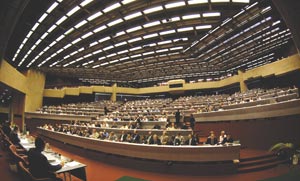
More than 1000 delegates took part in the conference |
More than 1000 delegates attended RRC-06,
which began on 15 May. Under the chairman ship of Kavouss Arastehof the Islamic Republic of
Iran, the conference held some 850 meetings and satisfied 70 493 requests (known as “requirements”) for entry in the plan for
digital broadcasting. It was also the first time that ITU had undertaken the
planning of analogue and digital services, in single and multiple frequencies,
all at the same time.
Finding solutions was an enormously complicated task, but nevertheless the
conference achieved all the objectives set out by the ITU membership. Almost
every requirement was met, while fully complying with the Radio Regulations and
a fundamental principle of ITU’s Constitution that the Union should “maintain
and extend international cooperation… for the improvement and rational use of
telecommunications of all kinds.”
The reasons for this success lay in the careful preparation begun in 2002 and
continued at the first session of the Regional Radiocommunication Conference in
2004. Also, on the sidelines of RRC-06, many discussions and negotiations took
place among small groups of neighbouring countries, leading to agreements that
were then approved by the plenary session of the conference. Overall, this
process was aided by a strong spirit of consensus and cooperation among
delegates. During the entire conference, it had never been necessary to take a
vote on any contentious point.
| |
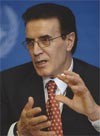 RRC-06
was chaired by Kavouss Arasteh (Islamic Republic of Iran) |
A triumph for ICT
A further factor behind the success was ITU’s own use of information and
communication technologies (ICT). To handle the thousands of items of data and
sort out bandwidth allocations and assignments, special computer software had
been designed by ITU and the European Broadcasting Union (EBU). And as well as
using ITU computers to run these programs, a crucial back-up system was provided
by a computer network operated by the European Organization for Nuclear Research
(CERN). Meticulous calculations made by these means were the foundation for a
plan that everyone could agree to.
This outcome could never have been achieved in 1961, when pencil-and-paper
calculations were the main method for working out the Stockholm Agreement, which
governed broadcasting in the European region for 45 years until one minute past
midnight on 17 June 2006. In a similar way, “we expect the new agreement to last
for decades to come,” the Director of ITU’s Radiocommunication Bureau Valery
Timofeev told journalists at the conclusion of RRC-06. In order to do so, the
plan has been carefully crafted so that it can easily accommodate changing
technologies.
Flexibility for the future
|
|
Vismedia |
|
|
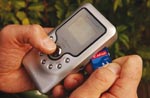
Digital radios can now also record and store programmes |
A major challenge faced by the conference was to find ways for digital
and analogue broadcasting to co-exist on the radio-frequency spectrum during
the transition period without causing interference. The Final Acts of RRC-06
include an Analogue Plan, covering this transitional period up to 2015, as well
as a Digital Plan for the new services. The latter will need to be adapted as
convergence between broadcasting and telecommunications continues, and as
technology develops in ways that we can barely imagine today.
However, the Plan contains mechanisms that allow nations to easily submit
modifications to spectrum use. According to some delegates, it is a
“forward-looking, long-life and flexible system” that will ensure a smooth
transition to digitization and continuing efficiency in how the technology is
used.
Dawn of a new epoch
The Final Acts of RRC-06 do not cover East Asia or the Americas,
which have other arrangements for allocating radio spectrum. Also, both the
United States and Japan have each established standards for this field that are
different from the European one. However, even though a nation in Latin America,
say, cannot be formally associated with the 2006 treaty, it is free to use the
“Geneva Agreement” as a model for advancing its services. In this way, the
agreement might lead to wider adoption of compatible technologies. This would
permit even larger economies of scale by manufacturers, thus lowering costs and
helping to close the digital divide.
Meanwhile, the new agreement sets the stage
for huge advances in broadcasting and telecommunications, with many new
applications on the horizon. “More than two-thirds of the world has agreed to
one digital technology, and has agreed to go forward within the same
timeframe,” ITU Secretary-General Yoshio Utsumi said at a press conference at
the end of RRC-06. “It was an epoch-making decision,” he said, and “it will
change the whole picture of ICT.”
A mammoth task and a huge achievement
The 2006 Regional Radiocommunication Conference:
- Held some 850 meetings during its five-week duration
- Handled 70 493 requests for radio spectrum usage (compared
with about 5000 in forming the 1961 agreement)
- Took just one weekend to draft the highly complex analogue
and digital plans, using sophisticated software and computer networks (compared
with 20 days for the simpler 1961 plan)
- In the VHF band, 98 per cent of requests for spectrum were
accommodated, and 93 per cent in the UHF band (a much higher level than in 1961)
- The Digital Plan is flexible enough to deal with decades of
changing technology and thousands more requests for spectrum usage
- The Final Acts consists of 1810 pages in its
“simplified” version (and is at least double this size when including the
complete database)
- The treaty was signed by some 120 countries, binding them to
switch to digital by 17 June 2015*.
* except for some VHF services in Africa, which will switch to digital by
2020.
|
|


