Trends in mobile communications
A joint ITU/Republic of Korea workshop examines social and human implications
for a more mobile world
Aworkshop on “Shaping the Future Mobile Information Society” was held in
Seoul (Republic of Korea) from 4 to 5 March 2004. The workshop was part of the
ITU “New Initiatives” programme run by the Strategy and Policy Unit (SPU),
and was preceded by a one-day Symposium on “Shaping the Future Broadband
Convergence Network”. The event benefited from the generous support and
collaboration of the Korean Ministry of Information and Communication (MIC) and
the International Cooperation Agency for Korea IT. Some 60 experts participated,
representing regulatory and policy-making agencies, mobile operators, service
providers, academia, private firms, and others. Svend Kraemer, Head of Sector
within the European Commission’s Information Society Directorate, chaired the
meeting. For documents and information see: www.itu.int/futuremobile.
|
Figure 1 — Mobile: the new global network? |
|
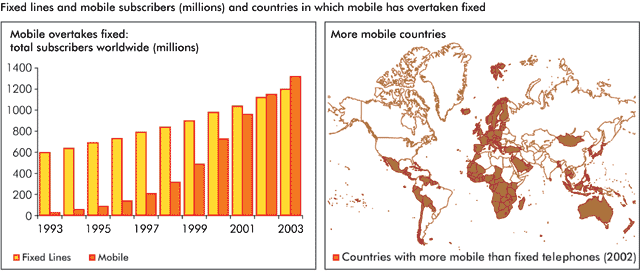
Note — Figures for 2003 are estimates.
Source: ITU. |
Where is mobile at?
At the end of 2003, there were over 1.35 billion mobile subscribers
worldwide, compared with only 1.2 billion fixed-line users (see Figure
1).
Mobile phones had overtaken the number of fixed lines globally by the end of
2002 and the number of subscribers continues to grow, albeit more slowly now
that many economies are approaching universal coverage. The rise of mobile
telephony to overtake fixed has numerous implications, but perhaps the most
significant relates to access to basic telecommunication services and
information and communication technologies (ICT). It is noteworthy that this
explosion in the use of mobile telephony has occurred largely irrespective of
geographic, socio-demographic or economic criteria.

ITU 020057/EyeWire
|
- In the Republic of Korea, mobile is continuing to grow by around 160
000 subscribers per month, but fixed-line subscriptions have started to decline.
Korea is a market leader in 3G use, based on CDMA-1x technologies. As of June
2003, just over 36 per cent of all Korean mobile subscribers were mobile
Internet users, with usage levels peaking at over 80 per cent among school
pupils. Favourite applications in Korea include karaoke songs and soap operas
delivered to mobile phones.
- In Morocco, mobile overtook fixed in August 2000. Critical factors
in its growth included the introduction of prepaid cards in late 1999 and the
market entry of a second GSM operator in April 2000. As at the end of 2003,
there are more than five times more mobile than fixed-line users (around a
quarter of the population). But fixed-line subscribers still account for
two-thirds of total revenue.
- In Norway, a head start in the 1980s (with analogue mobile service NMT) was followed up with aggressive rollout of GSM in the 1990s. By the time
mobile overtook fixed, in mid-2000, penetration of both was over 70 per 100
inhabitants. The volume of voice traffic has actually fallen since 2000, but
shifts in usage — from fixed to mobile, and from voice to data — have helped
to sustain revenue. Use of SMS (short message service) tripled between 1999 and
2002 and now stands at an average of over 600 per user per year.
- In Japan, fixed-lines overtook mobile around the end of 2000. Japan’s
major contribution to a “more mobile world” is possibly its early leadership
in mobile data services, initially through i-mode, and latterly through the
adoption of 3G mobile (IMT-2000). As at December 2003, there were some 13.8
million 3G users of whom over 90 per cent were using CDMA 1x systems and the
remainder using wideband CDMA. Japan’s leadership in this field has given it
an early insight into the use of video-telephony (real-time) and video-messaging
(store and forward) over mobile phones.
- Despite a late start, India has recently started to add new mobile
subscribers at a rate of around 2.5 million per month. Key factors in triggering
this turnaround have been the introduction of increased competition, a move from
receiving party pays (RPP) to calling party pays (CPP) and the introduction of a
unified licensing system. The combination of these factors has helped to reduce
calling rates to below 2 US cents per minute, among the lowest rates worldwide.
 |
 |
 |
 |
ITU 026259/A. de
Ferron
ITU 021003/A. de Ferron
ITU 040030/Siemens
ITU 032040/J.-M.Ferré |
Mobile market drivers and inhibitors
Probably the biggest market driver for mobile phones is “convenience”,
but there is a cluster of other factors that drive take-up, including security,
fashion, social contacts and work requirements. Among mobile data users, the
main applications include ring tones, logos and games. Over time, new services
are being developed that benefit from the higher capabilities of 3G networks,
such as downloading of songs, m-commerce or location-based services (LBS).
Wireless LANs, too, are extending the usefulness of spectrum-based services.
Market inhibitors include costs and the ability to control them, health fears
and loss of privacy. The North American market and others that have persisted in
the use of receiving party pays (RPP) continue to lag behind other economies
that use calling party pays (CPP) or, like India, that have shifted to CPP.
In the developing world, the cost of ownership has come down considerably but
continues to be a deterrent to wider mobile use in some economies. In Morocco,
operators enable contract users to set a voluntary limit on their monthly usage,
but this does not apply to prepaid users. To extend mobile usage to lower-income
users, Médi Télécom, the new market entrant, offers prepaid cards for DAM 20
(USD 2.30).
How will our lives change in the mobile information society?
Social changes are highly differentiated by age, gender and culture. In the
future, we will communicate not only with each other but increasingly with
machines. Early manifestations of this trend can be found in the development of
radio frequency identification tags (RFID) (see Box 1), ubiquitous
networking, and various trials on human to machine interaction.
Cultural adaptation
How have culture and etiquette and mobile usage affected each other? It seems
that users experience a liberating and unrestrained tendency to experiment, as
mobile phones increasingly become central part of daily life. One consequence of
this is the rise of a new casualness about space and time constraints, and about
use in public and private spaces and contexts. For example:
- A 2003 Nokia survey attributes to the use of cell phones the fact
that 71 per cent of respondents tended to arrive late at social events.
- In the Republic of Korea, self-restraint is now counter-acting
intrusively loud ring tones and voices.
- In Japan, people often cover their mouth with their hand out of
discretion when using a mobile in public. There is also some limitation on
mobile phone use in restaurants and public transport.
Wireless and the “portable Internet”
Of course, the future of wireless communications is not limited to the small
mobile devices of today. One promising concept to help accelerate the narrowing
of the digital divide is being promoted in the Republic Korea, where some 100
MHz have been set aside in the 2.3 GHz band in order to bridge the gap between
short-range wireless LAN technologies and longer-range 3G technologies. This
type of “portable Internet” solution could offer up to 1-2 Mbit/s of
bandwidth per user for an estimated USD 15 per month. Future mobile handsets
would work seamlessly with existing wireless infrastructures. This could prove
popular in developing markets where new networks are planned and where there is
a requirement to cover low-density rural populations. The “Portable Internet”
will be the subject of a new ITU Internet Report, due to be released in the
latter half of 2004.
|
RFID tags are essentially tiny microchips that act as transponders
(transmitters/responders), continuously waiting for radio signals to be sent by
transceivers, or by RFID readers. When a transponder receives a radio query, it
responds by transmitting a unique ID code.  Most RFID tags are passive, i.e. not
battery powered. The most important functionality of RFID tags is the ability to
track location. RFID tags can cost as little as 0.50 US cents. Some analysts say
that RFID will soon replace the familiar bar code used for retail. Most RFID tags are passive, i.e. not
battery powered. The most important functionality of RFID tags is the ability to
track location. RFID tags can cost as little as 0.50 US cents. Some analysts say
that RFID will soon replace the familiar bar code used for retail.
At Roppongi Hills in Tokyo, RFID is now used for retail shopping: the trial
of NTT DoCoMo’s “Rclick” service ran from 1 November 2003 to 1 February
2004, delivering information on users’ locations. DoCoMo issued about 4500
RFID tags (embedded in small handheld terminals), which can be attached to users’
mobile phones. Subscribers can inform the network that they wish to be located
by pushing a button. The small, handheld device then enables users to receive a
wide variety of area information as they walk around the complex.
Source: ITU Japan case study on “Shaping the Future Mobile Information
Society”.
|
|