| Home : ITU News magazine | |||||||||||||||||
A nationwide network in Nigeria
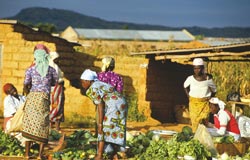
The National Rural Telephony project has been initiated by the Nigerian government to extend telecommunication infrastructure and services nationwide. The first phase of the project, due to be completed by the end of 2006, will link 280 rural communities to the public switched telephone network. In addition, mobile telephony will be deployed in rural areas, which are often under-served by private operators because they represent a less lucrative market. In Nigeria as elsewhere, the demand for telephone services is constantly increasing, given the benefits that ICT offers in almost every aspect of life. In its quest to bridge the digital divide and achieve the WSIS goal of higher connectivity, the government, together with a network of partners from business, is committed to developing an enabling environment for investment, both local and foreign. The Nigerian market for mobile phone services is one of the most important in Africa, with a steady growth of around 4 million subscribers per year since 2001. The government aims to make Nigeria Africa’s most advanced country in mobile communications by 2010.
Promoting digital inclusion in ChileWinner in the “Culture” category of a 2006 Stockholm Challenge Award, Nosotros en Internet is a project in Chile that seeks to promote expression of people’s experience, local cultural heritage and identity, through the training and use of internet applications adapted for these purposes. The lead agency in implementing the project is BiblioRedes. Its aim is to use ICT in modernizing public libraries, so as to help Chile bridge the digital divide. BiblioRedes is a private-public initiative, which wants to ensure that every Chilean citizen can access and use ICT to improve their quality of life. An essential element of the Nosotros en Internet strategy is to promote the use of web tools by local communities using a central online service. The project supports diverse cultural, social and economic organizations, which would otherwise have only limited opportunities to take an active role in shaping the information society.
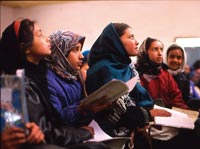
Reaching children in AfghanistanThe REACH Project is designed to help address the educational needs of Afghan children aged from 6 to 16 who, due to conflicts in their country, have received little or no education for a number of years. It is hoped that, by listening at home to the weekly radio programmes on BBC World Service’s Persian and Pashto services, children will be exposed to Afghanistan’s traditions, culture and history, as well as receive information about present-day concerns, such as health education. The 15-minute “Our World, Our Future” radio broadcasts are designed to broaden children’s horizons and encourage them to become active learners by giving them educational tasks to do during and after the programmes. All of the project’s staff, writers, and radio actors are themselves Afghan refugees. They have a practical knowledge of the real needs and aspirations of the country’s children, and a strong commitment to broadening their education. The United Kingdom’s Department for International Development, the United Nations Children’s Fund (UNICEF), and the Canadian International Development Agency are partners in the project. e-Madinah takes shape in Saudi Arabia
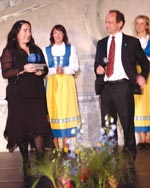
With technical cooperation from Malaysia, the Kingdom of Saudi Arabia is promoting ICT in the city of Madinah. The aim is to encourage governmental and business sectors to adopt greater use of ICT over a five-year period, under a project called eMadinah. The project includes five elements, to be pursued together: e-commerce, e-government, capacity-building, programme and change management, and knowledge management. All of these are geared towards addressing such challenges as giving every citizen the ability to access ICT, and enhancement of work and business opportunities. One of the outcomes of eMadinah is an ICT training institute, to be established in the country’s capital, Riyadh, in 2006. A joint Saudi-Malaysian ICT Fund will also be created, to spearhead private-sector investments in both countries.
|
|||||||||||||||||
 The World Ahead project is developing a low-cost, mobile personal
computer, named “Eduwise,” and encouraging the wider adoption of WiMAX
technology that allows people to make broadband connections to the internet over
longer distances. In general, the programme is expected to lead to greater
opportunities for widespread ownership and use of ICT, through better
training, access, and content. A multi-stakeholder approach will be adopted by
establishing an advisory board of non-governmental organizations to guide Intel
in the implementation of the World Ahead programme.
The World Ahead project is developing a low-cost, mobile personal
computer, named “Eduwise,” and encouraging the wider adoption of WiMAX
technology that allows people to make broadband connections to the internet over
longer distances. In general, the programme is expected to lead to greater
opportunities for widespread ownership and use of ICT, through better
training, access, and content. A multi-stakeholder approach will be adopted by
establishing an advisory board of non-governmental organizations to guide Intel
in the implementation of the World Ahead programme.