|

PhotoDisc |
Cybersecurity: An issue for all
Spam, viruses, worms, identity theft or phishing, Trojans and
denial of service all combine to make the issue of cybersecurity a serious one.
As computers and the Internet are now inseparable parts of daily life, the need
for effective security measures to protect the computer and telecommunication
systems is imperative. And, with today's mobile phones replicating the
functionality of personal computers (PC), mobile networks are increasingly
susceptible to malicious attack. A successful attack on a mobile network has the
potential to be very damaging, given that the mobile phone subscribers worldwide
far outnumber PC users. ITU estimates that in mid-2005, there were around 2
billion mobile phones worldwide, compared with about 750 million Internet users.
The Internet has opened up legitimate new trade routes and opportunities for
thousands. However, it has also become a trading place for anything from pirated
music and film to programs that allow the defrauding of companies by - other -
electronic means. As well, the Internet has made cross-border fraud infinitely
easier, which makes prosecution and investigation complicated.
Recognizing that confidence and security in the use of information and
communication technologies (ICT) are the main pillars of the information
society, the World Summit on the Information Society (WSIS) in December 2003
urged governments, in cooperation with the private sector, to consider
legislation that allows for effective investigation and prosecution of misuse
and strengthen institutional support at the international level.
ITU is increasing awareness of cybersecurity issues among stakeholders. For
example, the ITU WSIS Thematic Meeting on Cybersecurity, held in Geneva from 28
June to 1 July 2005, underscored the importance of sharing information on
national approaches, good practices and guidelines; developing warning and
incident response capabilities; harmonizing national legal approaches and
international legal coordination; technical standards; privacy, data and
consumer protection; and providing assistance to developing countries.
Dangers in the cyberworld
With such a huge focus on implementing the most advantageous IT solution or
determining which of the latest and greatest Web applications, servers and
databases best suits the mission of an organization, protecting the information
held by those assets has often been a second priority. Many enterprises may be
fooled into thinking that, because they have not been hit, there is no threat.
Not so! The cyberworld is open to very similar threats to the real world: theft,
racketeering, vandalism, exploitation, extortion, fraud and terrorism. The
recording industry, for example, is working hard to combat downloading of its
wares from file sharing networks.
Spam
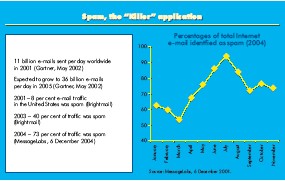 Statistics from MessageLabs, a global company that provides managed e-mail security services to more than 9000 businesses worldwide, show that of the 12.6 billion e-mails it scanned during 2004, a whopping 9.2 billion (or 73.2 per cent) were identified as spam. These statistics were brought live during the Cybersecurity Symposium II organized jointly in Moscow in March 2005 by the ITU Telecommunication Standardization Sector (ITU-T) and the Russian Association for Networks and Services (RANS). They show that the overall trend during 2004 was an increase in spam volumes, with sharp peaks in June and July (see chart entitled "Spam, the killer application"). Statistics from MessageLabs, a global company that provides managed e-mail security services to more than 9000 businesses worldwide, show that of the 12.6 billion e-mails it scanned during 2004, a whopping 9.2 billion (or 73.2 per cent) were identified as spam. These statistics were brought live during the Cybersecurity Symposium II organized jointly in Moscow in March 2005 by the ITU Telecommunication Standardization Sector (ITU-T) and the Russian Association for Networks and Services (RANS). They show that the overall trend during 2004 was an increase in spam volumes, with sharp peaks in June and July (see chart entitled "Spam, the killer application").
Some of the arrests that have been made since the introduction of anti-spam laws around the world have been important in demonstrating that spamming is a crime
that will be dealt with. The Australian Spam Act that went into effect in April 2004 is often cited as one of the most successful spam laws to date. This Act imposes fines of up to USD 1.1 million a day until a spammer stops. The most determined, however, transfer their business to countries where no legislation exists.
Viruses
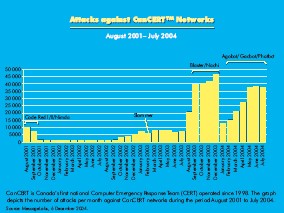 Another threat to computer systems has come from viruses. While most have contained relatively innocuous payloads, the potential exists for them to be damaging on a wide scale. The "I love you" virus that struck in the year 2000 offers an example of this. The year 2004 began with a bang when the first of the "MyDoom" worms entered the scene, followed by many variants of particular viruses. Of the 147 billion e-mails scanned by MessageLabs during 2004, about 901 million (or 1 in 16) contained a virus. The chart on CanCert Networks in Canada shows how these attacks on networks are increasing. Another threat to computer systems has come from viruses. While most have contained relatively innocuous payloads, the potential exists for them to be damaging on a wide scale. The "I love you" virus that struck in the year 2000 offers an example of this. The year 2004 began with a bang when the first of the "MyDoom" worms entered the scene, followed by many variants of particular viruses. Of the 147 billion e-mails scanned by MessageLabs during 2004, about 901 million (or 1 in 16) contained a virus. The chart on CanCert Networks in Canada shows how these attacks on networks are increasing.
Why this continual stream of reincarnated viruses and worms? One reason is that a virus code is often released into the public domain, making it easy for copycats to use as the basis of their own creations. Another is that virus writers are aware of the window of vulnerability, and know that they have a period of time during which no software-based protection exists against new malware. They take advantage of this by creating a malicious code designed to spread far and fast, thereby infecting the greatest number of machines.
For the anti-virus software vendor it is back to the drawing board, and so the
cycle continues.
Virus attacks can usually be traced to exploitation of one of a small number of
security flaws. And a simple policy of ensuring that all systems are kept up to
date with the latest security patches and users are aware of some simple
security rules will thwart the majority of these attacks. An additional
deterrent for virus writers is a tough legal policy.
But insider attacks are almost certainly more common and have the potential to
be much more damaging. ITU-T Recommendation X.800 lists a number of protection
methods that can be used against such attacks.
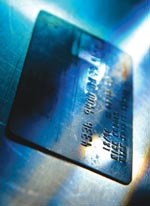
Phishing e-mails are those fraudulent notes that scam artists send you asking you to confirm your credit card data...
ITU 050027/PhotoDisc |
|
Phishing
Phishing attacks became the major threat of 2004, with a wave of them targeting
individual or small groups of companies specifically. This has put business on
the front line in the fight against online attacks.
Viruses and spam have dominated the e-mail landscape as the two main security
threats faced by businesses. And just as the convergence of the two began to
present a real potent threat, another equally sinister threat in the name of
"phishing" was in the making. In September 2003, MessageLabs intercepted 279
phishing e-mails (e-mails containing a URL to a fraudulent website). That figure
had risen to over 2 million by September 2004. So, in just twelve months,
phishing had become a threat to any organization or individual conducting
business online. During 2004, the company intercepted over 18 million phishing
e-mails. No wonder it dubbed 2004 "the year the big phish was landed."
Typically, phishing attacks require users to click on a URL within an e-mail,
which appears to have come from a legitimate bank or e-commerce site, then enter
personal account details into a fraudulent website, putting them at risk of
identity theft.
Then came the phishing e-mails designed to capture online banking details
automatically when a computer user opens the e-mail as opposed to when the user
clicks on the URL link.
In another twist, phishers attempt to recruit middlemen by luring unsuspecting
users into money-laundering operations and exposing them to possible identity
theft. They offer these potential victims positions with a legitimate
organization whose name is used in an attempt to lend credibility to the scam.
Phishing incidences are reported to have reached a peak in January 2005, dropped
but then shot up again in May 2005, exceeding anything seen before. Security
experts are attributing this to the huge rise of zombie botnets being used to
pump out massive volumes of the scam e-mails, as cybercriminals look to increase
their profits.
Apart from the rise in phishing, virus and spam volumes, tailored malicious
activity range from denial of service attacks targeted at blackmailing online
gaming sites to threats that send out child pornography in the name of a
particular reputable organization.
| |
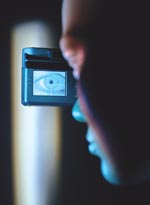 Watch
out for phishing e-mails trying to capture your personal data. If you want to do business online, do not click on an e-mail link. Go to the
company's website yourself and fill out information there Watch
out for phishing e-mails trying to capture your personal data. If you want to do business online, do not click on an e-mail link. Go to the
company's website yourself and fill out information there
ITU 050026/PhotoDisc |
A standards solution
Standardization provides a solid way of coordinating resources to fight
cybersecurity threats. ITU-T provides an international platform for the
development of the protocols that will protect current and next- generation
networks. At present, all 13 ITU-T study groups are looking at security-related
questions, and regular security workshops invite non-member participants to
contribute to a road map for future work and coordination between other
standards-development organizations.
A recent example of a standard addressing security concerns followed industry
demands for a new approach to assessing security risks in networks. ITU-T
Recommendation (X.805) will give telecommunication service providers and
enterprises the ability to provide an end-to-end architecture description from a
security perspective. The Recommendation will allow operators to pinpoint all
vulnerable points in a network and address them. Incorporating X.805 into a
risk-management policy will give the network owner the confidence to be able to
say that it has addressed security issues to the best of its ability.
There are over seventy ITU-T Recommendations focusing on security. ITU-T's work
on security covers a wide area. Work includes studies into: security from
network attacks, theft or denial of service, theft of identity, eavesdropping,
telebiometrics for authentication, security for emergency telecommunications and
telecommunication networks security requirements.
In fact, one of the most important security standards in use today is X.509, an
ITU-T developed Recommendation for electronic authentication over public
networks. X.509 is the definitive reference for designing applications related
to Public Key Infrastructure (PKI). The elements defined within X.509 are used
widely, from securing the connection between a browser and a server on the Web
to providing digital signatures that enable e-commerce transactions to be
conducted with the same confidence as in a traditional system. Without wide
acceptance of the standard, the rise of e-business would have been impossible.
Standards for next-generation networks
As we move to next-generation networks, ITU-T study groups are looking to
provide security solutions in this area, too.
Recommendation H.235 provides the protocols necessary for IP media such as voice
over Internet Protocol (VoIP) or videoconferencing calls to be authorized and
routed.
With the help of H.235, users communicating through IP media are authenticated
and authorized so that their communications are protected against various
security threats. Real-time multimedia encryption adds a further layer of
security, protecting against call interception. The security countermeasures are
designed to thwart service fraud, avoid service misuse and detect malicious
message tampering. H.235 also gives the ability to provide a greater level of
security using PKI certificates.
In addition to this standard, ITU-T's multimedia Study Group has started work on
a standard that will allow VoIP and other IP-based protocols to be more easily
implemented in a secure enterprise or service provider environment.
Sources: ITU, The MessageLabs Intelligence Annual Email Management and Security Report 2004
(see www.messagelabs.com/intelligence/).
|


;)
;)


