 Africa: The world’s fastest growing mobile market Africa: The world’s fastest growing mobile market
In its latest publication African Telecommunication Indicators 2004, released in Cairo, ITU examines the reasons behind the
continent’s rapid mobile sector expansion and explores the sector’s future
avenues for growth. “Mobile technology is the Information Society in Africa”,
explains Michael Minges, Head of ITU’s Market, Economics and Finance Unit and
lead author of the report. “It is a technology that has permeated more widely
than any other into new areas, and we must examine how we can utilize this
technology going forward, to help narrow the digital divide.”
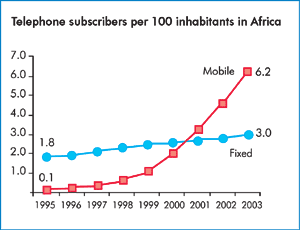
The report states that mobile penetration had reached 6.2 per 100 inhabitants at
year-end 2003, in contrast to 3 per 100 inhabitants for the fixed line (see
Figure 1, right chart). Mobile has been critical for enhancing access to
telecommunications in Africa where fixed lines are limited. Confirming this
widely held view, the report affirms that by 2003, nearly 70 per cent of all
African telephone subscribers used mobile — and that the figure was even higher in
Sub-Sahara, where three out of four telephone subscribers use a mobile. The
report indicates that
“this is the highest
ratio of mobile to total telephone subscribers of any region in the world”.
Demand, sector reform, the licensing of new operators, competition and the
emergence of major strategic investors are cited as key drivers of mobile usage
take-up.
Financially, the African mobile communications sector is also reported to be
performing well. In 2003, the sector broke the USD 10 billion barrier in
revenues with profits estimated at over USD 1 billion. The report states that
this wealth has spread to other stakeholders such as governments, who have
collected over USD 4 billion in licence fees, and to equipment manufacturers,
who have earned over USD 5 billion in contracts in Africa since 2000.
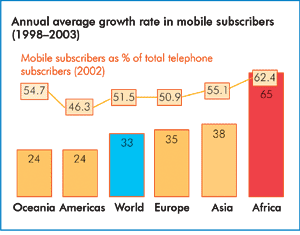
Figure 1 — Mobile in
Africa
Annual average percentage growth in mobile
network subscribers in the period 1998–2003 throughout the world regions
(left chart); and mobile and fixed telephone subscribers per 100 inhabitants
in Africa in the period 1995–2003 (right chart) |
|
 |
|
| Source: ITU World Telecommunication
Indicators Database. |
Huge demand
In Nigeria, the continent’s most populated nation with an estimated 130 million
inhabitants, mobile subscribers increased from a mere 25 000 in 1999 to 3.1
million in 2003, according to the report, which also states that that country’s
mobile network has been the fastest growing in Africa in the last three years.
The report highlights an example in late 2002 where demand for mobile was so
strong that all operators were forced to suspend the sale of new pre-paid
packages for about six months because their networks were overloaded. In August
2003, Globacom, the fourth licensed operator joined the Big Three — MTN, M-Tel
(the mobile arm of the incumbent NITEL) and Econet1 and distinguished itself
with the introduction of per-second-billing and data services. Globacom also
proposed a new pre-paid tariff scheme reducing connection charges allowing more
Nigerians to go mobile. Soon after Globacom entered the market, Econet and MTN
lowered their tariffs by about 20 per cent and also started offering per second
billing. By April 2004, Globacom had reached some 700 000 subscribers and taken
roughly one fifth of Nigeria’s increasingly aggressive mobile market.
The most pre-paid market in the world
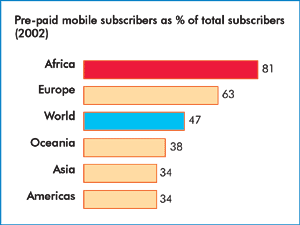
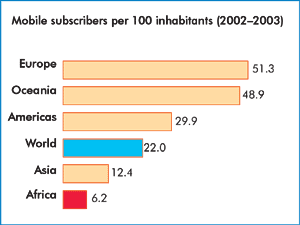
As shown in Figure 2, Africa is the most pre-paid market in the world.
Nevertherless, its overall mobile penetration is the lowest of any region at 6
per cent in 2003 compared to the global figure of 22. The percentage of the
African population within range of a mobile signal is estimated at only 60 per
cent — the lowest in the world. At the end of 2003, less than half the population
in Sub-Saharan Africa was covered by a mobile signal, according to the ITU
survey.
Figure 2 —
Characteristics of the African mobile market
Percentage of pre-paid mobile subscribers
throughout the world regions in 2002 (left chart); and mobile
subscribers per 100 inhabitants throughout the world regions in the
period 2002–2003 (right chart)
|
|
 |
|
Note — Right chart: Data for Africa and world refer to
2003 while for all other regions, data refer to 2002.
Source: ITU World Telecommunication Indicators Database. |
Strategic investors
in the mobile business
The report cites the top six strategic investors in the African mobile services
industry, who accounted for over 33 million subscribers in 2003 or two-thirds of
the total (Table 1). Five of the leading strategic investors in the region that
publish financial information reported USD 695 million of net income in 2003.
Table 1 — Africa’s mobile strategic investors
Top mobile groups in Africa by number of
proportionate subscribers (December 2003) |
Strategic investor |
Number of countries |
Subscribers in 2003 (000s) |
Revenue in 2003 in USD (million) |
Profit in 2003 in USD
(million) |
Profit as percentage
of revenue |
Countries |
Total
|
Proportionate*
|
| Vodacom** |
5 |
10
184 |
9666 |
2482 |
278 |
11.2% |
South Africa, Democratic Republic
of Congo, Lesotho, Mozambique, Tanzania |
| MTN** |
6 |
8928 |
8050 |
2434 |
258 |
10.6% |
South Africa, Cameroon, Nigeria, Rwanda, Swaziland, Uganda |
| Orange |
8 |
5560 |
3672 |
NA |
NA |
NA |
Botswana, Cameroon, Cote d’Ivoire, Egypt, Madagascar, Mali, Mauritius, Senegal |
| Orascom |
7 |
5645 |
2291 |
1119 |
123 |
11.0% |
Egypt, Algeria, Chad, Congo, Democratic Republic of Congo, Tunisia, Zimbabwe |
| Celtel |
10 |
2500 |
1700 |
446 |
74 |
16.6% |
Burkina Faso, Chad, Democratic Republic of Congo, Gabon, Malawi,
Niger, Sierra Leone, Tanzania, Uganda, Zambia |
| Millicom |
5 |
661 |
459 |
85 |
36 |
NA |
Ghana, Mauritius, Senegal,
Sierra Leone, Tanzania |
| Total |
32 |
33
478 |
24
138 |
6120 |
695 |
11.4% |
|
Notes:
NA Not Available.
* The number of subscribers based on the investor’s ownership share.
** Subscriber data refer to year-end 2003 and financial data to year ending 31
March.
Source: ITU adapted from company reports. |
 |
Table 2 shows the top ten mobile operators in Africa, ranked by number of
subscribers in 2003. MTN and Vodacom are reported to have leveraged their South
African success and
experience to expand into the rest of Africa. Celtel tends to invest in
Sub-Saharan Africa whereas Orascom is concentrated on the North African region.
Although Millicom is active in other parts of the world, its attention is on
developing markets. Econet, which started as the first private mobile operator
in Zimbabwe now has investments in Botswana, Lesotho and Nigeria and a recent
licence award in Kenya. Only Orange has a strategy focused more on developed
countries with most of its African investments arising out of former France
Telecom holdings in incumbent operators.
Table 2 — Top ten mobile operators in Africa
Ranked by number of subscribers in 2003 |
| Operator |
Mobile subscribers |
Mobile revenue |
(000s)
2003 |
D %
2002–2003 |
USD (million)
2002 |
ARPU in USD
2002 |
D %
2001–2002 |
| 1 Vodacom (South Africa) |
8910 |
19% |
1877 |
22 |
0.0% |
| 2 MTN (South Africa) |
6050 |
34% |
1167 |
23 |
0.8% |
| 3 Maroc Telecom |
5214 |
13% |
533 |
11 |
10.5% |
| 4 MobiNil (Egypt) |
2991 |
31% |
572 |
22 |
2.0% |
| 5 Vodafone Egypt |
2740 |
29% |
487 |
22 |
2.9% |
| 6 Méditel (Morocco) |
2060 |
29% |
210 |
13 |
45.0% |
| 7 Cell C (South Africa) |
1900 |
114% |
175 |
23 |
232.6% |
| 8 MTN Nigeria |
1650 |
82% |
509 |
69 |
232.6% |
| 9 Safaricom (Kenya) |
1376 |
112% |
125 |
23 |
25.0% |
| 10 Tunisie Telecom |
1346 |
134% |
212 |
62 |
75.6% |
| Top 10 |
34 237 |
34% |
5867 |
19 |
14.0% |
|
Source: ITU adapted from company reports. |
East Asian companies are also active with Telkom Malaysia leading the way
through participation as an investor in the privatization of several
telecommunication operators (South Africa, Ghana, Guinea). More recently,
Chinese equipment manufacturers have been entering the region and getting
involved in services, as exemplified by the purchase of Niger’s incumbent
operator by China’s ZTE, an exhibitor at Africa 2004.
Mobile data (2G)
The most widespread platform for access to non-voice services on a wireless
platform is from today’s second-generation mobile phones. There are signs of
emerging mobile data usage in Africa. Though most African operators do not
publish data on short message service (SMS) usage, among those that do, it is
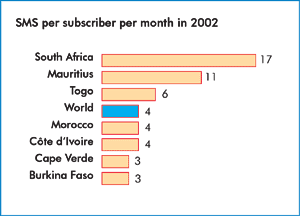
growing rapidly. For example, in more mature markets such as Mauritius and South
Africa, usage is far above the world average (Figure 3). While the majority of
SMS traffic tends to be the mundane person-to-person type, the report highlights
other interesting applications:
- In Uganda, FoodNet, a non-governmental organization working to get better
prices for farmers, collects wholesale and retail price information for some 25
agricultural products that are updated daily into a database. Farmers can then
send an SMS to obtain prices. Users of the service generate several thousand SMS
per month.
- In Kenya, where mobile operator Safaricom reported some 750 000 SMS per day
over its network in December 2002, election results were delivered via SMS.
Supporters also used SMS during the election to remind friends to vote.
- In South Africa, SMS is sent to tuberculosis patients, reminding them to take
their medication.
|
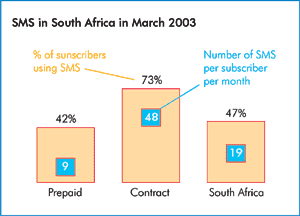
Figure 3 — SMS in Africa
Short message service (SMS) per subscriber per month in 2002 in selected African
countries (left chart); and SMS users by type of subscription in March 2003 in
South Africa (right chart) |
|
|
|
Note — World average for SMS per subscriber per month derived from February 2004
figure reported by the GSM Association. Figures in right chart refer to Vodacom
for percentage of subscribers using SMS and MTN for number of SMS per subscriber
per month.
Source: ITU World Telecommunication Indicators Database, MTN, Vodacom. |
Sustaining and expanding market growth
Price will be key
A major concern among some of the largest mobile operators is the decline of
average revenue per user (ARPU). In a region encompassing some of the world’s
lowest per-capita incomes, the cost of services is a pivotal issue for their
successful future uptake. Unless prices decline further, then would-be
subscribers will be unable to afford mobile. Yet operators still need to be able
to extract revenue in order to make operations viable.
Mobile faces the challenge of how to sustain its growth in the face of
constraints on affordability. Short-term growth will hinge on potential users
being able to afford the services which operators are offering. Crucially,
demand for the services is there. The challenge is to successfully meet this
demand.
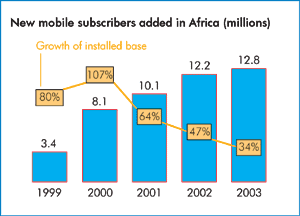
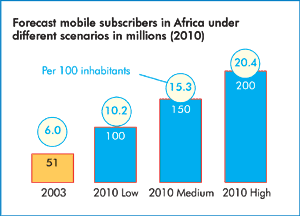
At current trends, ITU forecasts that the African mobile market will only have
around twice the number of subscribers in 2010 (100 million) as it had in 2003
(Figure 4, left chart). The report suggests a number of pro-growth policies to
exapand the mobile market.
|
Figure 4 — How much will the African mobile market grow?
Number of new mobile subscribers added in Africa in the period 1999–2003 (left
chart); and different forecasts of total number of mobile subscibers in 2010
(right chart) |
|
|
|
Note — Right chart: Low scenario assumes annual average growth of 10 per cent,
medium assumes 16 per cent and high 21 per cent.
Source: ITU. |
Mobile policy issues need to proactively seek to make competition work and to
intervene in any cases of dispute. A glimpse across the region’s mobile markets
reveals the benefits of competition; those with competition have significantly
higher rates of mobile penetration than monopoly markets, even where per-capita
incomes are the same.
The issue of interconnection has been a bone of contention in almost every
African country, with incumbents often dragging their feet over the signing of
interconnection agreements, making the launch of competing mobile services
difficult. To resolve these disputes, regulators are increasingly opting for
clearer, more analytical frameworks to calculate rates.
Manufacturers need to find ways of reducing equipment costs for lower income
regions such as Africa. They should become more involved in poverty reduction
initiatives by donating equipment for worthwhile causes such as SMS rural health
centres and schools and needy farmers.
Operators need to find innovative ways to reduce consumer prices and increase
coverage and quality of service. For example, operators can leverage incoming
roaming by increasing agreements in order to generate higher revenues and thus
keep national call costs down.
Donors could contribute to national universal access programmes, for example, by
providing financial resources to subsidize handsets, SIM cards and pre-paid
cards for low-income users. They might also support programmes to put in place
national and regional backbone infrastructures that are either non-existent or
grossly inadequate in most African countries and a reason for limited network
coverage, as many rural areas remain inaccessible by terrestrial networks or
uneconomic for access by satellite.
|


