|
Broadband access technologies

Stockxpert
|
In the region’s high-income economies, the increasing deployment of fibre-optic networks is improving access to fixed broadband. This is being driven by strong competition, particularly in markets such as Japan, the Republic of Korea, and Hong Kong (China), which lead the world in terms of the proportion of households with fibre-optic connections — a technology that is essential for supporting the next generation of ultra-high speed applications.
In most low and lower-middle-income economies in the Asia-Pacific region, fibre-optic deployment has mainly been limited to international or national backbone connectivity. Some economies are starting to roll out fibre-optic networks to premises in urban business districts, and China began offering fibre-to-the-home (FTTH) at the end of 2007. Sri Lanka Telecom has launched a fibre-to-the-building project in Colombo, laying some 75 kms of cable. In India, telecommunications operator Reliance is using fibre-optic networks and Ethernet LANs to connect more than three-quarters of a million buildings in over 40 cities.
In some countries, operators have been launched that offer only fibre-optic connections. For example, in Indonesia, Biznet operates fibre-to-the-building and fibre-to-the-home to provide broadband access in major cities. Indonesian efforts to deploy next-generation networks (NGN) include the construction of high-speed backbone infrastructure through the Palapa Ring Project, connecting 440 districts and cities across Indonesia.
Satellite, Wi-Fi and WiMAX technologies can provide broadband Internet access to remote communities, offering new opportunities for business and online education. For example, satellites are being used in Australia to provide broadband access to rural areas. Over 40 satellite broadband providers served some 58 000 broadband subscribers in Australia at the end of 2007.

Stockxpert
|
3G broadband
Third-generation (3G) mobile networks, such as wideband code division multiple access (W-CDMA) and evolution-data optimized (EVDO), have introduced broadband speeds to mobile phone services. (W-CDMA offers download speeds of up to 384 kbit/s, while CDMA 1X EVDO offers speeds up to 2.4 Mbit/s.) The Asia-Pacific region was the 3G mobile broadband pioneer, with Japan’s NTT DoCoMo launching the world’s first commercial W-CDMA network in October 2001. By the end of 2007, there were over 120 million mobile broadband subscribers in the region (see
Figure 1), with almost all (97 per cent) in upper-middle and high-income economies.
Figure 1— Mobile broadband subscribers, Asia-Pacific
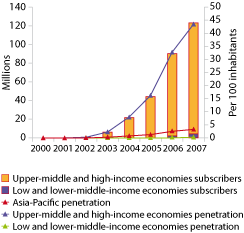
Source: ITU World Telecommunication/ICT
Indicators database.
Note — Mobile broadband refers to CDMA 1X EVDO, W-CDMA and HSDPA. |
While most of the region’s high-income economies have launched mobile broadband networks, few of the low and lower-middle-income economies have done so. At the end of 2007, only Indonesia, the Maldives, the Philippines and Sri Lanka had commercial W-CDMA networks.
The region’s two largest mobile markets, China and India, have yet to launch mobile broadband. However, India has announced it will hold an auction for at least five 3G broadband mobile licences before the end of 2008. And in China, the government is planning to issue three 3G broadband licences following a restructuring of the sector. Meanwhile, a 3G service was operated by China Mobile during the 2008 summer Olympic Games in Beijing. It is based on the Chinese 3G standard known as TD-SCDMA (time division synchronous code division multiple access).
In Sri Lanka, high-speed Internet centres that use 3G technology are being set up in some remote areas. Connected through a W-CDMA variant, high-speed downlink packet access (HSDPA) network, the Internet centres (called Easy Seva) provide fast and affordable access as well as new business opportunities to local entrepreneurs.
For users of mobile devices, 3G broadband speeds are particularly useful for data-intensive activities such as Internet browsing and video downloads. And in some economies, mobile broadband networks are beginning to have an impact on the overall market. Malaysia reported that there were 80 000 HSDPA subscriptions nationwide at the end of 2007, or six per cent of total fixed broadband subscriptions. In Australia, mobile wireless subscriptions to the Internet via data cards accounted for some nine per cent of broadband subscriptions in 2007. This suggests that 3G mobile broadband operators could emerge as viable competitors to fixed broadband operators.
WiMAX for rural areas
As well as the densely populated cities where broadband services are expanding fast, the Asia-Pacific region includes remote and rural areas that it may not be economic to serve through conventional fixed or 3G technologies. One solution is WiMAX (Worldwide Interoperability for Microwave Access) to connect people to the Internet wirelessly.

Intel
|
WiMAX connects a village in Viet Nam
A high-speed Internet connection has been provided to a remote village in Viet Nam by a public-private partnership involving Intel, the Vietnam Data Communication Company (part of the Vietnam Post and Telecommunication Group) and the United States Agency for International Development (USAID). Tourism is an important source of income for the villagers in Ta Van, but it had only two fixed-line phones and sparse mobile coverage. The project used a WiMAX base station to distribute a satellite signal that provides broadband links to computers and VoIP phones around the village. The school is connected, as well as the clinic, where staff use the Internet to find medical information. Guest houses too are online. Tourists now spend more time in Ta Van — and more money.
|
WiMAX is proving popular in Pacific island countries, for example, with operators in Fiji, Tonga and Vanuatu installing networks. In India, Tata Communications says that it has launched the largest WiMAX network in the world for business and retail clients. By March 2008, the firm had more than 5000 enterprise and retail customers in ten cities. It aims to sign up 200 000 enterprises in more than 100 cities by March 2009. In Pakistan, Wateen Telecom had attracted over 10 000 subscribers just four months after launching WiMAX in December 2007. And WiMAX has been launched by several Internet service providers in Cambodia, where there are nearly 2000 wireless broadband subscribers.
These developments suggest that WiMAX could be a viable option for broadband Internet access, particularly as the technology matures. Another deciding factor will be whether governments move fast to award the needed radio-frequency spectrum and whether new operators (as well as incumbents) can create more competition in the broadband market.
The role of government

Stockxpert
|
Governments have played an active role in the promotion of broadband at the national level in countries throughout the Asia-Pacific region. In high-income economies especially, its diffusion has been encouraged through national broadband plans. Policies include the opening of markets to new competitors in the leased-line market and for local service provision, as well as the liberalization of international gateways or of services such as voice over Internet protocol (VoIP). The region’s low and lower-middle-income economies are also increasingly taking a proactive approach, recognizing the importance of broadband for their economic development.
A number of countries have established specific broadband targets. In the Republic of Korea, for example, central and local governments are joining Korea Telecom to fund provision of broadband via satellite to the 240 000 households that are currently out of reach. The programme is due to be completed before the end of 2008. In its Intelligent Nation 2015 (iN2015) plan, Singapore aims to connect 90 per cent of households to broadband through fibre-optic networks by 2015. The governments of India and Pakistan both published broadband policies in 2004. However, most other countries have not announced concrete plans to promote broadband, and many low-income economies remain focused on basic connectivity.
Another role for government concerns the degree of competition in the broadband market — which affects prices and the variety of services. In most cases, legal authorization to provide Internet access does not include the right for an Internet service provider to install its own infrastructure. Instead, it must obtain a facilities-based licence (which adds to costs) or lease the needed infrastructure from other operators. Many of the building blocks for developing a broadband business are not fully liberalized. Among Asia-Pacific economies, only half report that international gateways are completely open to competition; fewer than half for the leased-line market, and fewer than a third for local services.
International bottlenecks
A major constraint on broadband connectivity in some Asia-Pacific economies is the lack of international Internet bandwidth. Extra capacity is needed to satisfy customers’ faster connection speeds, especially when they access a large amount of content overseas. International bandwidth capacity in the region has grown significantly, from 65 gigabits in 2001 to 1000 gigabits at the end of 2007. But a very wide gap remains between economies with the most international bandwidth and those with the least. High-income economies have an average of almost 2000 bits per inhabitant — some seventeen times more than lower-middle-income economies and almost 70 times more than low-income economies (see
Figure 2).
Figure 2 — International Internet bandwidth, bits per inhabitant, selected Asia-Pacific economies (2007)
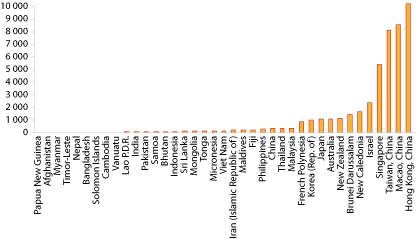
Source: ITU World Telecommunication/ICT
Indicators database. |
Bandwidth bottlenecks are a particular problem in land-locked countries without direct access to international fibre-optic cables. They also affect economies in the Pacific Ocean, where only Australia, Fiji, Guam, and New Zealand have undersea fibre-optic connections, and even then, demand can outstrip supply. In New Zealand, for instance, Internet service providers report that the cost of international bandwidth through the country’s single cable connection adds NZD 9 to the monthly price of broadband, or 18 to 30 per cent of a typical bill. Other economies in the Pacific have to rely solely on satellites for international Internet connectivity.
Efforts are being made to overcome such difficulties. The linking of Pacific island States by submarine fibre-optic cable is under consideration, and more cables are being laid right across the ocean. In June 2008, for example, Tyco Telecommunications Inc, of the United States, and Japan’s NEC Corporation began building the high-bandwidth “Unity” fibre-optic cable that will link the two countries. It is an interesting sign of the times that, as well as five telecommunication companies — from Japan, the United States, India, Malaysia, Singapore, and Hong Kong (China) — the consortium that owns the cable includes the Internet company Google. The expected growth in data and Internet traffic is the main reason for the new cable, which is due to come into use in early 2010.
Nokia
|
|
The report was prepared by ITU’s Market Information and Statistics Division. For more information, please visit:
www.itu.int/ITU-D/ict/
|
Two scenarios in Asia
The figures suggest that there are two distinct scenarios in the development of new telecommunication technologies in the Asia-Pacific region. In high-income economies, ubiquitous Internet access is progressing, through a competitive race to provide ever faster fixed broadband speeds and the deployment of mobile broadband networks at ever lower prices. In the region’s low and lower-middle-income economies, many Internet-based activities are being carried out over mobile phones with visits to community facilities or Internet cafés when higher speeds are required. Rather than making heavy investments in fixed broadband infrastructure, many of these economies are still concentrating on ensuring universal access to basic voice services or simple Internet connectivity.
Nevertheless, as incomes rise, people throughout the region will increasingly demand home-based broadband access. And broadband connectivity is crucial for many applications that have an important impact on development. Along with mobile services, it is the future growth area for telecommunications in the Asia-Pacific region, as elsewhere.
|