
© vario images GmbH & Co.KG/Alamy
|
Next-generation networks will help mitigate climate change
Next-generation networks (NGN) form a new architecture, based on the Internet protocol (IP), that will unify today’s fixed and mobile networks, as well as broadcasting. A recently published ITU report* looks at how NGN can minimize the power consumption of networks. It also examines the energy savings that can be obtained indirectly from greater NGN usage, such as through videoconferencing.
NGN are being developed with a number of different technologies, including wireless and mobile, optical fibre and cable, or by upgrading existing copper lines. Companies already rolling out NGN include BT in the United Kingdom, NTT in Japan, and AT&T in the United States. ITU predicts that, by 2012, developed countries will have full implementation of NGN in fixed-line networks, and in mobile networks by 2020. Developing countries are also seeking to deploy NGN technology.
Saving energy
|
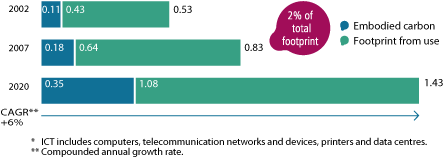
Figure 1 — The global ICT* footprint (in billion tonnes of CO2 equivalent)
|
|
 |
|
Source: SMART 2020: Enabling the low-carbon economy in the information age.
A report published by the Global e-Sustainability Initiative (GeSI) in June 2008. |
A recent study estimates that the information and communication technology (ICT) sector itself contributes around 2 per cent of global greenhouse gas emissions annually (see Figure 1). NGN offer great potential for reducing this carbon footprint by allowing efficient sharing and management of infrastructure. Here are some of the ways in which the architecture and technical characteristics of NGN can reduce demand for energy.
IP systems
The migration to NGN is expected to reduce power consumption by 30 to 40 per cent compared with the current public switched telephone network (PSTN). Introducing IP-based routing and switching systems has improved the efficiency of the core network substantially. This is especially true for voice services, where digital compression techniques have cut capacity requirements by up to 70 per cent. Energy savings can also be made because IP delivers multiple services — voice, e-mail and data downloads — to one device, as in third and fourth generation (3G and 4G) mobile telephony. This reduces the need to manufacture equipment, while new algorithms can prolong battery life. Nevertheless, improving the energy efficiency of devices remains a major challenge.
Multiple power modes
Broadband need not be an “always on” service with a constant, full power supply; it simply needs to be “always available”. Multiple power modes for broadband carried over NGN (including, for example, a “sleep” mode) mean that less energy is consumed while allowing connections to remain accessible when required. Multiple power modes have been incorporated into Recommendation ITU–T G.993.2, a standard also known as VDSL-2 which covers very high-speed digital subscriber line (DSL) broadband access.
According to the European Commission, total European electricity consumption for broadband could reach 50 terawatt-hours (TWh) a year by 2015, corresponding to 20 million tonnes of CO2 equivalent emissions. This could be halved by implementing its Code of Conduct on Energy Consumption of Broadband Equipment that includes the introduction of multiple power modes.
Less power for transmission
Efforts are under way to cut the power used by the DSL infrastructure that delivers broadband over wired networks. And the switch to fibre-optic networks offers major energy savings by NGN. For example, carriers can share fibre in the local loop and eliminate dependence on active network elements. This is also more economical with materials. A single optical fibre can carry as much data as several thousand copper wires, and over a longer distance without using repeaters, thereby avoiding the need to transmit power to customers’ premises and reducing energy costs.
Unified management
Network convergence in NGN leads to the centralization of management and control of voice, video and data services that previously might have been handled by separate companies. This greatly reduces the number of operations required, and thus also energy costs.
Fewer switching centres
Traditional networks require separate switching centres for fixed-line and mobile telephony, multimedia services and so on. NGN architecture saves energy by greatly reducing the number of centres required because of the use of higher capacity routers and higher speed transmission. For example, BT says that moving to NGN will require only 100–120 metropolitan nodes, compared with its current 3000 locations. Shared infrastructure has lower requirements for heating and lighting. And air conditioning might not be needed in many countries, as NGN equipment can tolerate a wider range of temperature, so switching centres can be cooled by fresh air.
NGN applications
|
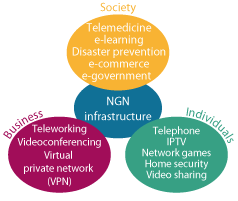
Figure 2 — Examples of NGN applications
|
|
 |
|
Source: Nippon Telegraph and Telephone (NTT). |
The applications and services (see
Figure 2) that NGN
are capable of carrying are also likely to reduce energy
consumption, and thus help to tackle climate change.
Videoconferencing, for instance, can reduce CO2 emissions by up to 98 per cent compared with a face-to-face business meeting that includes commuting, according to research reported in 2008 by Telefonica I+D, the research and development arm of Spain’s Telefonica Group. For people in developing countries with limited travel budgets, and those in isolated rural areas, remote collaboration through NGN — for business and education — can accelerate economic development.

BRCWCS
Data centres
NGN have an impact on the growing
number of Internet users worldwide and their increasing use
of broadband. This in turn is leading to explosive growth in
the number of data centres, whose computer servers not only
need power to run, but also to be kept cool. According to a
study by McKinsey & Co, the
worldwide energy consumption of data centres doubled between
2000 and 2006. The Google data centre in Oregon, United
States, reportedly consumes as much electricity each day as
the city of Geneva in Switzerland, although the source is
renewable hydro-electric power. However, an advantage of NGN
is that, because data transmission costs are close to zero
in IP networks, data centres can be sited in cooler places
and where renewable power is available, even if these are
far from most Internet users.
|
The monitoring and control of machinery and services is another area in which NGN can save energy. Broadband communications permit electricity distribution, for example, to be decentralized, with surpluses generated at the local level — even by individual households using sustainable energy sources — being redirected to satisfy demand elsewhere. This lessens the load imposed on a national electricity grid at times of peak demand, and correspondingly reduces the need to build new power stations that emit greenhouse gases.
In the home, broadband can be used to control appliances more efficiently. Researchers in Australia, for example, tried replacing ordinary thermostats in solar-powered water heaters with controls linked by broadband to data from weather stations and the electricity company. They found that the energy consumption of the heater was reduced by 25 per cent, and greenhouse gas emissions by 20 per cent.
The ITU report notes that “automotive transport represents one of the main sources of greenhouse gas emissions”, but this is an area where NGN can help too. Intelligent transport systems, for example, improve traffic management and save fuel (see article on “The Fully Networked Car” in ITU News of April 2008).
ITU’s work
NGN deployment represents a dramatic shift in the ICT landscape. ITU’s Next-Generation Networks Global Standards Initiative is developing the standards needed for a smooth and quick evolution, and the means to offer the wide range of services expected with NGN. Special attention has been paid to incorporating the need to combat climate change. An “Energy-saving checklist for standardization activities” has been produced, and each new ITU–T Recommendation should contain a clause on how the standard helps to cut emissions in the production and use of equipment. In addition, a new Focus Group on climate change began work in September 2008 and is developing methodologies to evaluate the impact of ICT on climate change.
* This article is based
on an ITU–T Technology Watch Report “Next-generation networks and energy
efficiency” published in August 2008. For more information visit
www.itu.int/ITU-T/techwatch/reports.html
|


