Towards a more secure future with mobile data
communications
|
ITU 940082/A. de Ferron
|
A case for Little LEO
systems
Arnold Ph. Djiwatampu
President, PT. TT-Tel Consulting
Indonesia
The terrible events on the peaceful island of Bali in the Indonesian
archipelago last year brought close to home a heightened awareness of the
insecure world in which we live. Big cities of the world are not immune to
danger. Remote islands are also exposed. There are no safe havens anywhere.
Thus, we all have a role, wherever we may live and work, to help shape a more
secure future and a more just society because the two goals are very much
intertwined.
Those of us who are privileged to work in telecommunications can look to our
industry for solutions appropriate to the times. Global security is an obvious
and urgent need now and on a sustained basis in the future. How then can
telecommunications serve this noble mission to help create and sustain a
condition of greater security around the world for all peoples while
contributing to social justice?
Of course, we know that there is not a single system in telecommunications
— satellite or terrestrial — that can do everything necessary to support
global security and a more just society. Each system has an inherent technical
capability or “specialty” enabling what it can do best. In the aggregate,
however, telecommunication systems represent a powerful tool for peace and
justice.
Our challenge then is to unleash the potential of these systems so that they
can go forward in the global marketplace and fulfil their part of the overall
mission. There has never been as important a forum as this World
Radiocommunication Conference (WRC-03) to make these things possible for peace.
WRC-03 Agenda item 1.16
This agenda item will require WRC-03 delegates to consider, for example,
allocations in feeder links around 1.4 GHz for mobile-satellite systems that
have service links below 1 GHz. These systems are known popularly as Little LEO
systems. Operating at low illumination or power levels to avoid interference
with existing or nearby band users and optimized for band sharing, these systems
provide digital store-and-forward data communications for asset tracking, remote
monitoring and control and messaging.
The Little LEO industry has not received any additional global allocations
from the international regulators since the World Radio Administrative
Conference of 1992 (WARC-92) — even though the demand for additional spectrum
has been well documented. Many bands below 1 GHz have been proposed at earlier
WRCs, but the proponents have not been successful because of competing
pressures.
Since 1996, and because of the failure of previous WRCs to allocate spectrum,
the Little LEO industry with service links below 1 GHz has been encouraged to
study bands above 1 GHz for feeder link operations. Sharing studies and
demonstrations have been going on since then and reported in the various forums
within the ITU process. In the international context, the 1390 –1393 MHz and
1429–1432 MHz bands have been identified as the frequencies suitable and
available for global allocations for feeder link operations for Little LEO
systems.
|
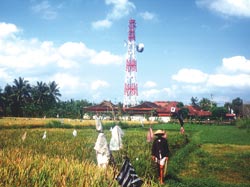
ITU 010549/Jean-Marie Micaud
Antenna in a paddy-field at Gianyar in the
island of Bali |
Addressing global security
How do Little LEO applications, such as asset tracking and messaging, serve
to promote greater security and justice for our world?
Let me take one example of a tremendous threat facing the busy harbours and
ports around the world from Singapore and Shanghai to Hong Kong and Rotterdam.
There are some 15 million shipping containers in circulation on a global
basis. These containers facilitate a growing import/export trading chain
strategically important to the world’s economies. At the same time, the
contents of these containers present a major security concern.
The commercial environment for containers is both global and inter-modal,
which means that the containers use various transportation modes (such as ships,
trains, trucks) to reach their final destination. The challenge then is to
document the contents of the containers, then to track their location anywhere
in the world on any transportation mode or loading facility, and to identify any
deviation of routing or tampering with contents.
Little LEO systems are optimized for asset-tracking globally and
inter-modally, and could provide certain solutions to help create a secure
global transport system. What is equally important is that Little LEO systems
can facilitate certain data communication solutions on a cost-effective,
unobtrusive and routine basis. This is exactly what is needed in this area of
global security because the effort will need to be sustained for years to come,
not just now or in the foreseeable future.
|
ITU 030053/Ali Arefzadeh
|
|
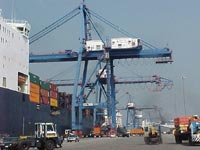
Little LEO systems are
optimized for global tracking of assets such as the 15 million shipping
containers in worldwide circulation whose contents present security
threats at sea, in ports, and in transit.
ITU 030054/Ali Arefzadeh
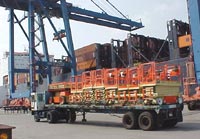
Many shipping containers pass
through the busy ports of Asia. Little LEO systems can identify container
location, routing deviation of containers, and tampering with the original
contents of containers
|
Addressing social justice
Let me also cite an example of how to address the social justice issue with
Little LEO systems. The Istanbul Declaration, one of the outcomes of the World
Telecommunication Development Conference 2002 (WTDC-02), recognized that “Universal
access to information and communication technologies (ICT) is widely viewed as a
key to economic prosperity” and that “new technologies have a significant
impact on the expansion of telecommunications and have the potential to close
the widening gap not only between developing and developed countries, but also
between urban and rural areas and between well-served and underserved areas
within a country.”
Furthermore, the report of the WTDC-02 Chairman on the Special Session on “Bridging
the Digital Divide” reinforced the common view of the link between ICT and
socio-economic benefits: “The digital divide is no longer defined in terms of
lack of access to telephones, but rather in terms of lack of access to ICTs…”
Indonesia is a vast country of 220 million people living on 17 000 islands,
with 70 000 villages across an archipelago stretching over an area similar to
that from the West Coast to the East Coast of the United States, or more
outstretched than from Dublin (Ireland) to Moscow. Similar situations in other
countries in the Asia-Pacific, Africa and Latin America would also require these
new satellite technologies to be able to cover the outstretched areas with
modern information technologies. We are committed to bringing the socio-economic
benefits of universal access to ICTs and service affordability to the people of
Indonesia and other countries as a positive means of bridging the digital
divide. That is why the allocation for additional feeder link under Agenda item
1.16 is crucial for developing an affordable non-geostationary non-voice mobile
satellite system.
It is well known that Little LEO systems have the capability to
cost-effectively serve not only urban populations but more importantly, for
social justice considerations, the remote and rural places of this Earth where
the benefits of technology have been slow in arriving. Little LEO systems, for
example, can bring two-way paging and messaging, including e-mail, to places
that have no other affordable options.
Hopefully, those delegates to the WRC-03 in Geneva who, in the past,
supported the large billion dollar technologies (whether satellite or
terrestrial, mobile or fixed) will now give a chance to the much lower-cost
Little LEO systems to survive and thrive.
Little LEO narrowband technology is proven. The market for rural and remote
messaging is recognized as needing these basic services. What is still missing
is the commitment of people of good will to respond to this moral imperative and
therefore allow the growth of the Little LEO industry.
Conclusion
We are on the eve of an important decision for the Little LEO industry.
Delegates at WRC-03 can decide to continue to hold back this emerging industry
or to allow it to go forward with sufficient spectrum.
If, after over 12 years, the regulators finally allocate additional global
spectrum to this industry, Little LEO systems will be enabled to deliver their
benefits to a waiting world. Obviously, Little LEO systems will not solve all
the problems of security and justice in our world, but they can play a part in
achieving the noble goals of security and justice that only the limits of
imagination can contain. Who then could deny them this last chance?
|


