The satellite transponder market
Transponder demand
| *Conducted by Euroconsult, a Paris-based
consulting company on satellite business (www.euroconsult-ec.com).
The market research and analysis outlined in this section is based on
Euroconsult data, unless otherwise indicated. |
A recent market survey* indicates that after more than 20 years of continuous
growth, transponder demand decreased by 0.9 per cent in 2001, but grew albeit
slightly (+2.5 per cent) in 2002 to a total of 5143 units (36 MHz equivalent).
The main customers of the satellite operators, namely telecommunication
operators, Internet service providers and the broadcasters, have been hurt by
the economic downturn of the past two years. The most established transponder
markets are reported to have experienced a lull while Internet trunking
continued to grow:
- broadcast of television channels (2067 transponders in 2002, +1.4 per
cent)
- voice and data trunking (1808 transponders in 2002, -0.3 per cent)
- video contribution (771 transponders in 2002, -0.4 per cent)
- Internet trunking (419 transponders in 2002, +35.6 per cent)
- Internet direct access (78 transponders in 2002, +28 per cent).
|
ITU 030078/Astrium
|
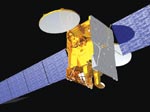
The good news is that there is still a significant growth potential in
transponder demand. In the next ten years, growth is expected to be driven by
television and video services and by Internet services, both for trunking and
direct access. By 2012, transponder demand should reach a total of 7917 units.
First signs of recovery were observed early this year. Further reductions in
transponder lease prices are seen as necessary in fuelling growth in transponder
demand. Price decrease is expected to continue in the short-term under the
pressure of customers and because of overcapacities still growing in several
regional markets.
|
A snapshot of civilian communications and broadcasting
satellites launched or to be launched into geostationary orbit in
2003-2007 |
| Year
of launch |
Launch
service provider |
Satellite
|
Satellite
operator |
|
2003 |
Arianespace |
Intelsat 907 |
Intelsat |
|
2003 |
Arianespace |
INSAT-3A
Galaxy XII |
Indian Space Research Organisation (ISRO)
PanAmSat Corporation |
|
2003 |
ILS* (Atlas IIIB) |
Asiasat 4 |
Asiasat |
|
2003 |
ILS |
Hellas-Sat 2 |
Hellas-Sat Consortium Ltd |
|
2003 |
Arianespace |
BSat-2c |
Broadcasting Satellite System Corporation (Japan) |
|
2003 |
Sea Launch |
Thuraya-2 |
Thuraya Satellite Telecommunications Company Ltd |
|
2003 |
ILS |
Rainbow |
Cablevision Inc. |
|
2003 |
ILS |
AMC-12 |
SES Americom Inc. |
|
2003 |
Sea Launch |
Telstar-13/Echostar-IX |
Loral Skynet/Echostar |
|
2003 |
Arianespace |
INSAT-3E
e-Bird |
Indian Space Research Organisation (ISRO)
Eutelsat |
|
2003 |
Arianespace |
AMC-13 |
SES Americom Inc. |
|
2003 |
Proton/Krunichev |
Yamal 200-F1
Yamal 200-F2 |
A/O Gazkom
A/O Gazkom |
|
2003 |
Arianespace |
Amos-2 |
Spacecom Ltd (Israel) |
|
2003 |
Arianespace |
Anik F2 |
Telesat Canada |
|
2003 |
ILS |
AMC-9 |
SES Americom Inc. |
|
2003 |
Arianespace |
DirecTV-7S |
DirecTv Inc. |
|
2003 |
ILS |
Eutelsat W3A |
Eutelsat |
|
2003 |
Proton |
Express AM11 |
Russian Satellite Communications Company (RSCC) |
|
2003 |
Sea Launch |
Galaxy-XIII/Horizons |
PanAmSat Corporation |
|
2003 |
Eurockot |
Intersputnik-100M1 |
Intersputnik |
|
2003 |
Eurockot |
Intersputnik-100M2 |
Intersputnik |
|
2003 |
ILS |
Superbird 6 |
Space Communications Corporation |
|
2004 |
Arianespace |
Agrani |
Agrani Satellite Services |
|
2004 |
Arianespace |
Amazonas |
Hispasat S.A. |
|
2004 |
ILS |
AMC-10 |
SES Americom Inc. |
|
2004 |
ILS |
AMC-11 |
SES Americom Inc. |
|
2004 |
Arianespace |
AMC-15 |
SES Americom Inc. |
|
2004 |
|
Anik F3 |
Telesat Canada |
|
2004 |
Sea Launch |
Apstar 5/Telstar-18 |
Asia Pacific Telecommunications Satellite Company |
|
2004 |
Proton |
Express AM1 |
Russian Satellite Communications Company (RSCC) |
|
2004 |
Proton |
Express AM22 |
Russian Satellite Communications Company (RSCC) |
|
2004 |
Proton |
Express AM3 |
Russian Satellite Communications Company (RSCC) |
|
2004 |
Arianespace |
Galaxy IR3 |
PanAmSat Corporation |
|
2004 |
Arianespace |
Galaxy VR |
PanAmSat Corporation |
|
2004 |
ILS |
Inmarsat 4F1 |
Inmarsat |
|
2004 |
Arianespace |
Inmarsat 4F2 |
Inmarsat |
|
2004 |
ILS |
Intelsat 10-02 |
Intelsat |
|
2004 |
Arianespace |
iPStar |
Shin Satellite |
|
2004 |
ILS |
MBSAT-1 |
Mobile Broadcasting Corporation of Japan |
|
2004 |
|
Measat-3 |
Binariang Sdn. Bhd. |
|
2004 |
Arianespace |
Satmex-6 |
SatMex |
|
2004 |
Sea Launch |
Spaceway 1 |
Hughes Spaceway |
|
2004 |
Arianespace |
Telkom-2 |
PT Telkom Indonesia |
|
2004 |
CGWIC/Long March |
DFH-4 |
CASC (China) |
|
2005 |
ILS |
Anik F1R |
Telesat Canada |
|
2005 |
|
Apstar 5B |
Asia Pacific Telecommunications Satellite Company |
|
2005 |
Arianespace |
INSAT-4A |
Indian Space Research Organisation (ISRO) |
|
2005 |
|
JCSat-9 |
JSAT Inc. |
|
2005 |
Sea Launch |
NSS-8 |
New Skies Satellites |
|
2005 |
Arianespace |
Star One C1 |
Star One |
|
2005 |
Arianespace |
Wildblue-1 |
Wildblue Communications Corporation |
|
2006 |
Arianespace |
INSAT-4B |
Indian Space Research Organisation (ISRO) |
|
2006 |
ISRO/GSLV |
INSAT-4C |
Indian Space Research Organisation (ISRO) |
|
2006 |
ISRO/GSLV |
INSAT-4E |
Indian Space Research Organisation (ISRO) |
|
2006 |
|
Koreasat-5 |
Korea Telecom |
|
2006 |
NASDA/H2A |
WINDS |
NASDA/CRL |
|
2007 |
ISRO/GSLV |
INSAT-4F |
Indian Space Research Organisation (ISRO) |
|
2007 |
ISRO/GSLV |
INSAT-4G |
Indian Space Research Organisation (ISRO) |
|
2007 |
Arianespace |
Alphasat |
ESA/CNES |
* ILS International Launch Services
The area shaded in green shows satellites already launched in 2003.
In italics: satellites launch and/or launch date conditional to satellite
financing.
Source: Euroconsult. |
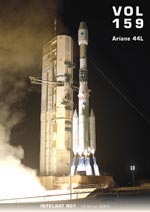
Europe’s Ariane-4 launcher ended its 15-year
career successfully on 15 February 2003 placing a communications satellite
into orbit
ITU 030075/© 2003 ESA - CNES - Arianespace |
A glance at satellite launches in the first quarter
of 2003
When Ariane-4 honourably retired from service…
Europe’s Ariane-4 launcher ended its 15-year career successfully on 15
February 2003 placing a communications satellite into orbit. The Ariane-4
launcher has made a total of 113 successful launches and placed 182 satellites
into orbit. On board historic Flight 159 was an Intelsat 907 satellite that is
to provide Internet link-up, telephony, television and corporate networking
services to the Americas, Europe and Africa over the next 13 years. During its
lifetime, the Ariane-4 launcher put a total of 23 Intelsat satellites into
orbit. Flight 159 lifted off from the launch pad at Kourou (French Guiana) with
each booster adorned with a green clover leaf bearing the inscription “good
luck with the last flight”. Now that Ariane-4 has been “honourably retired
from service,” its place will be taken by generic Ariane-5 launchers. —Source:
European Space Agency (ESA).
|
ITU 030077/AsiaSat
|
New generation satellite for Asia and Australasia
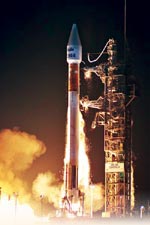
AsiaSat 4, was successfully launched by an Atlas IIIB rocket from Cape
Canaveral, Florida (United States) in April 2003. AsiaSat 4 carries a total of
28 C-band and 20 Ku-band transponders, operating in the fixed-satellite service
(FSS) and broadcasting-satellite service (BSS) frequency bands. It is designed
to provide a number of satellite applications, such as direct-to-home
television, VSAT for private business network and broadband and IP solutions. In
addition, AsiaSat 4 offers part-time and occasional access for news agencies and
broadcasters to relay news, live sports or special events across the footprints.
—Source: AsiaSat.
|
ITU 030076/© 2003 ESA - CNES - Arianespace
|
Successful liftoff for Ariane-5
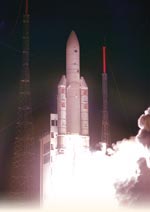
On 10 April 2003, Flight 160 of the Ariane-5 launcher successfully placed its
two payloads into orbit.
The first payload to be released into orbit, 27 minutes after launch, was the
INSAT-3A satellite, weighing 2950-kg at liftoff. This satellite contains a
meteorological observation mission together with a search and rescue payload,
and will also provide telecommunication and television transmission services for
India.
INSAT-3A was closely followed 11 minutes later by the 1760-kg PanAmSat GALAXY
XII satellite, designed to provide telecommunication links between continental
United States, Alaska and Hawai. The launch was from Kourou. — European
Space Agency (ESA).
|


