Is the “connected aircraft” coming of
age?
|
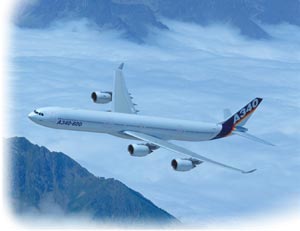
ITU 030072/Copyright Airbus
|
 |
Philippe Chenevier,
VP Special Projects, Products and Services Policy Division, Airbus |
Usage of Ku band from aeronautical mobiles for
broadband connection to the ground
The “dot-com” bubble two years ago has served at least one purpose:
showing that the world is becoming totally connected, and the Internet is the
ubiquitous network bringing the digital revolution. Coupled with the already
widespread usage of mobile phones, and growing usage of laptop personal
computers, the trend is definitely towards mobility without being disconnected.
The last frontier is the commercial airliner, where the only available
connection to the ground is the in-flight phone, which is very little used, due
to poor audio quality and discouraging pricing schemes and levels.
In the past two years, initiatives have been launched by a large aerospace
firm to link the aircraft to the ground, opening to the airlines and the
travelling public the perspective of being connected like at home or in the
office.
Whilst the aircraft was until now out of the digital world network, is the
time coming where it will be just another node in the Web?
The needs
When speaking of getting the aircraft connected, people start dreaming of
various applications, from simple e-mail, short message service (SMS) to Web
surfing and live television, not forgetting more sophisticated applications
directed to the airline.
These applications do not need the same bandwidth, and only virtual private
networks (VPN) and video applications require broadband. The airlines
professional applications and e-mail can be served with less than 100 kbit/s
channels.

When speaking of getting the aircraft
connected, people start dreaming of various applications, from simple
e-mail, short message service (SMS) to Web surfing and live television,
not forgetting more sophisticated applications directed to the airline
ITU 030073/Copyright Airbus |
The networks
There are several networks available through which airliners can be connected
to the ground. Some are ground-based and others are satellite-based. These
networks differ in maturity and coverage.
In terms of maturity, so far, only two networks can be said to be mature and
can claim several years of continued operations. The others are either with an
uncertain future, or recently deployed or in limited scale experimentation.
As for coverage, having a worldwide coverage is a myth. Only one network
covers the polar area, and it has very limited data speed. The established
L-band network gives a quasi-global coverage, spanning to 70/75° latitude.
There are also some regional networks, using land-based systems, which provide
low speed data communication over the United States. Finally, one broadband
network, using Ku band, is under trial on limited North Atlantic coverage with
plans to expand to worldwide coverage. Ku band has, however limitations to about
65° latitudes.
The challenge of aeronautical mobiles
Developing connectivity solutions for commercial aviation is facing some
specific challenges, which have an impact on the potential success of the
business:
- First, the development of technical solutions inflates with the stringent
aeronautical requirement. This impacts both time to market and cost.
- Second, the antenna is limited in size and height, since it has to be
mounted outside of the fuselage under a radome. It drives the cost of the
antenna to skyrocketing values.
- Third, the regulatory environment is still forbidding transmission from
aeronautical mobiles in the Ku band, which is the prime candidate for
broadband connectivity.
- Fourth, the airline decisions process is slow. After a few leading,
innovative airlines, it will take several years before a large proportion of
airlines decide to equip their fleet.
- Finally, fitting a fleet of several hundred aircraft without incurring
specific downtime leads to several years before completing the equipment of
the aircraft.
All this adds up to several years, before reaching a number of aircraft large
enough to ensure a proper load and traffic volume.

Airbus is now using available solutions via
the Inmarsat Swift64 service associated to a portfolio of airline
applications and passenger messaging featuring e-mail and SMS. At the same
time, it is working to mature the broadband technology so as to lower cost
and weight of equipment
ITU 030074/Copyright Airbus- Image Graphique
i3m |
The economics
Broadband service is not cheap presently. The aircraft equipment cost is
high; close to USD 1 million. The impact on the aircraft operations is
expensive: drag of the radome, weight of the equipment and loss of payload (as
much as 3 passengers). Finally, the network will require a large number of
transponders to achieve quasi-worldwide coverage.
Networks that are dedicated to the aeronautical service only run the risk of
facing several years of fixed expenses without commensurate revenues to ensure
breakeven due to the slow ramp-up of the traffic.
Besides, there are still uncertainties on the real level of passenger demand
for broadband service at the cost of USD 30 to 35 per flight quoted presently.
Today, airline applications run on lower speed networks that do not require
expensive, bulky and heavy equipment on board. It is expected that a number of
airlines will prefer concentrating first on these solutions, for which they have
a better visibility in terms of business return, while offering messaging
services that use the existing equipment on board.
The speed of worldwide roll-out of in-flight broadband services will hinge on
a number of factors, including customer demand, approval of frequency allocation
and a change in the Radio Regulations — a matter that is on the agenda of the
World Radiocommunication Conference (WRC-03), to be held in Geneva from 9 June
to 4 July 2003.
Conclusion
In summary, demand for connectivity is diverse and no single solution fits
all needs optimally; there is a variety of networks, few of which have
demonstrated maturity. Finally, broadband cannot cover all needs, due to its
cost, weight and bulkiness.
Airlines need a clear, positive and prudent response, that:
- limits their risks;
- is modular and scalable;
- can be installed on any aircraft;
- uses open technical solutions and available networks;
- provides a step-wise growth path to higher bandwidth;
- provides a return from improvement in their own operations;
- matches target price of USD 10 to 15 for passenger mail service.
In that perspective, Airbus is now using available solutions via the Inmarsat
Swift64 service associated to a portfolio of airline applications and passenger
messaging featuring e-mail and SMS. At the same time, it is working to mature
the broadband technology so as to lower cost and weight of equipment. In the
meantime, demand should firm up, so that both increased market demand and lower
access cost to the technology will eventually switch the broadband business
model from impossible to sustainable. However, if that happens, it should not be
before several years.
|


