| Home : ITU News magazine | ||||||||||
Cape Verde in a nutshellCape Verde is located in the North Atlantic Ocean some 450 km west of Senegal and consists of ten islands. The archipelago is characterized by several distinctive geographical and historical features. While it is the coolest nation in West Africa, it has a history of recurring droughts, which have, in the past, caused starvation. Droughts are also one of the causes for large-scale emigration. Cape Verde is also distinctive as being farther from the African mainland and closer to the Americas than any other African country. In terms of demography, Cape Verde is unique as the islands are said to have been uninhabited when the Portuguese first arrived in 1456. Portuguese is the official language although Cape Verde’s national language is Creole (“Kriolu”), which is derived from ancient Portuguese and languages spoken in the coastal areas of West Africa.
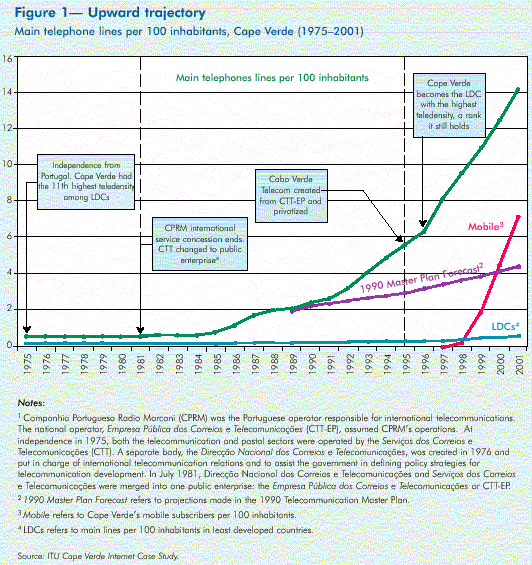
A national census was carried out in 2000 and counted a population of 434 812. The population is young, with over 42 per cent under the age of 14 and only 6 per cent over the age of 64. The average Cape Verdean is a little over seventeen years old. Many Cape Verdeans have emigrated and though estimates vary, there are at least as many Cape Verdeans abroad as in the country. The nation became predominantly urban during the 1990s, with the urban population standing at 53 per cent in 2000. Achieving universal accessCape Verde has made enviable gains in its telecommunication market since independence from Portugal in 1975. Telecommunication development followed three distinct phases (see Figure 1):
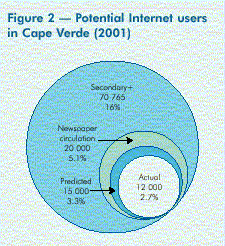
Universal access to telecommunications is high. By the year 2000, CVT had fulfilled its universal access obligation by providing at least one telephone in all 241 communities with a population of more than 200 inhabitants. In addition, 90 per cent of the population is within coverage of the mobile cellular network. Universal service — or the availability of a telephone in a household — has progressed steadily. The percentage of households with a fixed-telephone line increased from 15 in 1992 to 60 in 2001; the third highest level in Africa (after Reunion and Mauritius). A major factor is growing wealth. The monthly fixed telephone subscription charge — which has remained at the same price of USD 2.08 (ECV 250) — amounted to 2 per cent of per capita income in 2000, down from almost 5 per cent in 1992. One bottleneck constraining home telephone ownership is the lack of electrical energy. Only half the country’s households had electricity in 2000. Where Cape Verde could be…and howAt the end of 2001, there were an estimated 12 000 Internet users in Cape Verde, accounting for 2.7 per cent of the population. There are reasons to believe that this figure is lower than it should be. For example, a linear regression of Cape Verde’s Internet penetration and gross domestic product (GDP) per capita compared to 143 other countries forecasts that Internet penetration should be 3.3 per 100 inhabitants — implying that there should be around another 3000 users more than the estimated 12 000. Another indicator that has been found to be a good proxy for Internet penetration is newspaper circulation. The figure for Cape Verde is 5.1 per 100 inhabitants, suggesting that there should be around 20 000 Internet users in the country. Education is another proxy for the potential Internet market. Over 70 000 Cape Verdeans in the country have a secondary or higher education, which accounts for 16 per cent of the population.
There are a number of reasons why Cape Verde is not living up to its Internet potential. CVT is the only Internet Service Provider (ISP) and has not fully exploited the market’s promise. Dial-up prices remain relatively high, particularly for an LDC. Thirty hours per month of Internet usage, for example, cost almost USD 30, equivalent to around 12 per cent of per capita income. When one adds on telephone usage charges and a PC, the amount is beyond the reach of most Cape Verdeans. There are also few Internet cafés. *
Leveraging LDC statusIn 1999, Cape Verde received over USD 300 per capita in development assistance, the highest amount for an independent country. Development agencies like to invest in Cape Verde, where their assistance shows concrete results. One reason is Cape Verdeans’ ability to formulate concrete project proposals relevant to their development needs. Another is their determination to be involved in their projects from the beginning to the end. The nation has been particularly successful at leveraging assistance to develop ICT infrastructure. The development of e-government in Cape Verde has its roots in a World Bank project on public sector reform. Some of the funding was steered towards computerization and ICT training. When the project first started in early 1999, there were only a few computers within government, some of which had a dial-up Internet connection. Within six months, ten ministries and 500 PCs had been connected to the Internet and by year-end 2000, all ministries (across 50 buildings in the capital, Praia) and 1400 computers had connections to the Internet. Today, the government network covers every ministry and gives Internet access to some 2000 government employees (13 per cent). While World Bank funding was essential, the success and rapid expansion of the project were determined by the way the Cape Verdeans involved in the project used this opportunity.
At a crossroadsCape Verde has risen to the top of the LDCs in terms of network infrastructure. It now needs to consolidate the gains from infrastructure development and move to a higher level. This includes developing value-added services on top of the infrastructure. One necessity is opening up the ISP market — in line with government aims to liberalize the economy — and developing content services such as Web design and hosting, portal development and e-businesses. The government also needs to give greater visibility to the Internet and its benefits for national development. This involves developing more content for the public, such as e-citizen services. A move in this direction will constitute the first step towards an information society. The complete Cape Verde Case Study can be downloaded at www.itu.int/ITU-D/ict/cs/capeverde/index.html.
|
||||||||||
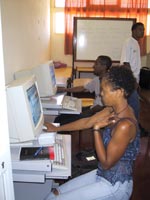 At
the end of 2001, there were an estimated 12 000 Internet users in Cape
Verde, accounting for 2.7 per cent of the population (434 812 according to
the census of 2000)
At
the end of 2001, there were an estimated 12 000 Internet users in Cape
Verde, accounting for 2.7 per cent of the population (434 812 according to
the census of 2000)