New Partnership for Africa’s Development (NEPAD)
A bold initiative for Africa’s revival
| The third World Telecommunication
Development Conference (Istanbul, March 2002) passed a resolution for
engaging the International Telecommunication Union in NEPAD. In October
2002, the Plenipotentiary Conference, the top policy-making body of ITU,
meeting in Marrakesh reaffirmed that decision through another resolution.
As the implementation of NEPAD gathers momentum, ITU News takes a
closer look at Africa’s new agenda of where it wants to go in the area
of information and communication technologies, or ICTs. |
|
ITU 010018/UN – M. Grant
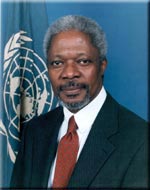
“The digital divide can — and will — be bridged.”
Kofi Annan, UN Secretary-General
|
|
ITU 030009

“We need digital solidarity founded on
a digital charter.”
President Abdoulaye Wade of Senegal
|
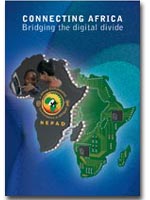 What is NEPAD? What is NEPAD?
The New Partnership for Africa’s Development is a pledge by African
leaders, based on a common vision and firm and shared conviction that they have
a pressing duty to the African people to eradicate poverty and to place their
countries, both individually and collectively, on a path of sustainable growth
and development, and at the same time, to participate actively in the world
economy and body politic. This new African initiative was conceived and adopted,
as the continent’s main development framework, by Heads of State and
Government of the Organization of African Unity (now African Union) at their
Summit in Lusaka (Zambia) in July 2001. It is founded on a hard-headed
assessment of the political and socio-economic realities in Africa today, and on
the conviction that the development of the continent is ultimately the
responsibility of Africans themselves.
NEPAD is also a response to the call of the United Nations Secretary-General,
Kofi A. Annan, to the UN Millennium Summit in September 2000, stressing that “the
digital divide can — and will — be bridged”. The majority of the world’s
population has yet to benefit from new technology — notably information and
communication technologies. “That is why the Millennium Summit recognized the
key role of partnerships involving governments, bilateral and multilateral
development agencies, the private sector and other stakeholders in putting ICTs
in the service of development. That is why, a year before, at the opening
ceremony of the TELECOM 99 global event, I launched an appeal to
governments and to the private sector to support the ITU initiative to convene a
World Summit on the Information Society,” Mr Annan declared.
NEPAD recognizes the significant and cross-cutting impact of ICTs on all
aspects of human life. African leaders identified the development of the ICT
sector as one of the priority programmes of NEPAD, aimed at defining the
continent’s new and aggressive efforts to accelerate its economic development
and growth. But for this growth to occur, they also recognize that three
conditions must prevail:
- peace, security, democracy and good political governance;
- improved economic and corporate governance;
- regional cooperation and integration.
NEPAD further points to several other priority sectors requiring special
attention and action. These include physical infrastructure, such as roads,
railways linking neighbouring countries, as well as power systems; human
development focusing on health and education, including the development of
skills; agriculture; and promoting the diversification of production and
exports, with a focus on market access for African exports to industrialized
countries.
Dialogue around these NEPAD priorities is well under way with the Group of
Eight (G-8) industrialized countries and other donors, and discussions have been
gathering momentum across Africa and around the world about this new vision for
the future of the continent.
At the second Preparatory Committee meeting (Geneva, 17–28 February 2003)
for the World Summit on the Information Society, President Abdoulaye Wade of
Senegal, who is the Honorary Chairman of the e-Africa Commission said: “We
need digital solidarity, perhaps founded on a digital charter, by which
economies higher up on the ICT development scale would be bound to help those at
the lower end. This would be based on a digital snake, with a gradually
narrowing gap between the extremes.” On the ICT front, NEPAD’s objectives
aim to double the teledensity by 2005, with an adequate level of access for
households; lower the cost and improve reliability of service; achieve
e-readiness for all countries in Africa; develop and produce a pool of
ICT-proficient young students from which Africa can draw trainee ICT engineers,
programmers and software developers; and develop local content software, based
especially on Africa’s cultural legacy.
|
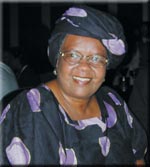 South Africa’s Minister for Communications, Ivy
Matsepe-Casaburri, announced the creation of the e-Africa Commission during ITU
TELECOM AFRICA 2001 South Africa’s Minister for Communications, Ivy
Matsepe-Casaburri, announced the creation of the e-Africa Commission during ITU
TELECOM AFRICA 2001
ITU 010079/MOC, South Africa
|
The e-Africa Commission
The e-Africa Commission is the NEPAD special Task Force on ICT matters.
Announcing the creation of the Commission at ITU TELECOM AFRICA
2001, South Africa’s Minister for Communications, Ivy Matsepe-Casaburri, said:
“In order to ensure that NEPAD’s priority programmes are implemented
speedily, and that they have a visible and positive effect on the lives of
ordinary Africans, the continent’s leadership established special Task Forces…
It is with a great sense of privilege, therefore, that I announce the creation
of the first NEPAD initiative, the e-Africa Commission.” Almost one year
later, in September 2002, the NEPAD Steering Committee confirmed the e-Africa
Commission.
The e-Africa Commission functions through two committees. One is the
Executive Committee, chaired by former President Alpha Oumar Konaré of Mali,
who is also Chairman of the e-Africa Commission. The other is the Programme
Coordinating Committee comprising ten commissioners selected for their
international knowledge and expertise to lead the work in the Focus Areas of the
Commission.
|
ITU 030012/M. Harbi
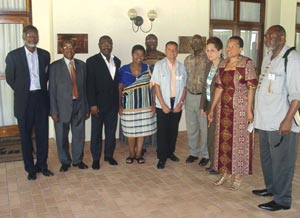
Members of
the Executive Committee and some of the Commissioners in their first meeting in
South Africa. From left to right: N. Quaynor; Professor O. Ajayi; S. Taylor; Ms
L. Shope-Mafole; H. Chasia, Executive Deputy Chairman of the e-Africa
Commission; M. Harbi; Professor P. Kinyanjui; Professor N. Hegazy; Ms P.
Mallela; and C. Diarra
|
Priority Focus Areas
At the first meeting of the Executive Committee and the Programme
Coordinating Committee, held in Kwa Maritane (South Africa) from 16 to 18
January 2003, several domains were identified as initial top priority Focus
Areas for the e-Africa Commission. These include:
- Human development: The e-schools project.
- Infrastructure development: low-cost satellite access for schools,
submarine cable for East Africa.
- e-policies and strategies.
- Special programmes (Youth project).
- Public e-awareness.
- Local content.
The NEPAD e-schools project
Education and health are among the uppermost priorities of NEPAD.
Accordingly, for the e-Africa Commission, the application of ICTs to education
will be the highest of its priority areas to join education and health
objectives of NEPAD and the UN Millennium Development Goals. And so, the NEPAD
e-schools project is high on the Commission’s agenda. But what is an e-school?
It is a school with a minimum set of ICT tools necessary to improve and
accelerate the provision of education in Africa. The e-Africa Commission is busy
laying the foundation to attain the target set by African leaders that the
continent’s high school students should be information technology (IT)
literate in the next five years, starting from the beginning of 2004. Another
objective is that at the end of ten years, any child graduating from an African
primary school should be IT literate. A number of satellites in orbit today,
owned by different operators, have footprints on the African continent and have
transponder capacity that is not currently in use. The Commission has approached
some satellite operators to discuss the provision of low-cost satellite capacity
in support of the NEPAD e-schools project and other requirements. It is also
talking to other possible partners for innovative solutions for the associated
ground infrastructure (e.g., satellite terminals, computers and local power
systems) at the schools.
ITU contribution
ITU Resolution 124 from Marrakesh gives full support to NEPAD in five broad
areas: policy and regulatory issues, financing and investment, infrastructure
development, universal access and ICT development, and human resources
development and management. It instructs the Director of the Telecommunication
Development Bureau to pay particular attention to the implementation of the
provisions of the ITU–D Istanbul Action Plan relating to support for NEPAD,
earmarking resources so that this can be permanently monitored. It also requests
the SecretaryGeneral to release appropriate financial resources for activities
to support NEPAD, in particular the surplus from ITU TELECOM WORLD
exhibitions and forums.
Prior to taking this decision, the plenipotentiaries noted
Resolution 56/218 of the United Nations General Assembly, which in part
reaffirms that plans and modalities of the United Nations future engagement with
NEPAD should be considered during 2002. It also calls on the United Nations
system and the international community to support the New African Initiative and
to ensure effective representation.
Partnerships for progress
The United Nations ICT Task Force
The e-Africa Commission is NEPAD’s instrument for collaboration in ICT
matters with other bodies in Africa and abroad.
Already, the Commission has started a fruitful collaboration with UN ICT Task
Force, initially to focus on projects in the areas of human development,
infrastructure, and e-policies and strategies. As the bulk of the NEPAD ICT
programme will be implemented in the form of projects, the UN ICT Task Force
could play an important role in helping to build the Commission’s capacity in
the areas of project formulation, planning, execution, monitoring and
evaluation.
The G-8
Leaders of the G-8, at their Summit in Kananaskis (Canada) in June 2002, met
with the presidents of Algeria, Nigeria, Senegal and South Africa, and with the
Secretary-General of the United Nations to discuss the challenges facing Africa,
as well as the G-8’s response to NEPAD. This summit adopted the G-8 Africa
Action Plan as a framework for action in support of NEPAD, giving a strong
stamp of approval to the latter’s programme. Each G-8 country pledged to
establish enhanced partnerships with African countries whose performance
reflects the NEPAD commitments. The G-8 Summit in Evian (France) in June 2003
will review progress on the implementation of the Africa Action Plan, based on a
final report from the G-8 Personal Representatives for Africa.
Conclusion
In the past, many interesting and promising initiatives have been developed
in key areas (development, human rights, conflict prevention…), but have
failed for different reasons. NEPAD has not been constructed to be just another
initiative. It is a holistic, integrated sustainable development initiative for
the economic and social revival of Africa. The wide support received from the
G-8 Summit, the European Union, the United Nations with its specialized
institutions, the Bretton Woods Institutions, the Nordic countries, the World
Economic Forum and others, is a demonstration of the seriousness and credibility
of this initiative. The e-Africa Commission, as the NEPAD ICT Task Force, is
determined to take the appropriate actions to help Africa bridge the digital
divide, and plans to be very active in the two phases of the World Summit on the
Information Society in 2003 and in 2005.
|
Contributed by Mohamed Harbi, e-public awareness Commissioner,
E-Africa Commission
|
|


