The satellite industry since WRC-2000
|
ITU 030029/Euroconsult
|
The satellite industry continues to experience growth in spite of set-backs
in the development of Global Mobile Personal Communication Services by
Satellite. For some time now, the demand for spectrum/orbit usage has been
increasing for virtually all space communication services — but most notably
for fixed-satellite, broadcasting-satellite and mobile-satellite services.
Market research* on satellite business estimates that between 175 and 201
satellites will be launched over the period 2001–2010 to meet demand, with a
market value of USD 21.9–26.5 billion. However, in the period since the World
Radiocommunication Conference in 2000 (WRC-2000), the general economic
conditions and the mixed fortunes of telecommunication carriers and the industry
as a whole have been very visible in satellite services development.
Fixed-satellite services
The year 2002 is said to have marked the second year of negative growth in
revenues for FSS operators. With consolidated revenue estimated at USD 6.6
billion in 2002, the 36 FSS satellite operators (see Table 1) are said to have
experienced a year of negative growth (–4.4 per cent). This contrasts with the
record growth achieved in 2000 when revenue topped USD 7 billion. While the year
2000 was boosted by exceptional events, in 2001 and 2002 the industry had to
cope with the fall of the telecommunications market. Despite the decline in
revenues, the FSS industry is expected to remain healthy, with possible recovery
in 2003.
The world availability of satellite transponders is reported to have grown
strongly in 2002, with 950 new transponders available on 20 newly launched
satellites, contrasting with only 400 new transponders on 10 satellites in 2001.
In Russia, for example, two domestic satellite operators, RSCC and Gascom, are
in the process of renewing and enlarging their fleets. In 2000, RSCC decided to
launch a new series of six “Express” satellites, which will expand its fleet
from 95 to around 250 transponders. While the majority of this capacity will be
used by Russian customers, the excess will be sold to customers in Asia,
especially in China. Gascom, related to gas company Gazprom, has two more “Yamal”
satellites under construction. Gazprom is a major customer of Gascom, utilizing
around 40 per cent of the satellite transponder capacity. Other customers
include Russian network television, government and telecommunication companies.
Much of RSCC’s capacity is used for VSAT networks.
| * Conducted by Euroconsult, a Paris-based leading consulting company
on satellite business (www.euroconsult-ec.com).
The market research and analysis outlined in this article is based on
Euroconsult data, unless otherwise indicated.
|
|
|
_
|
|
|
Table 1 – The 36 fixed-satellite service (FSS)
operators
|
|
| |
Operator
|
Satellite system
|
Service coverage |
|
|
Trans-oceanic |
Continental |
| |
APT Satellite |
Apstar |
|
 |
|
|
ASCO |
Arabsat |
|
|
|
| |
Asia Satellite |
Asiasat |
|
|
|
|
Binariang |
Measat |
|
|
|
| |
China Satcom |
Chinastar, Chinasat |
|
|
|
|
Egyptian Satellite |
Nilesat |
|
|
|
| |
Eurasiasat |
Eurasiasat |
|
|
|
|
EuropeStar |
EuropeStar |
|
|
|
| |
Eutelsat |
Eutelsat 2, Hot Bird, W, Seasat |
|
|
|
|
France Telecom |
Telecom 2 |
|
|
|
| |
Gascom |
Yamal |
|
|
|
|
Hispasat |
Hispasat |
|
|
|
| |
Insat |
Insat |
|
|
|
|
Intelsat |
Intelsat |
|
|
|
| |
JSAT |
JCSat, Nstar |
|
|
|
|
Korea Telecom |
Koreasat |
|
|
|
| |
Loral Skynet |
Telstar |
|
|
|
|
Mabuhay |
Agila |
|
|
|
| |
Nahuelsat |
Nahuel |
|
|
|
|
New Skies Satellites |
NSS |
|
|
|
| |
NSAB |
Sirius |
|
|
|
|
RSCC |
Gorizont, Express |
|
|
|
| |
Satelindo |
Palapa |
|
|
|
|
Satelites Mexicanos |
Satmex, Solidaridad |
|
|
|
| |
SES Global |
Astra, AMC |
|
|
|
|
Shin Satellite |
Thaicom |
|
|
|
| |
SingTel Optus |
ST, Optus |
|
|
|
|
Sino Satellite |
Sinosat |
|
|
|
| |
SCC |
Superbird |
|
|
|
|
Spacecom |
Amos |
|
|
|
| |
Star One |
Brazilsat |
|
|
|
|
Telkom Indonesia |
Telkom |
|
|
|
| |
PanAmSat |
Galaxy, PAS |
|
|
|
|
Telenor |
Thor |
|
|
|
| |
Telesat Canada |
Anik, Nimiq |
|
|
|
|
Turk Telekom |
Turksat |
|
|
|
| |
©
Sourced from Euroconsult 2003. |
Mobile telephony: still a niche market for satellite
While mobile-satellite services (MSS) have experienced difficult times in
recent years, in 2002 the MSS operators continued to make progress, but with
very different business models. For example, Inmarsat, signed up its 250 000
customers and launched its interim high-speed (144 kbit/s) service ahead of the
launch of “BGAN” in 2004, which is expected to provide a mobile 400 kbit/s
service. Iridium Satellite, which rose from the bankruptcy of Iridium LLC,
renewed its contract with a partner, securing its future at least for the near
term. The regional MSS operators, ACeS in Asia and Thuraya in the Middle East
are reassessing their business models. ACeS, while not abandoning the mobile
service, is looking to use its capacity to provide fixed rural telephony where
demand is high and unmet.
Satellite television broadcasting
Growth continues in revenues, television channels and subscribers
With an estimated 50 per cent of the transponders in orbit broadcasting
television channels, broadcasters remain the largest customers for the FSS
industry, providing over 60 per cent of its revenues.
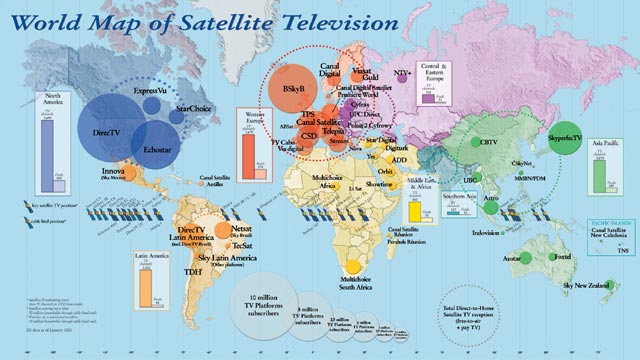
Despite a difficult economy, the direct-to-home (DTH) satellite television
broadcasting industry continued to grow in 2002. Market research shows that some
six million additional television households subscribed to satellite pay-TV
during 2002, bringing the total of satellite television subscribers to over 52
million households at year-end. The top three satellite broadcasters were
Echostar (1.3 million net new subscribers) and DirecTV (1 million new
subscribers) in the United States, and BSkyB in the United Kingdom (800 000 new
subscribers). During the same year, SkyPerfecTV in Japan passed the 3-million
subscriber mark (400 000 new subscribers) and Canal Satellite in France the
2-million mark (150 000 new subscribers). Revenues of satellite pay-TV increased
from USD 22 billion in 2001 to around 25.5 billion in 2002 for the 55 DTH
multi-channel pay-TV broadcasters.
 According to industry forecasts, the cable and satellite industry in Asia and
the Pacific is set to grow from the current 157 million subscribers to over 228
million in the next eight years, recording a 45 per cent growth rate from 2002
to 2010. China and India are expected to continue to be the key markets in 2010,
with 128 million subscribers in China and 53.35 million in India. ** According to industry forecasts, the cable and satellite industry in Asia and
the Pacific is set to grow from the current 157 million subscribers to over 228
million in the next eight years, recording a 45 per cent growth rate from 2002
to 2010. China and India are expected to continue to be the key markets in 2010,
with 128 million subscribers in China and 53.35 million in India. **
Satellite television channels
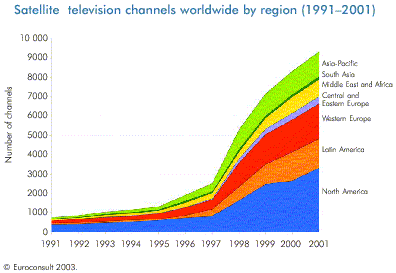
Some 1150 new satellite television channels were launched worldwide in 2002,
bringing the net total to about 10 500 channels currently broadcast by
satellite. In a difficult advertising market, growth was largely sustained by
multi-channel pay-TV offerings with about 750 new television channels broadcast,
and a further 400 new free-to-air and individual premium channels. Growth is
expected to continue in 2003 with good medium-term prospects sustained by
consolidation in the DTH satellite broadcasting industry.
|

ITU 030004/PhotoDisc
|
Further developments to be considered at WRC-03
Radio frequencies and the geostationary satellite orbit are limited natural
resources, which must be used rationally, efficiently and economically. The
International Telecommunication Union (ITU) upholds the right of all countries
to equitable access to satellite orbit space. International agreement on the way
the various bands of the radio-frequency spectrum are used is essential to the
smooth operation of a growing range of critical applications, from aircraft and
maritime navigation to wireless telephony, satellite broadcasting and scientific
research. On this score, the ITU Radiocommunication Sector (ITU–R) and in
particular world radiocommunication conferences play a vital role in regularly
updating the basis for allocation and use of the radio-frequency spectrum and
satellite orbits.
|
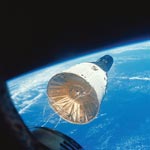
ITU 030032/PhotoDisc
|
Spectrum allocation and sharing will be a challenge for the upcoming World
Radiocommunication Conference (WRC-03), to be held in Geneva from 9 June to 4
July 2003. WRC is the forum that defines and updates the Radio Regulations —
the binding international treaty that governs the allocation and use of the
radio-frequency spectrum by a plethora of different services worldwide.
|

ITU
010101/PhotoDisc
|
Private sector plans to deploy new non- geostationary satellite
constellations to deliver voice telephony and broadband data services, along
with a new wave of traditional “geostationary” satellite deployments geared
to meeting steadily rising demand for Pay-TV, future interactive entertainment
services, high-speed Internet and corporate networking, all necessitate the
development of technical sharing criteria and arrangements to ensure that
neither type of satellite system would cause harmful interference to the smooth
functioning of the other. Such ongoing developments have required detailed
consideration of new or revised technical solutions. For example, additional
spectrum allocations made by WRC-97 to planned non-geostationary fixed-satellite
systems (NGSO FSS) were subject to strict power limits in order to protect GSO
and other services already operating in those bands.
WRC-03 will be key in updating the regulatory framework, as well as the
sharing scenarios and methodologies in order to ensure a fair and efficient use
of the radio-frequency spectrum to enable the various industry segments to
deploy new services or expand existing ones to generate capacity for new
services and technologies. In this regard, the work carried out by ITU–R study
groups, the Special Committee on Regulatory and Procedural Matters and the
Conference Preparatory Committee in preparation for WRC-03 makes possible the
necessary technical and operational bases on which to take sound decisions.
|
** Based on the latest figures published by the Cable and Satellite
Broadcasting Association of Asia (CASBAA).
|
|