E-Strategy

With the public key infrastructure in place and
operational, certified users from both developing and industrialized
countries will be able to communicate securely, conduct business
transactions in a secure and trusted manner and run other e-services such
as e-government, e-health and e-learning
Photo: EyeWire (ITU 020057)
|
Digital inclusion
ITU recently launched a new and broader
framework for collaboration in building trust and secure infrastructure in
developing countries through a Memorandum of Understanding called World e-Trust.
This multilateral framework is intended to attract more actors and to
enable developing countries to work hand-in-hand with technology providers in
order to play a more active role in building the global information society and
in creating digital opportunities.
Public key infrastructure: The key to the digital age
The E-Strategy Unit of ITU’s
Telecommunication Development Bureau (BDT) makes available secure and low-cost
solutions from a consortium of providers of public key infrastructure
(PKI), enabling developing countries to establish infrastructure for digital
certification and value-added e-services. In-kind contribution of more than USD
10 million from WISeKey and its industry partners and more than 16 months of
technology and application development have helped evolve appropriate solutions
for the particular needs of the participating developing countries.
The Corporación Ecuatoriana de Comercio Electrónico
(Corpece), an Ecuadorian enterprise based in Quito, is one of the early
beneficiaries of this effort. Along with industry partners, the enterprise has
benefited from digital certification and value-added e-services and training,
and is now authorized to issue digital certificates to national entities wishing
to conduct various forms of electronic transactions. Similar projects involving
a variety of entities are being deployed in a number of countries.
Turkey’s World Trade Centre in Ankara, for example, is due
to be authorized to issue digital certificates. Trade associations and chambers
of commerce such as Burkina Faso’s Chambre de commerce, d’industrie et d’artisanat
(CCIA) and Côte d’Ivoire’s Association pour la promotion des exportations
(APEX-CI) have reached different stages of delivering e-services based on
digital certificates.
In Cambodia, funding from the Swiss Federal Office for
Communications (OFCOM), the Swiss telecommunications regulator, has enabled the
Ministry of Posts and Telecommunications to install hardware and software and is
awaiting the training and audit needed prior to rolling out the service.
Telecommunication operators, such as Mali’s SOTELMA, Peru’s LimaTel and
Senegal’s Sonatel, also see PKI infrastructure as an addition to their
portfolio.
Major projects in E-services/applications
A secure and robust infrastructure
is fundamental to building confidence in the use of public networks for the
delivery of value-added e-services. More than 100 developing and least developed
countries have requested the assistance of ITU in deploying such infrastructure.
Four least developed countries (Burkina Faso, Cambodia, Mali and Senegal) are
amongst the first twelve nations scheduled to have operational infrastructure
for digital certification and value-added e-services.
Through its Electronic Commerce in Developing Countries
(EC-DC) venture launched in March 1998, ITU has played a key role in the
on-going deployment of PKI technology in more than ten countries involving many
organizations. These include telecommunication operators, ministries, chambers
of commerce, regulatory agencies, Internet service providers, trade associations
and federations, World Trade Centres, non-governmental organizations (NGO) and
financial institutions.
ITU/BDT together with the United Nations Development
Programme (UNDP), the United Nations Development Fund for Women (UNIFEM), as
well as African women entrepreneurs worked hand-in-hand to define strategies for
mainstreaming women and their concerns in information and communication
technologies.
ITU works in partnership with WTC Geneva, WISeKey SA and many
private sector companies to build e-transaction infrastructures and create other
IP-based e-services (such as e-commerce, e-government and e-marketplace). By way
of an example, ITU and WISeKey tested and launched a PKI-enabled secure B2B
portal in May 2001. One of the early beneficiaries of this e-marketplace will be
EPZDA Mauritius. National operations providing e-payments and secure
e-transactions, funded by both public and private sectors, have also been
launched in Brazil, Morocco, South Africa and Venezuela.
Thanks to ITU, several developing countries have, for the
first time, become actively involved in deploying services aimed at building
security and trust (using digital certification, digital signatures) and
extending beyond commercial applications to societal ones such as health,
business, education and government.
Internet protocol: Enabler of ICTs
The possibility of transmitting voice
over IP-based networks, with all its challenges and opportunities, is a
milestone in technology convergence. Following the ITU World Telecommunication
Policy Forum on IP Telephony in March 2001, BDT has received several requests to
assist developing countries in mapping the path from circuit-switched to IP and
multi-protocol networking. In response to the concerns and needs of developing
countries, ITU has advised and assisted on the technical, socio-economic and
policy issues pertaining to the introduction of IP Telephony (see http://www.itu.int/ITU-D/e-strategy/internet/iptelephony). Mauritania’s
Secrétariat d’Etat en nouvelles technologies (SENT) has adopted the
recommendations of ITU/BDT for its ICT policy with a view to developing IP-based
local area network (LAN), wide area network (WAN) and telephony for its
e-government project — a model being considered by Burkina Faso as well.
In Cameroon, technical and financial assistance was provided
to the Association pour le soutien et l’appui à la femme entrepreneur (ASAFE)
based in Douala to obtain a high-speed IP wireless connection to the national
backbone. Technical assistance was provided to Sotel, the national operator in
Chad, and to Gamtel, Gambia’s telecommunication operator, to exploit the
potential of IP for Internet, intranet, extranet and telephony applications.
Technical assistance and training was provided in IP networking to Costa Rica,
using modern planning tools provided by NTT Comware. In partnership with UNDP,
ITU/BDT is exploring ways of implementing Internet nodes and a national IP
backbone in Congo-Brazzaville. SOTELMA is receiving assistance in implementing
Internet remote access. Technical assistance is being provided to Rwanda’s
education network (RwEDnet) under the “Imfundo” project supported by the
United Kingdom’s Department for International Development.
|
(ITU 020064)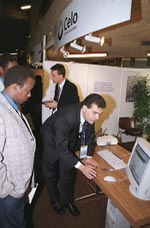
An
agreement with WISeKey and its industry partners and trade communities of the
World Trade Centres to expand secure e-transactions in 100 developing countries
has attracted several leading technology providers
|

(ITU 020065)
|
Other projects in progress scheduled to be operational in
2002 include: Bulgaria’s project to enhance government services through
e-government, Cuba’s Empresa de Servicios Informáticos de Santiago de Cuba
(ESI Stgo), the Islamic Republic of Iran’s E-commerce project for D-8 Members
(Bangladesh, Egypt, Indonesia, Iran, Malaysia, Nigeria, Pakistan and Turkey) and
Pakistan’s Sysnet (Telecommunications and Networking Systems Integrator).
Partnerships
Partnerships are critical for the development
of sustainable, cost-effective service-based e-applications and secure
transaction technology. ITU has signed three agreements so far:
-
Fundandina:
This partnership led to an operational electronic commerce centre in
Venezuela, generated new alliances with other major players from the Latin
American region, several operational ICT projects, a centre for training and
development providing ICT training and more than 90 Internet portals (http://www.fundandina.org).
-
WISeKey and World Trade Centre:
An agreement with WISeKey and its industry partners and trade communities of
the World Trade Centres to expand secure e-transactions in 100 developing
countries has attracted several leading technology providers, who
have contributed software, hardware, services and consultancy to develop
public key infrastructure, applications and services in several developing
and least developed countries worldwide.
-
Goodwin Procter LLP: Free
legal assistance is provided to ITU Member States who request it to
establish the legislative framework for e-services. The Washington-based law
firm evaluates existing laws and subsequently proposes changes to
enable secure e-transactions to take hold. Governments and legislators then
make the necessary amendments and enact the new laws. Through an agreement
with Goodwin Procter LLP, ITU has assisted countries such as Mongolia to
establish a legislative framework for e-services.
|
Contributed by
Alexander Ntoko, Head, E-Strategy Unit, ITU/BDT.
|
|


