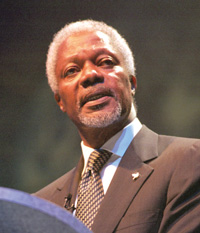
A technological revolution is transforming society in a profound way. If harnessed and directed properly, information and communication technologies (ICT) have the potential to improve all aspects of our social, economic and cultural life. ICTs can serve as an engine for development in the 21st century, and as an effective instrument to help us achieve all the goals of the Millennium Declaration — the landmark document adopted by a record number of leaders when they met for the Millennium Summit to address the key challenges of our time.
Yet the majority of the world's population has yet to benefit from the new technology. That is why the Millennium Summit recognized the key role of partnerships involving governments, bilateral and multilateral development agencies, the private sector and other stakeholders in putting ICTs in the service of development. That is why, a year before, at the opening ceremony of the ITU Telecom 99 global event, I launched an appeal to governments and to the private sector to support the ITU initiative to convene a World Summit on the Information Society.
This global gathering will be a unique opportunity for all key players to develop a shared vision of ways to bridge the digital divide and create a truly global information society. It will be an opportunity to develop specific solutions and tools and adopt a realistic and viable plan of action. As I said in my report to the Millennium Summit, the digital divide can — and will — be bridged. The World Summit on the Information Society is a crucial step towards this end.
Kofi A. Annan
United Nations Secretary-General
|
The Summit is being organized by the United Nations system under the high patronage of UN Secretary-General, Kofi A. Annan, with the International Telecommunication Union taking the lead role in cooperation with other interested UN agencies, and will occur in two phases. The first phase will take place in Geneva from 10 to 12 December 2003 and the second in Tunis in 2005 |
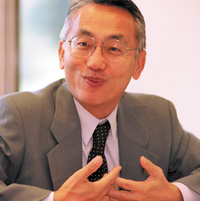
The spread of information and communication technologies, especially the Internet, is revolutionizing whole aspects of social, cultural and economic life. ICTs are creating many new opportunities but, because of their uneven spread, they are also creating new challenges, notably the emergence of "digital divides". The holding of the World Summit on the Information Society, in Geneva in 2003 and in Tunis in 2005, under ITU's leadership, provides a chance to develop solutions to these challenges, especially as they relate to Africa and the least developed countries. The Summit is expected to produce a shared vision among world leaders, the private sector and the NGO community on how to bring about sustainable development through ICTs.
Yoshio Utsumi
ITU Secretary-General
Moritz Leuenberger
President of the Swiss Confederation
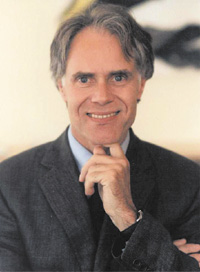
The modern world is undergoing a fundamental transformation, moving rapidly towards the Information Society. This promises a fundamental change in many aspects of human existence. Man is a social creature, who has a fundamental right to participate in social life and this participation implies having access to the Internet. Each new technology contains chances and risks and it is our duty to increase these chances and minimize the risks. For the new communication technologies, the major danger is that their access would be reserved only to certain countries or circles, the others being separated from the Information Society and its tremendous developmental potential. The aim of the World Summit is therefore to develop a common vision and understanding of the Information Society and to draw up a strategic plan of action for concerted development, primarily in order to reduce the digital divide. All countries, developing and developed, must work together to reach this goal. Switzerland, and in particular Geneva with its international opening, have always been involved, and will stay involved in bringing the benefits of the information technologies to everyone, and especially the developing countries. That is why Switzerland sees this Geneva 2003 Summit as an extraordinary opportunity to set up a framework of cooperation between governments, civil society and actors of economy.
Zine El Abidine Ben Ali
President of the Republic of Tunisia
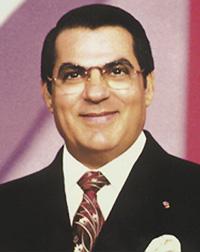
Tunisia is proud to be hosting the World Summit on the Information Society in 2005, where the aim will be to bring the machinery of international cooperation to bear on reducing the digital divide, modern information and communication technologies being among the main tools for promoting just, comprehensive and sustainable development.
These technologies, the mastery and proper utilization of which depend primarily on human competencies and collective intelligence, provide, particularly to developing countries, an exceptional opportunity to advance by leaps and bounds towards meeting their peoples' aspirations for progress and stability.
However, in order to achieve these justifiably ambitious objectives, there has to be a proper balance between mastery of these technologies and their use in the interests of peoples and the preservation of their identity within an intercultural framework. The active participation of civil society and the private sector is thus essential.
Firm as it is in its determination to lay the foundations for the society of learning and intelligence, Tunisia is fully capable of making an active contribution to efforts aimed at assisting the developing countries not to be outstripped by technological progress and to strengthen their presence in the global communication sector. This is one of the most important and ambitious aims to which participants in the World Summit to be held in Tunis in 2005 will be devoting their full attention.
It is our ardent hope that each stage of the Summit will be crowned with success for the good of all humankind.
The Summit aims to bring together Heads of State, executive heads of United Nations agencies and of other international organizations, industry leaders, non-governmental organizations, media representatives and civil society
All governments have a stake in the Information Society, whatever their level of national income or infrastructure facilities. Governments are a key to bringing the benefits of the Information Society to everyone through the development of national and global policies and frameworks to meet the challenges of the Information Society.
In their pursuit of the public interest, governments can raise awareness, facilitate access to information for the public, and they also can lay the foundation for all citizens to benefit from ICTs in terms of improved quality of life, social services and economic growth.
The Summit offers a unique opportunity for the global community to reflect, discuss and give shape to our common destiny in an era when countries and peoples are interconnected as never before. The UN family of organizations serves as a catalyst for change by bringing together governments, as well as the private sector, international institutions and civil society in pursuit of common goals.
ITU is well placed to bring together all stakeholders. With its membership of 189 Member States and more than 650 Sector Members representing companies and organizations with an interest in telecommunications, ITU has a long tradition of working with the private sector. Its ability to bring together these representatives from competing companies and from governments of all ideological persuasions is perhaps the Union's greatest strength.
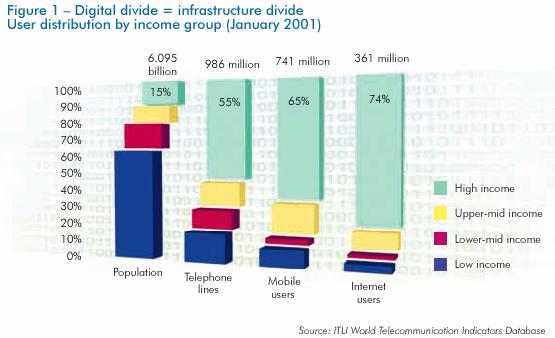
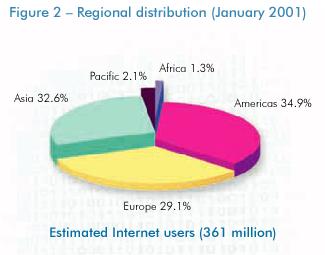
Further, ITU's broad membership base and the consensus approach taken by its study groups ensure that future developments benefit from a wealth of experience and creative ideas from representatives of leading entities in the field of telecommunications around the world. The establishment of a partnership between the private and public sectors has come to play an increasingly important role for ITU in the implementation of telecommunication development activities designed to ensure that new technologies reach all parts of the world.
Clearly, then, taking an active role in the Information Society is crucial to the relevance of the UN system in general and
to ITU in particular as it revamps itself to meet the ever-growing challenges of the fast-paced industry it serves.
|
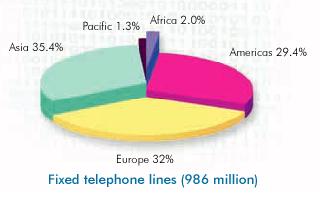
By the time of the first phase of the Summit in 2003, there will be more than one billion users of fixed-line phones and more than half a billion Internet users |
The private sector can play an active role, in conjunction with governments and civil society, by offering an economically viable model to achieve the development objectives on the world agenda.
The contribution of the private sector is instrumental in creating the material conditions for universal access to information and value-added ICT services. Its involvement in the Summit will help create a sound basis for economic development through stable and skilled new employment opportunities, and the creation of local industries dealing in assets, hardware, software, content and services. It will also aid in fostering new types of partnerships.
Civil society is playing an active role in identifying the social and cultural consequences of current trends and in drawing
attention to the need to introduce democratic accountability on the strategic options taken at all levels. Its diversity and,
often, hands-on approach to issues, make civil society a key player in the renewed international partnership called for by the
UN Secretary-General.
|
This section is adapted from "World Summit on the Information Society", Geneva 2003, Tunis 2005"—Brochure prepared under the direction of M. Harbi. |
High-Level Summit Organizing Committee holds first meeting
As preparations for the World Summit get in full swing, HLSOC*, which stands for High-Level Summit Organizing Committee, will be another important acronym to remember. The purpose of this committee is to coordinate the efforts of the United Nations system in the preparation, organization and holding of the World Summit and it is composed of heads of UN agencies interested in the event.
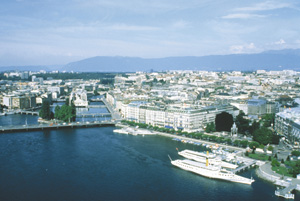
Three Preparatory Committees of the Summit are also planned. The first one will take place in Geneva from 1 to 5 July 2002
Photo: Office du Tourisme de Genève (ITU 010100)
At its first physical meeting, held at the United Nations headquarters in New York on 18 October 2001, HLSOC had a productive and useful exchange of views on a wide range of topics concerning the Summit. The meeting was chaired by Yoshio Utsumi, ITU Secretary-General and Chairman of HLSOC. It brought together representatives from FAO, ITU, UNCTAD, UNESCO, UNITAR, WIPO, WMO, WTO and the United Nations Department of Economic and Social Affairs (UN-DESA).
Reporting on the latest developments in Summit preparations, Mr Utsumi highlighted the establishment of the Executive Secretariat** at the ITU headquarters in Geneva. He also cited the support the United Nations Economic and Social Council (ECOSOC) had expressed for the Summit.
In the conclusions of ECOSOC 2001, a statement referring to the Summit says: "The United Nations' role in this effort is pivotal, including inter alia through partnerships with relevant stakeholders — [such as] the private sector and relevant international organizations — particularly in assisting developing countries in maximizing the benefits they can secure from ICTs. In this context, the Council welcomes the forthcoming World Summit on the Information Society which is to be organized in two phases, the first one in Geneva in 2003 and the second one in Tunis in 2005."

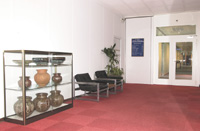
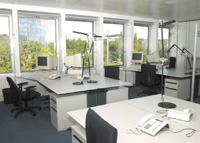
Renovations made to the fifth floor of the Varembé building have turned it into an ultra-modern, elegant place for business and it serves as offices for the Summit Executive Secretariat
HLSOC reviewed its terms of reference and decided to welcome the involvement of the UN Regional Economic Commissions and UNITAR in its work. Further, HLSOC has agreed to invite the two host countries to attend its meetings as observers.
Arthur Levin, Chief, a.i., Coordination, External Relations and Communication Units, introduced the Operation Plan for the Summit. The Plan was prepared by ITU staff and the Executive Secretariat, and was well-received for its completeness.
With respect to the preparatory process, HLSOC reached a number of conclusions which require:
On the question of finances, HSLOC agreed that one way of maximizing resources will be for UN agencies to pool their efforts when organizing ICT-related meetings and to seek to align such meetings with the Summit preparatory process. This will be crucial as many agencies at the meeting noted that they are already extensively involved in ICT projects. HSLOC further recognized the need to provide funding to assist developing countries to participate in the process.
Renovations made to the fifth floor of the Varembé building (the oldest of ITU's three buildings) have turned it into an ultra-modern, elegant place for business and it serves as offices for the Summit Executive Secretariat. These offices have been furnished impeccably — courtesy of the Federal Office for Communications (OFCOM), the Swiss telecommunications regulator.
The Executive Secretariat is made up of staff from Member States, the UN agencies participating in HLSOC, the private sector, as well as NGOs and civil society. At the time of the HSLOC meeting, ITU had already received 14 commitments to detach experts to the Executive Secretariat.
HLSOC has agreed to hold one physical meeting per year and to conduct its work by e-mail in the interval between such
meetings. Further, it has requested the UN Administrative Coordination Committee to place on the agenda of one of its meetings
(either Fall 2002 or Spring 2003) the World Summit on the Information Society and issues related to this topic.
*What is HLSOC?HLSOC was established in 2000 by the UN Administrative Coordination Committee (ACC) — a forum that brings together annually executive heads of the UN system. CompositionHLSOC is composed of a Representative of the Secretary-General of the United Nations and executive heads of UN agencies that have expressed interest to help organize the Summit. They are listed below in alphabetical order.
The Executive Director of the United Nations Institute for Training and Research (UNITAR) and the Executive Secretaries of the UN Regional Economic Commissions became members of HLSOC during the meeting in October 2001. Mandate
|
** Role of the Executive Secretariat
|
ITU is actively seeking partnerships for the Summit in what promises to be a massive undertaking. The Union is encouraging all its Member States and Sector Members to commit themselves to the preparations of the Summit in order to make this event a success.
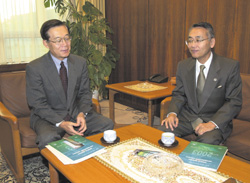
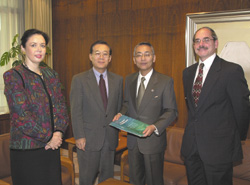
Photos: A. de Ferron (ITU 010094/ITU 010095)
From left to right (seated): His Excellency Ambassador Koichi Haraguchi, Permanent Representative of Japan to the Office of
the United Nations in Geneva and other international organization in Switzerland, announcing the news of the Japanese
government's donation to Yoshio Utsumi, ITU Secretary-General; and (standing): Francine Lambert, Head, Corporate
Communication, ITU; Ambassador Haraguchi; Mr Utsumi; and Arthur Levin, Chief, a.i., Coordination, External Relations and
Communication Units, ITU
Responding to this call, Japan made a contribution of JPY 15 million (USD 120 704) on 25 October 2001, and has pledged an additional 15 million in the coming months (USD 241 409 in total).
Announcing the news of the Japanese government's donation, His Excellency Ambassador Koichi Haraguchi, Permanent Representative of Japan to the Office of the United Nations in Geneva and other international organizations in Switzerland, said:
"We recognize that closing the digital divide is a vital issue in the international arena. In this sense, we believe that the World Summit on the Information Society, being prepared as a result of ITU initiatives, is a timely and significant task. Taking into account the importance of the Summit, we have decided to appropriate JPY 15 million to ITU from the budget of the Ministry of Public Management, Home Affairs, Posts and Telecommunications."
The Japanese Government's efforts to promote ICTs are not new. Examples include the "e-Japan Strategy", which aims to put the country at the forefront of ICTs. Also, in 2000, Japan played a leading role at the G8 Summit, which came up with the "Okinawa Charter on the Global Information Society". This Charter recognizes that ICTs represent one of the most potent forces in shaping the 21st century.
"ICTs are fast becoming a vital engine of growth for the world economy. They are also enabling many enterprising individuals, firms and communities, in all parts of the globe, to address economic and social changes with greater efficiency and imagination. Enormous opportunities are there to be seized and shared by all," states the Charter.
It is in the light of the revolutionary impact of ICTs on the way people live, learn and work and the way government interacts with civil society that nations adopted the Okinawa Charter.
By the same token, Japan's contribution to the preparatory process of the Summit is a commitment to dealing with the growing problem of inequality of access to ICTs. In the words of Ambassador Haraguchi:
"It would be highly appreciated if our donation could stimulate positive support of various forms from countries or organizations. This Summit will be a precious guidance to the development of the Global Information Sciety of the 21st century. We are sure of the Summit's glorious success, and will do our best to ensure our continued support."
|