A number of questions were discussed at the ITU Strategic Planning Workshop (Geneva, 19–21 September 2001) on the theme of licensing third generation (3G) mobile systems. How should radio spectrum left unused after the first round of issuing 3G or IMT-2000 licences be dealt with? What factors should determine the organization of subsequent licensing rounds in order to assign the additional radio spectrum identified at the World Radiocommunication Conference (WRC-2000) for IMT-2000 applications, or the additional spectrum that will be needed between 2005 and 2010 to accommodate the anticipated increase in 3G traffic?
Should national and international roaming be part of a 3G licence condition or should this be left to market conditions? What further regulatory safeguards are needed to allow effective and affordable roaming?
Given the likelihood that existing incumbent carriers may gain control of licences to be granted, should one or more of those licences be reserved for new entrants? If yes, under what conditions? What role, if any, should ITU play with regard to the regulatory and economic issues raised by 3G mobile services? Is there a role for ITU in efforts to resolve 3G issues of an international nature, including interconnection disputes, roaming and global circulation of 3G terminals?
ITU conducted a number of country case studies and released a Briefing Paper for the workshop. Countries were selected for their level of telecommunications development, regional diversity, and recent 3G licensing activity. This article looks at Japan and how it has blazed the trail to be a front runner in 3G deployment, using an ITU standard.
There are three main driving forces behind the introduction of IMT-2000 in Japan. The first is the growing demand for
multimedia services. Now that Internet and narrowband ISDN have dominated fixed networks, the market is starting to
demand similar capabilities in mobile environments. The phenomenal success of services such as i-mode (see box on
page 6) points to the need for advanced mobile applications. The second force is the demand for international roaming.
Despite being an island country, a huge number of Japanese people travel overseas for business and leisure, creating a
large market for global services. The final and perhaps most important issue is the lack of frequency caused by the
dramatically unexpected rise in the number of cellular subscribers. Existing second generation (2G) frequency bands (800
MHz and 1.5 GHz) appeared insufficient, and services using different frequency bands were, therefore, considered
necessary. Responding to this need, the Japanese Government decided to work towards the deployment of IMT-2000 networks.
| *This article has been adapted from 3G Mobile Policy: The case of Japan, which forms part of a series of telecommunication case studies produced under the ITU New Initiatives Programme. The case study was prepared by Lara Srivastava (lara.srivastava @itu.int), Project Manager, ITU New Initiatives Programme and directed by Ben Petrazzini (ben.petrazzini@itu.int), Telecommunication Policy Adviser in the Stategy and Policy Unit. Full texts of this and other case studies on 3G, covering Sweden, China, the Hong Kong Special Administrative Region (SAR), Chile, Venezuela and Ghana, can be found at www.itu.int/3g. |
ITU began its work on IMT-2000 standardization in the mid-1980s. In April 1993, Japan's Association of Radio Industries and Businesses (ARIB), a private standardization organization, established the country's IMT-2000 Study Committee. This committee was given the mandate to study the air-interface technologies for IMT-2000. It was made up of some 90 companies, including operators such as NTT DoCoMo, KDDI and J-Phone (see box), and manufacturers, notably NEC and Fujitsu. Members of that committee were responsible for proposing IMT-2000 systems. At the end of its studies, the committee concluded that wideband code division multiple access (W-CDMA) was the most suitable standard for Japan. W-CDMA was accepted by Japan's Telecommunication Technology Council (TTC) and proposed to ITU in June 1998. Both Japan and Europe recommended different variations of W-CDMA. On the other hand, the United States recommended standards based on cdma2000 and TDMA technologies.
For fear of creating another closed domestic system, such as the personal handyphone system (PHS) and the personal
digital cellular (PDC) system, Japan opted to switch its core network to GSM technology.
Major players in Japan's mobile marketThree mobile phone operator groups currently offer 2G services in Japan: NTT DoCoMo, KDDI and J-Phone. All three are also entitled to offer 3G services in the future. NTT DoCoMo was established in 1991 and has its origins in the NTT mobile phone department. The group has nine regional operators. NTT's subsidiary PHS operator, NTT Personal, unable to reach its target subscriber base merged with NTT DoCoMo in 1998. The DoCoMo Group offers PDC mobile phone (800 MHz and 1.5 GHz) and PHS services. In April 2001, NTT DoCoMo had a total of 36.6 million subscribers and aims to cover 97 per cent of the population by March 2004, with a projected subscriber base of 6 million. The investment required for such an effort is estimated at JPY 1.1 trillion (USD 9 billion). NTT DoCoMo will be the first operator to launch 3G services in Japan under the brand name
"FOMA" (freedom of mobile multimedia access), which is based on the ITU standard W-CDMA. The
full-scale commercial launch of FOMA was initially scheduled for 30 May 2001 but was postponed to 1 October
2001. Meanwhile, NTT DoCoMo's introductory service that is to end on 30 September 2001 allowed a number of
users to choose from three different types of handsets: standard type (FOMA N2001), visual type (FOMA
P2101V) and data-card type (FOMA P2401).
Japan has taken a leap into the future of 3G mobile communication services. A number of selected
users have been testing NTT DoCoMo's 3G introductory service, which ended on 30 September 2001. Branded
FOMA (freedom of mobile multimedia access), this service will be launched commercially in Japan on 1
October 2001 KDDI and the "au" brand.Two fixed-line operators (DDI and KDD) and one mobile-phone operator (IDO) merged into KDDI in October 2000. At that time, IDO was offering its mobile-phone service in the Kanto and Tokai areas. DDI had a subsidiary mobile operators group known as Cellular Phone Group, which offered mobile services in seven other regions. With the exception of Okinawa Cellular Phone (in parts of the Kyushu area), the Cellular Phone Group operators were merged into one operator known as au. Today, KDDI offers its own mobile-phone service in the Kanto and Tokai regions while au offers service in other regions (except in the Okinawa Cellular Phone service area). Both companies, KDDI and au, have branded their mobile services as "au". There were 11.25 million au subscribers in April 2001. The KDDI Group offers an array of mobile services using the PDC and PHS technology and the cdmaOne system. Concluding that it could not compete with NTT DoCoMo's own PDC technology, KDDI adopted the cdmaOne system in 1998, banking on its high quality voice service. As a result, about 70 per cent of KDDI subscribers now use the cdmaOne system. The KDDI Group has other mobile-phone operators, for example the Tu-ka Group. Tu-ka launched its services in 1994 and was originally owned by Nissan, the second largest car manufacturer in Japan. But in 1998, Nissan sold its stock to DDI. Mobile-phone operators of the KDDI Group (au and Tu-ka) offer an Internet connection service called EZWeb. In April 2001, there were 6.1 million au and 1.1 million Tu-ka EZWeb subscribers. KDDI plans to introduce 2.5G services in the autumn of 2001. J-Phone was established in 1992 and launched its services in 1994. It is subsidised by Japan Telecom, one of the country's major fixed-line telecommunication operators. The group offers a 1.5 GHz mobile-phone service. It does not have a PHS operator. In April 2001, it had 10.2 million subscribers. Originally, this group consisted of nine regional operators. In 2000, operators in east Japan (Hokkaido, Tohoku, Kanto) were merged into J-phone East Japan and those in west Japan (Kyushu, Chugoku, Shikoku, Kansai, Hokuriku) were merged into J-phone West Japan. J-Phone's Internet connection service is called J-Sky, and had attracted some 6.7 million subscribers by April 2001. In March 2001, J-Phone announced that it would delay the launch of its 3G service by six months from December 2001 to June 2002. The main stockholder of J-Phone is Voda-fone, the largest mobile operator in the world. Vodafone announced its purchase of all BT owned J-Telecom and J-Phone stocks in May 2001. Since August 2001, Vodafone owns 45 per cent of J-Telecom stocks and 46 per cent of J-Phone stocks (J-Telecom owns the other 54 per cent). |
Mobile Internet: Precursor to 3G?Japan has introduced a wide array of mobile Internet services, and witnessed phenomenal growth in usage and subscribers. In May 2001, there were 68.4 million mobile subscribers in the country, of which 50 per cent were using some kind of Internet browsing service. Mobile Internet services are offered both on the PDC and PHS platforms. The story of i-modeMobile browsing services began when NTT DoCoMo introduced its i-mode (information-mode) service in February 1999. Other mobile operators also began competitive Internet connection services in 1999, with KDDI launching EZWeb and J-Phone launching J-Sky. An i-mode enabled phone allows users to access customized Internet content over a packet-based network. Web content for i-mode is developed using compact hypertext markup language (cHTML), a subset of hypertext markup language (HTML) coding which is used to create typical Web pages. These then become i-mode compatible websites. There is also the special company coding that enables the creation of icons representing concepts such as joy, sadness, hot spring baths, noodle shops, a particular train line (for example, the Shinkansen) and Japanese holidays. The i-mode system does not use the open source wireless application protocol (WAP) technology, but uses instead a special set of simplified HTML tags. Subscribers to i-mode can download a range of items, including images of cartoon characters, weather reports, news and entertainment listings. However, the most popular services are still those that allow people to interact with each other. Users of i-mode can send e-mail to other i-mode users, other mobile-phone users with compatible handsets, as well as to personal computers (PC). Other transactional services include mobile banking and ticket reservations. The data is transmitted over a packet-based network at the transmission speed of 9.6 kbit/s, and billed on the basis of bits or packets transmitted. Users are charged a subscription fee of JPY 300 per month and are billed JPY 0.3 per packet (128 bytes). Some content providers charge an additional fee of JPY 200 to 300 per month. There are both "official" and "unofficial" i-mode sites. In the case of official sites, there is a contractual arrangement between NTT DoCoMo and the content provider. Under this arrangement, NTT DoCoMo collects the content charge for the content provider and keeps a commission of 9 per cent. In the case of unofficial websites, users must pay the content provider directly. Currently, i-mode users have access to just under 1800 official content sites and over 40 000 unofficial sites. By 10 September 2001, there were over 27 million i-mode mobile Internet subscribers. This represents over 60 per cent of NTT DoCoMo's total cellular subscriber base. Today's i-mode service is very popular among young users aged 18 to 30, the heaviest users being teenage girls and young women. Some of the main reasons being advanced for the success of i-mode are the packet-switched data network and billing system, the use of compact HTML for viewing Web content, and the positioning of NTT DoCoMo as both an Internet service provider (ISP) and a mobile operator. This means that users receive only one bill for the service and need to register only once. In an effort to extend their browser and Internet services, the incumbent operators NTT East and NTT West (the regional fixed-line operators) launched an Internet service for fixed-line users in June 2001. The new "L-mode" service will allow residential users to access unofficial i-mode content services via special fixed telephone sets equipped with display panels. The Ministry of Public Management, Home Affairs, Posts and Telecommunications (MPHPT) gave its final approval for the service in April 2001, after ensuring that other ISPs will be allowed to carry data traffic between a user's local access point and NTT's Internet gateway. The charge for this service is JPY 200 per month in addition to ISP charges. NTT hopes to attract 1.5 million subscribers in the first year of the service. On 28 June 2001, NTT DoCoMo announced its new location-based service, known as i-area, for its i-mode handsets. To access the i-service, users simply go to the i-mode portal site and click "i-area" to view a large menu of information. Since i-mode base stations automatically recognize the handset's area code, users do not need to enter their location. Initially, information services will include weather forecasts, local guides to shops, restaurants and hotels, detailed searchable maps and 24-hour traffic updates. The service will not be subject to a subscription fee, although some content providers may levy fees on certain types of information. At the outset, i-area will not be provided for FOMA i-mode 3G handsets.
|
IMT-2000 is much more than a simple mobile phone! At last you can see the face of the person you are talking to,
thanks to a videophone — a mobile communication service that uses real-time video
Photo: NTT DoCoMo (ITU 010068)
In Japan, mobile operators are subject to the Telecommunication Business Law and the Radio Law. There
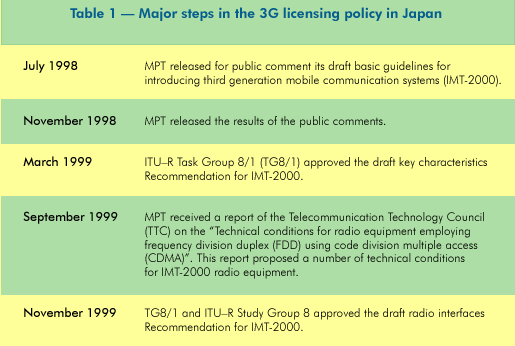
were a number of important stages in the policy-making process for IMT-2000, some of which are summarized in Table 1.
When the Ministry of Posts and Telecommunications (MPT**) released its draft basic guidelines in July 1998 for
introducing 3G mobile communication systems, it received 26 comments from 33 organizations, most of whom were mobile
operators and manufac-turers. On the whole, the respondents agreed with the substance of the basic guidelines. Among the
highlights were the choice of standard, technical conditions and licensing.
|
**With effect from 6 January 2001, the functions of MPT were redistributed to two bodies: the Ministry of Public Management, Home Affairs, Posts and Telecommunications (MPHPT) and the Postal Service Agency. |
Eighteen of the 33 respondents commented that the standard to be adopted by Japan should not be unique, as in the case of the second generation PDC standard. Four of the respondents expressed concern over excluding the cdma2000 system from the list of standards adopted. On the question of licensing, all the 20 respondents opposed the auction method. Twelve of them recommended comparative selection (also known as "beauty contest"), a method whereby a government invites applications that are rated according to some pre-set criteria. Licences are then allocated to those whom the government believes best meet the stated requirements. For example, in Sweden where this method was used, the initial criteria were that: sufficient capital must be available, technical plans must demonstrate reliability, access, speech quality and other service guarantees. Furthermore, business plans must be commercially feasible, and applicants must have suitable experience and expertise.
The main elements of the report, which the Telecommunication Technology Council (TTC) submitted to MPT in September 1999 (see Table 1), are highlighted below. Typically, TTC reports provide the technical basis for ministerial regulation.
Other ITU recommended systems (CDMA/TDD and TDMA) were not included in the report. However, the report did state that
if necessary, these systems would be considered in the future.
|
|
Global circulation of IMT-2000 terminalsIn Japan, global circulation for visiting terminals is covered under the Radio Law according to which each radio station requires a licence to operate. Since a handset is defined as a "radio station", each handset in Japan requires a radio licence under the Radio Law. However, handsets can be covered by an operator's comprehensive or blanket licence such that all the operator's handsets in circulation are deemed to be licensed. The comprehensive licence is valid for a period of five years and for a limited number of handsets.
Photo: PhotoDisc (ITU 010567) The Radio Law also covers the issue of foreign radio stations. To be granted entry to operate within Japan, foreign radio stations, including 3G stations, must comply with the technical standards set out in the Radio Law. However, the actual procedures for demonstrating such compliance are not yet in place and indeed have yet to be determined. Japan is apparently hoping for the possibility of a 3G MoU (similar to the GMPCS MoU), before determining which procedures need to be followed for foreign handsets. In April 2001, a significant breakthrough was made when the European Union and Japan signed a mutual recognition agreement (MRA) for equipment standards on a limited range of products. However, the MRA only covers a few countries and does not address the issue of visiting terminals. Thus, considerable work remains to be done to enable 3G users to roam freely from country to country. |
MPT finalized its policies for the introduction of IMT-2000 and radio station licensing after accepting comments from its public consultation in February 2000. There were no strong objections to any of the proposed policies. One of the concerns expressed related to the equitable treatment of DS-CDMA and MC-CDMA. MPT responded that since both systems are covered by regulation on wireless equipment, treatment would not be discriminatory. Another concern had to do with the lack of consideration given to international roaming. MPT responded that negotiations for roaming would only occur at a later date and that for this reason, it was not cited as a licensing condition. Japan's licensing policy does not oblige operators to roam between different systems because in MPT's view, this should be left to commercial negotiation between the parties.
The policies on the introduction of IMT-2000 were finalized in March 2000, and fixed the number of operators to three per region. New as well as incumbent operators were eligible for these three licences, with the exception of fixed regional operators. Operators were required to cover 50 per cent of the population in the first five years. The policies favoured applicants with know-how of IMT-2000 technologies and systems.
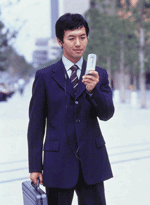
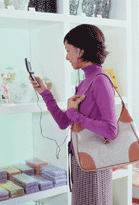


Mobile Internet users can enjoy a range of devices and services. They can download images of cartoon characters,
weather forecasts, news, entertainment, as well as local guides to shops and restaurants
Photos: NTT DoCoMo
Licences could be granted on a regional or nation-wide basis. The policies endorsed the technical conditions outlined in
the TTC report, thereby approving DS-CDMA (or W-CDMA) and MC-CDMA (cdma2000). Third generation mobile operators were to
be chosen through a comparative selection process. The forty-day application period was to begin in April 2000. Service
was to be launched sometime in 2001.
The policies on the licensing of 3G radio stations covered the comparative selection method. Furthermore, the criteria below were to be taken into account during the licensing process if the number of applicants exceeded three:
|
|
|
*Both NTT DoCoMo and J-Phone applied for an extension of the launch date. First, J-Phone announced that it would delay the commercial launch of its services by six months. Then, NTT DoCoMo, expected to be the first operator to launch 3G services in Japan, announced that it would postpone the commercial launch of its 3G FOMA (freedom of mobile multimedia access) service from May to 1 October 2001. Meanwhile, it has been running an introductory FOMA service in the Tokyo area from 30 May 2001 to 30 September 2001 in order to assess system performance and provide customer feedback ahead of the October launch. **Kinki region is also known as Kansai. Source: Adapted from MPHPT.
|
MPT began accepting licence applications in April 2000 for a forty-day period. Only the three incumbent operators (the NTT DoCoMo Group, IDO and Cellular Group (KDDI) and the J-Phone Group) applied for the three available 3G licences in each region and submitted their business plans. The licensing procedure was the same as for other Type 1 operators — the three applicants were required to obtain permission under the Telecommunication Business Law and a licence under the Radio Law. On 30 June 2000, MPT allowed changes to their status under the Business Law and granted preliminary permits for their radio stations under the Radio Law. Upon construction of their networks, these operators were to be duly inspected and licensed by the Ministry.
A modified auction approachLicensing in Hong Kong SAR through a "royalty-based" system The Office of the Telecommunications Authority (OFTA) in Hong Kong has released the rules for the auctioning of four 3G licences in September 2001. OFTA has adopted a hybrid approach that requires bidders to pass a pre-qualification round prior to bidding for the licences. In order to reduce the upfront financial burden on operators, the framework adopted involves a "royalty-based" payment scheme. Each licensee would pay a percentage of its network turnover, and would also be subject to a schedule of minimum payments. The initial reserve price would be 5 per cent of network turnover, with an annual minimum payment of HKD 50 million (USD 6.4 million) for the first five years, increasing annually thereafter (i.e., from year six) for the remaining term of the 15-year licence period. The identity of bidders would be kept hidden during the main bidding stage in order to minimize opportunities for collusion. Notably, the auction rules include the condition that licensees must set aside at least 30 per cent of their network capacity for mobile virtual network operators (MVNO). This condition caused controversy when first announced because operators said that no more than 20 per cent of a licensee's network should be reserved in order to avoid a situation whereby an MVNO could obtain more overall capacity than a licence holder by aggregating capacity from different network owners. Another licence condition is that a 3G licence winner who is also a 2G operator must offer domestic roaming services to new entrants. Source: Total Telecom, "HK operators to bid for 3G licences despite complaints", 19 July 2001. |
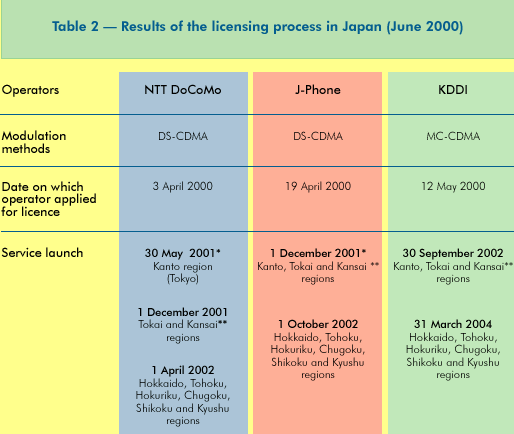
Granting 3G licences in Japan was straightforward: the number of applicants (three) matched the number of licences. The
policies for comparative selection were therefore not invoked. Effectively, there was no contest. As long as the
applications met the basic requirement, 3G licences were granted. Table 2 summarizes the final licensing decision issued
by MPT in June 2000. Licensees are subject to conditions as set out in the relevant legislation and in their business
plans as submitted to the Ministry.
The main reason behind the limitation on the number of licences was the shortage of frequencies. The regulator had a total of 60 MHz available for 3G services (uplink and downlink). This meant that in order to allocate a minimum of 2 x 20 MHz blocks of spectrum, only 3 licences could be awarded. In addition, since PHS operators were occupying the 1.9 GHz spectrum, there was significant concern regarding interference with the 2 GHz spectrum allocated by the ITU World Radiocommunication Conference for 3G services.
A major limitation to the competitive landscape for 3G is the lack of additional radio spectrum for mobile services. The concept of a mobile virtual network operator (MVNO) offers the possibility of introducing new players who stimulate the development of innovative services, improved quality of service and price competition. Mobile operators in Europe, for instance, are considering the provision of network access to MVNOs through commercial negotiations or through regulatory measures.
An MVNO has been defined as an operator that offers mobile services but does not own its own radio frequency. In this respect, it can be a mobile service provider or a value-added service provider. It is to be noted that there are divergent views on how to define an MVNO, and this is one of the current challenges facing regulators, particularly in Europe.
In Japan, the June 2001 amendments to the Telecommunication Business Law introduce the concept of wholesale
telecommunication businesses in an effort to create more flexible networks. In other words, the new provisions allow
Type I operators to offer their network infrastructure to other Type I and II operators on a wholesale basis. The only
regulatory procedure required would be a notification to the Minister. This concept is applicable to the radio spectrum,
as the legislation does not limit it to the fixed-line environment.
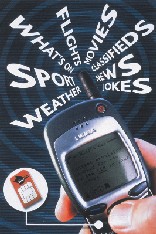
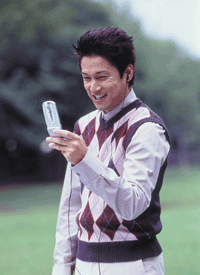
Given the large number of mobile data users, the focus in Japan has now shifted from increasing the uptake of mobile
data to developing the multi-purpose and multi-functional handset
Photo: Nokia (ITU 010574)
In fact, the study group which was set up in July 2000 and which released its final report in June 2001 on "Business models for next generation mobile phones", refers to these amendments as creating incentives for the introduction of MVNOs in Japan. This report endorsed NTT DoCoMo's plans to open up its network to other Internet service providers by 2003. The report also mentions KDDI's plans to open its mobile EZWeb network on a case-by-case basis, albeit without confirming a date. J-Phone has yet to declare an open network strategy but is looking into the possibility. The report stresses the importance of open network access to the expansion and success of future mobile services. It argues that an open network policy will allow new players to enter the mobile browsing market and provide a basis for the development of MVNOs and alternative information providers.
However, the report does include the caveat that since the concept of MVNO is not clearly defined and can refer to various types of businesses, each individual MVNO case is to be examined carefully under the Business Law before determining the appropriate set of regulatory measures. Before these amendments came into force, the United Kingdom's Virgin Group had already announced its intention to enter the MVNO market in Japan in April 2001 (see box).
The first round of licensing 3G mobile services in Japan was a relatively simple matter. Although only the monopoly local fixed-line operators, NTT East and NTT West, were excluded from the process, the government received only three applications for the three available licences. These 3G licences were allocated to the country's three incumbent mobile operators (NTT DoCoMo, KDDI, and J-Phone), covering over 90 per cent of the mobile market. None of these operators had to pay up-front fees — they were only required to pay radio-usage fees in the region of USD 5 per subscriber per year. At every stage leading up to the granting of licences, the government emphasized the importance of transparency of the process and public consultation. PHS operators were financially constrained and the larger PDC operators had been merged into one of the three incumbents.
Like other regulatory authorities such as the Office of the Telecommunications Authority (OFTA) of the Hong Kong Special Administrative Region (SAR) and the United Kingdom's Office of Telecommunications (Oftel), MPHPT is concerned with enhancing competition in the 3G market after the licensing process. MPHPT has been exploring the possibility of allowing market entry to MVNOs, an idea which has been endorsed by the Ministry's study groups. In order to allow new players to flourish in the 3G arena, mobile operators have been encouraged to open up their platforms for mobile Internet access and content provision.
Given the large number of mobile data users, the focus in Japan has now shifted from increasing the uptake of mobile data to developing the multi-purpose and multi-functional handset. In the future, mobile operators will have to be more and more imaginative about the purpose of the mobile phone. In this regard, Japan appears to be ahead of most other countries.