


The reform of the information and communication technology (ICT) sector has fuelled major changes at the regulatory and institutional levels. One of the most striking changes has been the rise of the regulatory agency in the communications sector. There are now 106 telecommunication regulatory agencies in the world, and their number is expected to increase to at least 120 by year-end 2001.
It is one thing for countries to make a policy decision to create an independent regulatory agency, and quite another
to empower the agency to act independently and effectively. Regulatory agencies are not created in vacuums. Inevitably,
they are the products of political, social, legal and economic conditions that exist at fixed points in time in each
country. Nor are these conditions static; regulatory approaches and policies change, and agencies change with them.
|
* Contributed by Nancy Sundberg, ITU/BDT. Tel.: +41 22 730 6100. Email: nancy.sundberg@itu.int). |
There is no textbook for government policy-makers to quote, chapter and verse, in establishing an independent regulatory agency that will achieve their national goals. The means by which each country creates, structures and implements its regulatory body is one of the most important factors in the success of its reform process. Increasingly, then, newly appointed and responsible regulators are searching for models and best practices as guideposts for their own actions.
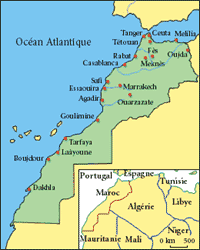
As more and more Member States of the International Telecommunication Union (ITU) ask for references and models in regard to the independence, effectiveness and operation of regulatory agencies, the Sector Reform Unit of the Telecommunication Development Bureau (BDT) has decided to conduct five case studies in this area in 2001. Each of them investigates how the country select-ed has established its regulatory agency and assesses its effectiveness by reviewing its structure, its functions and powers, its financing and its degree of transparency, independence and fairness. This article deals with the first case study, which is Morocco.
Morocco is a developing country with strong traditions and great economic and social contrasts. It has a population of over 29 million, more than half of whom are under the age of 20. Morocco has a modern Post Office and Telecommunications Act, a new Competition Act (which entered into force in July 2001) and a national strategy to make itself a player in the information and knowledge society. But it has not been an easy road.
Morocco seemed entirely appropriate for a case study focusing on the first stage of the telecommunication reform process, in view of the success that the country has achieved in this area and the fact that a number of its practices and procedures can serve as a useful reference for others.

In the space of three years, the national telecommunication regulatory agency, ANRT, had established its
legitimacy, credibility and independence despite institutional and structural constraints.
This photo shows a partial view of the ANRT Head Office in Rabat
(ITU 010074)
The sequence of events in the introduction of reforms in Morocco has undoubtedly played an important role in the success of this initial phase. First of all, a new law regulating the telecommunication sector was adopted, then a regulatory agency was set up, then certain segments of the market were opened up to competition and licences issued, and subsequently the traditional operator was partly privatized. In other words, Morocco made sure it had a proper legal and regulatory framework installed before opening up the market to competition.
In the space of three years, the national tele-communication regulatory agency (Agence nationale de réglementation des télécommunications — ANRT) has established its legitimacy, credibility and independence despite institutional and structural constraints. As soon as ANRT was set up, its first task was to put in place the procedure for awarding the second GSM licence, which was a success in terms of its transparency and openness and the results achieved.
The liberalization and partial privatization of telecommunications has had positive results in several areas. They included the sale of the second GSM licence for USD 1.1 billion and partial privatization of the traditional operator (Maroc Télécom) for USD 2.3 billion. These events were followed by a rapid increase in the number of mobile subscribers, from 116 000 in 1998 to nearly 3 million by the beginning of 2001, exceeding all public and private sector estimates made at the time when the second GSM licence was being awarded. Furthermore, the number of mobile subscribers surpassed that of fixed-line subscribers in 2000.
Implementation of the initial reforms in the telecommunication sector did not come without effort. The debate that began in 1984 finally reached a conclusion in 1996 with the adoption of Law 2496 on telecommunications. Under the aegis of the late King Hassan II and senior State officials, this initial set of reforms was then able to see the light of day.
A sweeping restructuring of the sector has been carried out in three stages (see Figure 1). It essentially consisted in splitting the national post office and telecommunication agency (Office national des postes et des télécommu-nications (ONPT)), into two separate entities — a telecommunication entity called Itissalat Al Maghrib S.A. (Maroc Télécom) and a postal entity called Barid Al Maghrib (Postes Maroc) — and establishing an independent regulatory body, ANRT. Under this legislation, ANRT is now responsible for implementing telecommunication policy, administering the application of laws and regulations with respect to all those involved in the telecommunication sector and resolving disputes.
The reforms are currently moving ahead swiftly, and will extend to all sectors of public infrastructure (energy, postal services, transport, etc.). These reforms, including the establishment of a credible and independent regulatory agency, backed by the political will that has been evident in regard to their implementation and monitoring at the government level, have enabled Morocco to take its place on the international stage and gain a reputation as a stable country with clear rules and a high level of confidence. At the economic level, this has manifested itself in the form of major investments by foreign firms in Morocco's telecommunication market.
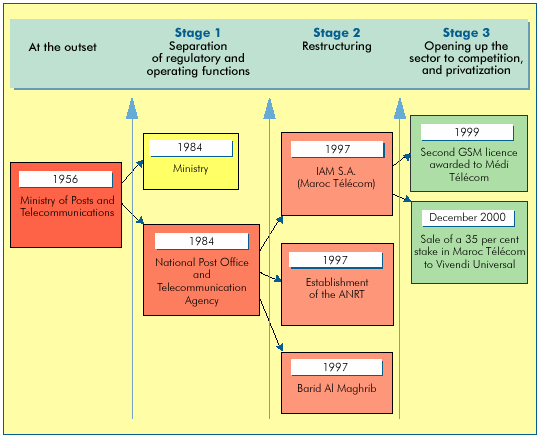
Figure 1 – Reforms and gradual deregulation in Morocco
Source: Adapted from ANRT.
The results achieved so far have served to reassure anyone who at the outset might have been resistant to change and to the need to establish a telecommunication regulatory agency.
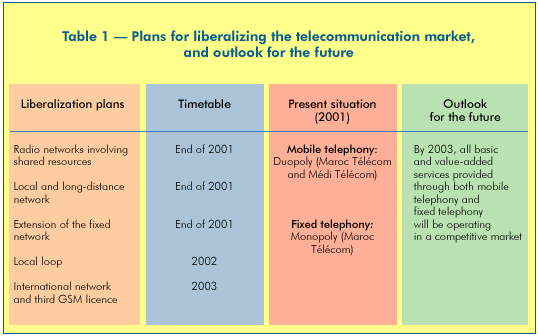
Now that Morocco has successfully established a regulatory agency that is effective, credible and legitimate in discharging its technical regulatory functions, the country is about to embark on a critical stage in its development. In this second stage, ANRT will have to demonstrate its effectiveness and ability in regulating competition, as basic services are liberalized (see Table 1).
An analysis of the effectiveness of ANRT (www.anrt.net.ma) in the field of communications, reviewing its organizational structure, its financing, its functions, mandates, powers and capacities from the standpoint of transparency, independence, fairness and receptivity is available at www.itu.int/itud/treg/. This case study provides Morocco's reply to all the following questions, which apply to any regulatory agency:
|
|