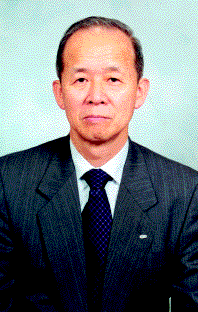
Yasuhiko Kawasumi
Vice-Chairman
Telecommunication Development Advisory Group (TDAG)
Introducing voice and multimedia communication services to rural areas — especially in the developing countries — is one of today's greatest challenges for governments, operators and industry. Within the ITU Telecommunication Development Sector (ITU–D), a Task Force of Focus Group 7* is working hand in hand with the Telecommunication Development Bureau (BDT) to find solutions to this challenge. The Task Force is a follow-on committee to the 1999/2000 Focus Group on Rural Applications known to many simply as FG7.
FG7 recently released a major report entitled "New Technologies for Rural Applications". After a year and a half of work, mainly conducted over its website (www7.itu.int/itudfg7), FG7 had collected some sixty case studies from around the world. The FG7 report is based on the analysis of these studies, and recommends new technologies for rural applications such as telemedicine, distance education, community and small business development, emergency support, disaster relief and environmental monitoring. It presents six recommendations to BDT, which should serve to accelerate the development of rural communications as a means of bridging the digital divide. In essence, the recommendations highlight the need for BDT to:
The report also provides guidelines for designing ICT systems for the rural areas of developing countries.
|
*Focus Group 7 was set up in April 1999 by TDAG with the mandate to study ways of promoting the development of new telecommunication technologies for rural applications. FG7 derives its name from Topic 7 of the World Telecommunication Development Conference (Valletta, March 1998). It works under the auspices of Study Group 2 of ITU–D. |
The FG7 report recommends "packet-based wireless technology combined with Internet protocol (IP) routers" as being suitable for the rural areas of developing countries for a number of reasons. For example, packet-switched networks break up the data to be transmitted and send them in the form of packets, along various routes, to their destination. Packet-based networks have certain advantages over traditional circuit-based networks. One advantage is that breaking communication down into packets allows the same data path to be shared simultaneously among many users in the network. This type of communication between sender and receiver is known as a connectionless service (as opposed to a dedicated one). Most traffic over the Internet uses packet switching, and the Internet is basically a connectionless network. Voice calls using the Internet's packet-switched system are possible. Contrasted with packet-switching is circuit-switching technology where, for example, the regular voice telephone network in which the communication circuit (path) for the call is set up and dedicated to the participants in that call. For the duration of the connection, all resources on that circuit are unavailable for other users. In a relatively short time, packet-based networks have become the platform of choice for new telecommunication networks.
GlossaryTCP/IP Transmission control protocol/Internet protocol. OSI Open systems interconnection. The OSI model classifies data transfer protocols in a series of layers. It sets worldwide standards of design for all data telecommunication protocols, ensuring interworking capability of equipment provided by different manufacturers. |
Wireless refers to telecommunication in which electromagnetic waves, rather than wires, carry a signal over the communication path. Wireless infrastructure can be divided broadly into four categories, namely: portable wireless, mobile wireless, fixed wireless, and infra-red wireless. Wireless technology is evolving rapidly and is viewed, at present, as one of the most important tools for reducing the digital divide. Wireless infrastructure provides faster roll-out times, lower maintenance costs and greater network flexibilities. FG7 identified, through its case studies, ten types of wireless access systems, illustrating existing and emerging access options for rural communities.
A wireless router is a device, or in some cases, software in a computer, that determines the next network point through which a packet should be forwarded to its destination. The router is connected to at least two networks and decides which way to send each information packet, based on its current understanding of the state of the networks to which it is connected. A router creates or maintains a table of the available routes and their conditions and uses this information, along with distance and cost algorithms, to determine the best route for a given packet. It is technologically possible, using available products, to establish an access network in rural and remote areas using routing technology.
Router-based local access networks using TCP/IP and transport layers (OSI layers 3 and 4) can be interconnected with the public switched telephone network (PSTN) using gateways that comply with ITU–T Recommendation H.323. Real-time voice calls can be transmitted at any quality over closed router networks with the use of voice over IP (VoIP) software. The quality of service can be maintained on a properly configured and managed network because traffic is controlled from the subscriber to the PSTN gateway by a single service provider. In this way, a router-based access network using IP is more analogous to a local area network (LAN) than to the global Internet. When combined with wireless technology in the local loop, such a network may provide an affordable and sustainable solution for rural areas, particularly when the primary services delivered over the network employ multimedia.
The wireless router provides circular coverage with a radius of up to 5 km when configured in compliance with certain regulations on frequency use and maximum transmission power (this is dependent on country regulations). In general, if higher power is allowed, the wireless reach can be much longer. Some manufacturers have designed their wireless routers for usage in the 2.4 GHz band allocated to industrial, science and medical (ISM) services.
Service providers in rural areas often lack sufficient data to assess accurately the demand for services in a given region. Modular systems that allow the network to expand as needed, and at the lowest incremental cost are, therefore, preferable. Since rural networks can serve anywhere from a few tens to thousands of subscribers, scalability is also an extremely important economic consideration.
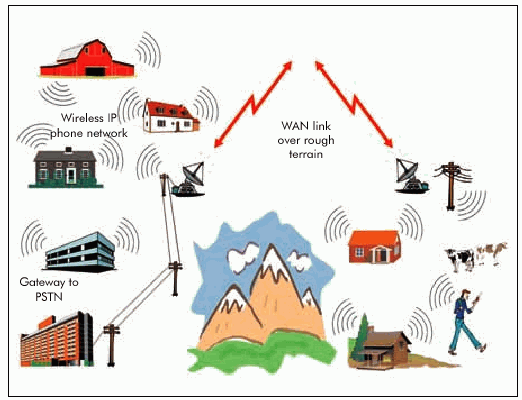
Wireless IP-Based networks at PSTN edge
Source: KDD
One of the most successful technology strategies for minimizing operation and maintenance costs of rural installations has been the shift from network functions to remote management systems. Travel to rural areas for network configuration, maintenance and repairs increases the risks and expenses for network operators.
Rural communities often lack the technical skills needed to install, configure and upgrade software on a typical personal computer (PC). This makes it difficult to promote effective and broad-based use of Internet resources. Computers and thin clients**, which can be managed over communication lines, can help reduce the cost resulting from poor maintenance, as well as the high failure rate associated with training rural inhabitants in the complexities of PC hardware and software configuration.
The end users of connectivity-based services in the rural areas of developing countries may be unfamiliar with telephones, computers and technology in general. A certain proportion of potential users will be illiterate or semi-literate, and they may have cultural behaviour which makes it difficult to use certain types of user interfaces. Input and output mechanisms incorporating icons, voice-based instructions, choice of language and text may improve usability for rural customers, and hence revenue generation for service providers.
Unlike business and consumer markets in developed countries, rural markets in developing countries cannot sustain rapid turnover of equipment every two to three years. Most systems will take at least three years to recover initial investment, others will take much longer than that. Equipment designed for deployment in the rural areas of developing countries should be durable, rugged and future-proof to the extent possible. Provisions must also be made for servicing, repairing and providing spare parts for the equipment over at least five to ten years.
|
** Thin client, when applied to computing devices, generally indicates a client with reduced processing or overall computing capabilities. |
The developed-country standard of a telephone in every household — and a computer on every desktop — is much too costly for the income levels in the rural areas of developing countries. As a result, many countries have encouraged the development of local phone shops and multi-purpose community telecentres (MCT) where villagers can access telephones, e-mail, educational media, training courses, telemedicine, and other related services on a pay-as-you-go basis. Telephones and information technology devices installed in shared facilities may require metering functions, software to manage multiple accounts or users, and other specialized payment or billing.
A wide variety of actors are involved in the design of applications and information technology (IT) networks in rural areas. Governmental, educational, international and non-governmental organizations in developing countries routinely design and implement IT projects to support their own applications. As a result, it is even more important, now and in the future, that equipment used in rural and remote areas conforms to standards approved by ITU and other recognized standards-setting bodies. Software applications should support open protocols applicable to OSI layers 3 and higher, and should comply fully with relevant ITU Recommendations on LAN/PSTN interconnection.
Since many rural areas are not connected to their country's main power grids, power requirements are a critical consideration in selecting technology for them. Devices should be designed for minimal power consumption, efficient power management, compatibility with off-grid and renewable energy systems, and other energy-conserving features.
The FG7 Task Force is lending its support to BDT in following up the recommendations listed at the beginning of this article. Already, the Task Force has drawn up a pilot project model designed to test the use of wireless, packet-based communication technologies in delivering multimedia applications to rural areas. Access technologies meeting this description will be tested in rural areas, under the leadership of BDT, in order to begin assessing their capability to deliver voice, facsimile, text, image, audio and video communications cost effectively in rural areas in an affordable and sustainable manner.
As a first phase, pilot projects will be constructed in five countries to be selected from Africa, Asia, Latin America, Arab States, and the Commonwealth of Independent States (CIS). In this regard, the Task Force has drawn up a Request for Proposals on pilot projects to build packet-based wireless IP networks in rural areas and to spur the spread of Internet services. In addition, it has developed criteria for selecting locations for such pilot projects.
BDT invites project proposals from developing countries in response to the pilot project model document, which is now available from each ITU regional office and from the Bureau's main office in Geneva. This document was also presented to regional preparatory meetings in Bali (April, 2001) and in Yaoundé (May, 2001), and will be presented to the forthcoming meeting in Trinidad and Tobago (October, 2001) to encourage interested countries to send in their applications. The expectation is to expand pilot projects to an even larger-scale programme in the next phase.
Meanwhile, BDT is mobilizing the necessary funds and resources from within and outside ITU to support the pilot projects, which are directed at bridging the digital divide. Administrations of developed countries, major ITU Member companies, United Nations agencies and other related organizations and institutions are invited to respond to the BDT initiative. This is the first step towards a universal fund to be launched by ITU to promote accessibility to Internet services with multimedia service capabilities in the rural and remote areas of developing countries.
The International Telecommunication Union and the Australian National Office for the Information Economy (NOIE) have signed a Memorandum of Understanding (MoU) to enhance the training of the Asia-Pacific region's policy-makers, administrators, regulators and corporate directors in managing telecommunication networks and services. This training will be offered through the ITU Asia-Pacific Centre of Excellence (CoE) project.
Under the terms of the MoU, the Australian Communications Authority (ACA) will share its knowledge and expertise in telecommunication regulation with the developing countries in the region. The Australian Government will underwrite the CoE financially for a period of six months and has further agreed to transform ACA's training material from lecture notes into visually-rich, online multimedia products that are appealing and easy-to-use. It will also develop downloadable training modules suitable primarily for senior managers and executives drawn from the region's private and public organizations in the information and communication technologies (ICT) sector.
"Transfer of knowledge is one of the keys to unlock human capacity in our sector," said Hamadoun Touré, Director of the ITU Telecommunication Development Bureau (BDT). "Through this agreement to diffuse the benefits of its unique experience in liberalization, Australia is contributing to efforts deployed for bridging the regional divide in ICT-readiness," he also remarked.
"The development of all is to the benefit of all," said Richard Thwaites, NOIE's General Manager, International. "We are committed to assisting in the development of infrastructure and expertise, particularly with our neighbouring countries with whom we have economic and trading relationships. ITU, notably through its recent regional Centres of Excellence initiative, is an effective partner in this process."
The first training module will be on the subject of numbering. The finished product will include Web pages with a unique look and feel that will be replicated throughout the training modules.
"By applying creative design and technology to existing training materials, the project aims to make the content more appealing so as to retain the interest of users and to enable them to quickly understand and absorb the topics and issues," said Arthur Morse, Project Manager of the Asia-Pacific Centre of Excellence. The region's cultural, linguistic and developmental diversity will be taken into account during the preparation of the on-line training modules.
The Asia-Pacific CoE project was initiated by BDT in early 2000 to establish a virtual regional network of research and training centres, which are run by governments or academic institutions. It provides Web-based courses and programmes on policy, legal and regulatory aspects in the ICT sector. The CoE was set up with surplus funds from ITU Telecom events in collaboration with partners such as the Office of the Telecommunications Authority (OFTA) of the Hong Kong Special Administrative Region (SAR) and the Infocomm Development Authority of Singapore (IDA).
ITU and Waseda University (Japan) sign MoU to enhance technology transfer in the Asia-Pacific regionA Memorandum of Understanding was signed on 1 August 2001 between ITU and the Waseda University in Tokyo to bolster human resources development and research in information and communication technologies (ICT) in the Asia-Pacific region.The MoU was signed at the Waseda campus by Yoshio Utsumi, ITU Secretary-General, and Takayasu Okushima, President of Waseda University. Under the terms of the MoU, Waseda University will provide academic expertise and technical assistance and share its knowledge in new technologies and distance learning — a field in which it has implemented projects with several neighbouring countries. Beneficiaries of this new cooperation will be primarily senior managers and executives drawn from private and public organizations in the region's ICT sector. More than 100 dignitaries attended the signing ceremony. Among them were several Congressmen, top officials of the Ministry of Public Management, Home Affairs, Post and Telecommunication including Kaoru Kanazawa, Vice-Minister for Policy Coordination (International Affairs) and Koichi Uchida, Director-General of the International Affairs Department, as well as CEOs of major corporations including Akira Shiomi, President of ANRITSU Corporation and Yutaka Hayashi, President of the Communications Industry Association of Japan. "This partnership between ITU and an academic institution brings a new dimension towards creating an environment in which relevant information and knowledge may be more readily accessed and exchanged," Mr Utsumi said during the signing ceremony. He went on to add that in today's global and networked economies, knowledge is a main weapon of success. "To enable developing economies to compete fairly in this new environment, human resources development must be improved in quantum terms. Training institutions working hand in hand with ITU in a collaborative venture is clearly a promising and concrete way to make headway." Established in 1882, Waseda University is a private institution with 50 000 students. The establishment boasts academic exchange agreements with 300 universities and research institutes in some 50 countries. "Our University's global partnership with ITU, as well as with industry and government, is expected to be most beneficial to participants in meeting the challenge of education and research in ICT," said Mr Okushima. As a first step in this partnership, the Global Information and Telecommunication Institute (GITI) of Waseda University will organize a workshop in Tokyo in November 2001 on new trends in ICT technology for regulators and policy-makers. |