ITU TELECOMMUNICATION INDICATOR UPDATE


MOBILE ON THE EVE OF 3G


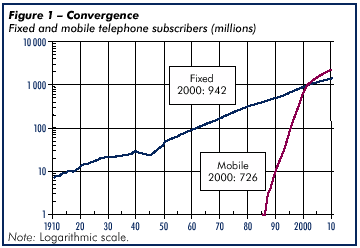
At the start of the last decade, there were just over 10 million mobile cellular telephone subscribers around the world. This figure had grown by almost 70 times to over 725 million or one mobile phone for every eight inhabitants at the beginning of 2001. The mobile phonebook shows little sign of slowing as the number of subscribers added grows each year – there were 234million new mobile subscribers in the year 2000. Growth has been steady at an average of 50 per cent per year since 1996. The introduction of second-generation networks such as GSM sparked an increase in mobile growth. Will third generation (3G) networks, planned to be launched this year, also push up mobile growth?


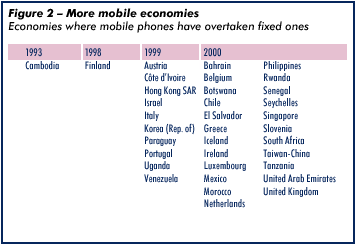
At current growth rates, the number of mobile subscribers will surpass that of fixed telephones in the middle of this decade (see Figure 1). There are 35 markets – both developed and developing – where this transition has already taken place (see Figure2). The mobile phone is becoming away of life for many, transcending the limitations of fixed telephones. One phenomenon is that fixed household telephone penetration is holding steady or even dropping as users opt for mobiles.
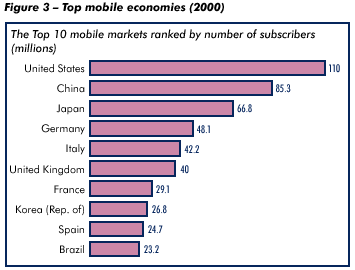
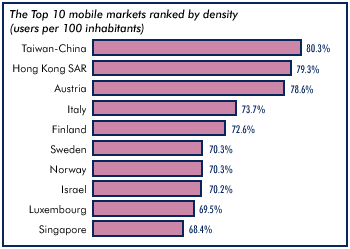
In Finland, the percentage of households with a fixed telephone has dropped from 94 to 83 over the last ten years while that of mobile phones has increased from 7 to 60. In developing countries, competition and pre-paid cards are proving a potent combination for driving mobile growth. The rise of mobile in developing countries is perhaps most powerfully conveyed in the fact that based on current growth, China will surpass the United States and emerge as the world's largest cellular market sometime this year (see Figure 3). Unlike fixed telephone penetration, which generally peaks at around one telephone for every two inhabitants, mobile penetration has not yet reached an upper limit. The highest mobile penetration is found in Taiwan-China (see Figure 3). Ten years ago it had less than 100 000 mobile phones; today four out of every five Taiwanese has one. Mobile penetration increased by 25 points in 2000 among the top ten most wireless economies. At that rate, most adults will soon have at least one mobile phone.


MOBILE INTERNET

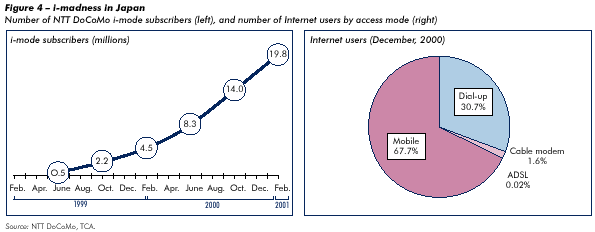
There are a variety of Internet-like applications available for today's mobile phones. The introduction of the second generation GSM mobile phone brought a simple but popular application called Short Message Service (SMS), which allows text messages to be sent from one telephone to another. This e-mail for telephones has proven popular for market segments ranging from youngsters to the hard of hearing. According to the GSM Association, in the month of January 2001 alone, some 15 billion messages were sent around the world, for an average of 30 per GSM subscriber. This is almost quadruple the 4 billion sent in January 2000. The Wireless Application Protocol (WAP), which was commercially launched by many operators in 2000,allows mobile phones to browse the Internet. Users access websites specially adapted to fit the screen size of a mobile phone. By the end of 2000, over 100 mobile operators had launched WAP. According to the WAP Forum, there are some 10 000WAP sites in 95 countries. Although there are around 50 million WAPphones in circulation, there were less than 5 million users at the end of 2000. WAP has been plagued by a number of problems including a shortage of handsets, slow speed and a lack of applications. The tepid acceptance of WAP contrasts markedly with Japan's mobile Internet experience. Japan was the first country in the world to launch mobile Internet services when NTTDoCoMo started its i-mode service on 22 February 2000. In one year, there were five million subscribers. Six months later, this number had more than doubled. At the end of March 2001, some 22 million people were using i-mode. There are two other mobile Internet services in Japan, EZWeb and J-Sky, operated by competitors of NTT DoCoMo.The three services had 35 million subscribers between them in March2001, with almost 70 per cent of all Japanese Internet surfers logging in from a mobile (see Figure 4). Indeed, NTT DoCoMo is now the world's second largest Internet Service Provider (ISP), after America Online. One of the attractions of i-mode is that, unlike WAP, HTML-based web-sites can be easily adapted. There are 1600 sites on NTT DoCoMo'si-mode portal. In addition, there are some 40 000 i-mode compatible sites. Another i-mode success factor is that it is "always on" and priced according to information retrieved and not usage time.

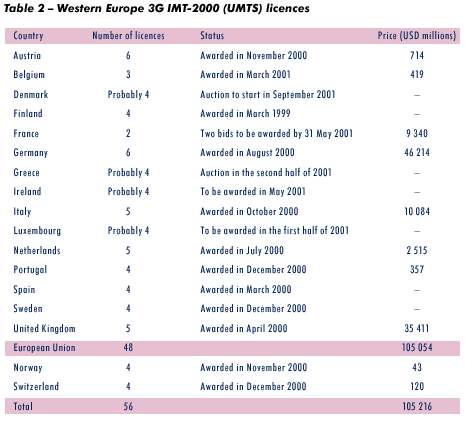
The industry is now on the verge of another breakthrough to so-called third generation mobile networks. This milestone is significant for two reasons. Firstly, it marks the first time that there will be a global standard for mobile networks. Up until now, mobile systems have been based on a variety of national and regional standards with no less than a dozen different ones in operation around the world today. This has had a detrimental effect on compatibility and prices. Secondly, the new 3Gnetworks will support broadband Internet access. The 3G standard goes by the ITU name IMT-2000. Adopted by the world telecommunication community in November 1999, IMT-2000will support high bandwidth including a minimum speed of 144 kbit/sand 2 Mbit/s under low mobility environments. The European Union has been an early advocate of 3Gnetworks and called upon its members to rapidly license the system and launch networks by a target date of January 2002. Most Western European countries awarded licences in 2000 (see Table 2). In Asia, NTT DoCoMo intended to be the first operator in the world to launch 3G services and was granted an IMT-2000 licence in June 2000.Although the operator widely publicized plans to be the first to start a service in May 2001, it will instead begin with a test launch – commercial operation has been postponed until October 2001.

MOBILE BUSINESS

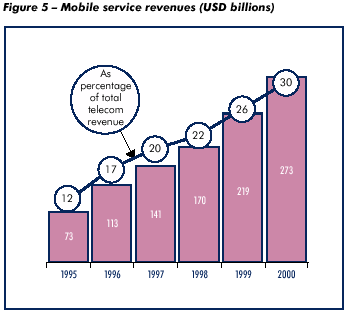
The value of mobile in the overall telecommunication market is growing. In the year 2000, mobile revenues were USD 273 billion, accounting for almost one-third per cent of the total worldwide telecommunication revenues (see Figure 5). On average, a mobile cellular subscriber generates revenue of USD 39 per month.  

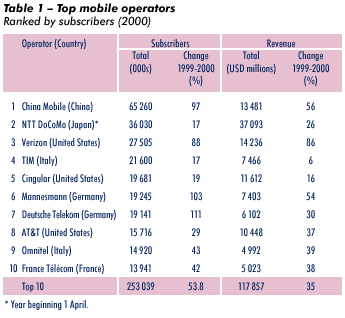
The launch of IMT-2000 networks will add to the globalization of the mobile industry. This is because, for the first time, there will be a world standard, enhancing roaming and interoperability. The industry has continued to witness growing mergers, acquisitions and partnerships and these are likely to intensify as operators move to create global networks. Two of the top ten national mobile operators in 2000 are new (Verizon and Cingular) and result from the merger of North American cellular companies. Two others, Mannesmann and Omnitel, belong to the Vodafone group (see Table 1).Another indicator of the emergence of mobile is that there are now more mobile subscribers than personal computers or Internet users in the world. With the advent of mobile Internet, will this mean that every mobile subscriber will also be an Internet user? This must be what mobile operators are gambling on, especially in Europe where USD 105billion has been spent on acquiring3G licences (see Table 2).


SINGAPORE COUNTRY PROFILE

 
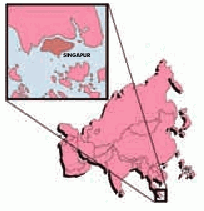
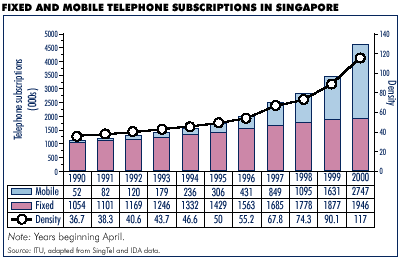
The Republic of Singapore – derived from a Sanskrit word meaning "Lion City" – consists of a main island 660 km Singapore's census counted almost four million inhabitants in June 2000. This diverse country includes Chinese (77 per cent), Malay(14 per cent) and Indian (8 per cent) ethnic groups. English is widely spoken and is the official language in government. Singapore has one of the most advanced telecommunication networks in the world with very high levels of access. This has been possible due to the small size of the country – essentially a large city –as well as rising levels of income. For example, in 1970 Singapore's per capita income was under USD 1000,ranking it 33rd. By 1998 this figure had risen to almost USD 25 000, making Singapore the eighth richest country in the world. The telecommunication market has been characterized by progressive liberalization from a State-owned monopoly provider to full competition. The incumbent telecommunication operator – Singapore Telecommunications Limited (SingTel) – was partly privatized in October 1993. The launching  of a second mobile cellular operator – Mobile One – took place in April 1997. In order to introduce a fixed-line competitor, SingTel was compensated for bringing forward the expiry of its fixed monopoly from 2007 to 2000. The second fixed and  was licensed in 1999. In January 2000, the government announced that the telecommunication market would be fully opened to competition in April 2000. SingTel and StarHub were compensated for this change. Practically every household in Singapore has a fixed telephone, 18.9 percent have a second line and over half have a mobile phone. In July 2000, the number of mobile-phone subscribers surpassed that of fixed telephone line subscribers. The island's three cellular operators have launched mobile Internet services based on the Wireless Application Protocol (WARP). In April 2001, the industry regulator – the Infocommunications Development Authority of Singapore (IDA) – awarded third generation mobile spectrum to all three incumbent mobile operators. 

Singapore is deep into cyberspace. A 1999 IDA survey found that 42 percent of Singaporean households had Internet access, one of the highest home penetration rates in the world. In December 2000, there were 1.9 million dial-up Internet subscriptions for a penetration rate of 48.3 per cent. This figure includes "free" Internet subscriptions where users only pay for telephone usage charges. SingTel has provided each of its telephone subscribers with an Internet account so, theoretically, every home with a PC and modem has access to the Internet. IDA is actively promoting broadband Internet through the nationwide Singapore One backbone. Almost all homes are broadband "ready". By the end of 2000, the country had some 70 000 high-speed ADSL (asynchronous digital subscriber line) and cable modem subscriptions and over 250 000 broadband Internet users. Singapore is one of the ITU Internet Case Studies. Additional information is available at www.itu.int/ti/casestudies.


For more information or comments on the UPDATE, please contact: 
ITU/ BDT, Telecommunication Data and Statistics, 
Place des Nations, 
CH- 1211 Geneva 20 (Switzerland). 
Tel.: +41 22 730 6090. 
Fax: +41 22 730 6449. 
E-mail: indicators@itu.int.


Back to top