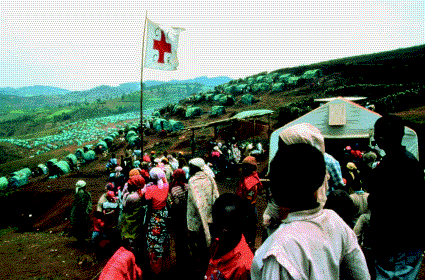
Photo: CICR/I. Gassman(ITU 970052)
Communication links are almost always disabled and disrupted during the first hours of natural disasters. This loss of communications is in itself a disaster. Very quickly, the areas hit by a disaster find themselves cut off. For relief operations, this is an equation with several unknowns. When relief workers arrive on the scene, there is an urgency to establish effective and comprehensive communication links between the affected area, national disaster response facilities, and with the larger international community.
Access to information is paramount. Relief agencies need to know: how many people have been injured or are dead; how many need medical help or transportation to medical facilities; where the people trapped in damaged buildings may be; and where search and rescue teams are most needed. All of this calls for tremendous international cooperation on different fronts. ITU's own mandate in disaster communications is to promote the adoption of measures for ensuring the safety of life through telecommunication services.
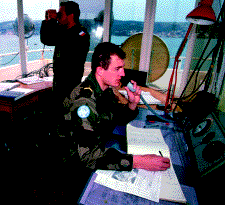
From 28 to 30 May 2001, Tampere, the third largest city in Finland, will host the second Conference on Disaster Communications (CDC-2001) under the patronage of the Finnish President, Tarja Halonen. CDC-2001 is open to participants from all sectors concerned with the application of telecommunications to disaster mitigation and response operations. These include: humanitarian organizations, such as United Nations agencies, the Red Cross movement, as well as national, regional and intergovernmental and non-governmental organizations (NGO); national and international regulatory authorities; private sector enterprises, such as national and multinational telecommunication service providers and manufacturers of telecommunication equipment, as well as other experts from all these fields and from the academic sector.
Much has been achieved since the United Nations proclaimed the 1990s the "International Decade for Natural Disaster Reduction (IDNDR)" and organized the International Conference on Disaster Communications in Geneva in 1990. But a lot remains to be done. The CDC-2001 agenda (see programme on pages 18-19) highlights the need for cooperation among all those involved in improving disaster preparedness and response. The much-needed interconnectivity among the communication networks of all partners can only be achieved if users and providers of these networks and tools work together, and if the regulatory framework allows the unhindered use of all appropriate communications. Once again, the Tampere event is expected to provide a way forward.
Built between two beautiful lakes, the city of Tampere has, over the past 10 years, become synonymous with international gatherings on telecommunications for humanitarian assistance. The first of these gatherings was the Tampere Conference of 1991, which resulted in the adoption of the first Declaration on Disaster Communications. This landmark declaration is a statement of experts from major humanitarian organizations, regulatory authorities and the private sector. It became the foundation of all subsequent work towards an international treaty to allow the unhindered use of telecommunication technology in international disaster response.
In particular, the Tampere Declaration called on ITU Member States to take all practical steps to facilitate the rapid deployment and effective use of telecommunications equipment for disaster mitigation and disaster relief by reducing, and where possible, removing regulatory barriers and strengthening transborder cooperation between countries.
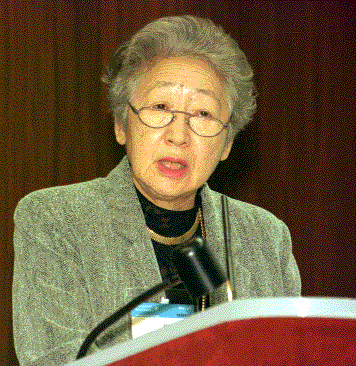
The combined efforts of the ITU and the United Nations Office for the Coordination of Humanitarian Affairs (OCHA) led to the adoption of the Tampere Convention on the Provision of Telecommunications for Disaster Mitigation and Relief Operations, an international treaty, deposited with the United Nations Secretary-General. As part of its name suggests, this treaty was adopted in Tampere at the Intergovernmental Conference on Emergency Telecommunications in 1998 (ICET-98). The Tampere Convention was opened for signature in New York on 22 June 1998, and will remain open until 21 June 2003. Under international law, the Convention will officially come into force 30 days after an official ratification or "consent to be bound" has been received from 30 countries. As at 15 March 2001, the Convention had been signed by 48 Member States and ratified by eight. This treaty is particularly important for humanitarian organizations, which rely heavily on telecommunications equipment to coordinate the complicated logistics of rescue operations.
Very often, the transborder use of telecommunication equipment is impeded by regulatory barriers that make it extremely difficult for humanitarian organizations to import and rapidly deploy such equipment without the prior consent and approval of the relevant local authorities. These organizations include OCHA, the United Nations High Commissioner for Refugees (UNHCR), the International Committee of the Red Cross (ICRC) and the International Federation of Red Cross and Red Crescent Societies (IFRC). The Convention, among other things, aims to reduce administrative formalities of all kinds (licences, customs, charging, etc.) and to promote the drawing up of national plans and inventories of telecommunication resources to be deployed in the event of a disaster or emergency.
Like the 1991 conference, CDC-2001 is expected to come up with a statement of experts in the form of recommendations,
and will provide an excellent opportunity for governments to sign and ratify the Tampere Convention.
|
- For registration and payment for CDC-2001, please contact: Internet address: www.tavicon.fi/english.htm - For further information on CDC-2001, please contact: |

|
"First, the Convention puts in place a structure for managing requests for telecommunication assistance and for minimizing the impediments to that assistance before disasters occur. Second, it creates mechanisms for identifying and evaluating best practices, model agreements, and other valuable resources currently in use by disaster mitigation organizations - public and private - and for developing new ones where needed. Finally, the Convention contributes the force of multinational moral persuasion to the importance of this subject and to the people involved in disaster mitigation relief. It recognizes publicly that telecommunications are essential to dealing with disasters, not just because reliable telecommunications are a critical underpinning of all other mitigation and relief efforts."
Professor F. Cate, Advisor to the Chairman of the Intergovernmental Conference on Emergency Telecommunications (ICET-98), Tampere, 16-18 June 1998. |
|
The Tampere Convention |
||
 |
|
|
|
The United Nations Secretary-General is the Depositary of the Convention. |
||
|
The United Nations Emergency Relief Coordinator is the Operational Coordinator under the Convention, working closely with the International Telecommunication Union. |
||
|
For further information on depositary matters (signature, ratification, acceptance, approval or
accession), please contact: |
 |
|
|
HOW TO SIGN / RATIFY this convention |
||
|
Proper full powers are required by all persons seeking to sign a treaty deposited with the Secretary-General of the United Nations or to make a reservation upon signature, except Heads of State or Government, or Ministers of Foreign Affairs. | |
Full powers should: |
||
|
||
| As already stated, full powers are not required where the Head State or Government or the Minister of Foreign Affairs signs in person. Furthermore, where general full powers have been issued to a person and have been deposited with the Secretariat in advance, specific full powers are not required. | |
|
| It is advised that, whenever possible, full powers should be submitted for verification to the Treaty Section of the United Nations in advance of the intended date of signature. | ||
Here is a sample of an instrument of full powers:
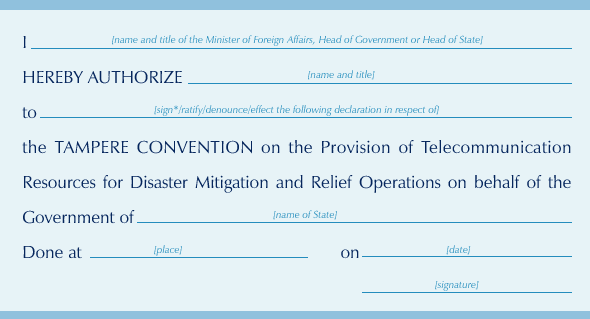
| * Subject to the provisions of the treaty, one of the following alternatives is to be chosen: [subject to ratification] or [without reservation as to ratification]. |
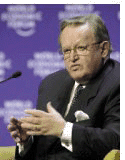
"Finland's engagement in relief efforts around the world, combined today with our expertise in
telecommunications, has given us an understanding of how fundamentally important a functioning telecommunications
system is in any emergency situation."
Martti Ahtisaari
Former President of the Republic of Finland, patron of ICET-98.
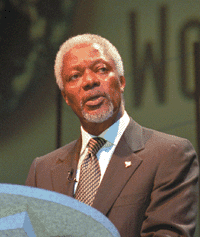
"Humanitarian work is one of the most important, but also one of the most difficult tasks of the United Nations. Human suffering cannot be measured in figures, and its dimensions often surpass our imagination, even at a time when news about natural and other disasters reaches every corner of the globe in next to real time. An appropriate response depends upon the timely availability of accurate data from the often remote and inaccessible sites of crises. From the mobilization of assistance to the logistics chain, which will carry assistance to the intended beneficiaries, reliable telecommunication links are indispensable."
Kofi A. Annan
Secretary-General of the United Nations.
An extract from the ICET-98 Guide, Tampere, 16-18 June 1998.
Published by
International Telecommunication Union
Place des Nations
CH-1211 Geneva 20
Switzerland
Telephone: + 41 22 730 6039
Fax: +41 22 730 5939 / 733 7256
E-mail: pressinfo@itu.int
| 1991 |
|
| 1994 |
|
| 1994-1997 |
|
| 1996 |
|
| 1997 |
|
| 1998 |
|
| 2000 |
|
| Monday, 28 May 2001 |
|
09h30–10h15 |
Opening statement |
10h15–10h30 |
Working procedures and organization of the
conference |
|
10h30–11h00 |
Keynote speeches |
| Theme 1: | Users view on disaster reduction, disaster response and disaster recovery. Experiences, needs, existing tools of communication |
|
11h30–12h00 |
The role of United Nations This presentation highlights the different
missions of the United Nations from the perspective of telecommunications |
14h45–15h15 |
When the worst happens |
|
12h00–12h30 |
The role of voluntary organizations |
15h45–16h15 |
After the Worst has happened: Return to Normal |
|
14h00–14h45 |
Two views on crisis management Two presentations illustrate the complexities of international crisis management and the necessity of reliable and flexible communication methods |
16h15–16h45 |
Advance planning of disaster communications |
|
|
16h45–17h00 |
Discussion |
| Tuesday, 29 May 2001 |
| Continuation of Theme 1: | Users view on disaster reduction, disaster response and disaster recovery. Experiences, needs, existing tools of communication |
|
09h00–10h00 |
Regional profiles |
10h00–10h30 |
Response preparedness |
| Theme 2: | Technology issues. How can technology respond to the needs? Equipment manufacturers, telecommunication operators and interest groups report how their products and services can be used to prevent, respond to and recover from disasters |
|
11h00–11h15 |
Conventional PMR |
12h15–12h30 |
Radio amateurs |
|
11h15–11h30 |
TETRA |
14h00–14h15 |
Global satellite networks for personal communications |
|
11h30–11h45 |
2nd generation cellular networks |
14h15–14h30 |
Regional satellite networks |
|
11h45–12h00 |
IMT-2000 |
14h30–14h45 |
The benefits of an open protocol |
|
12h00–12h15 |
What can HF radio offer in the future? |
14h45–15h00 |
Can the Internet provide the interconnectivity? |
| Theme 3: | Regulatory issues. Standardization of systems. Provision of frequency spectrum. Are there regulatory constraints? What can be done to alleviate difficulties? |
|
15h30–16h00 |
The Tampere Convention |
16h00–16h30 |
World Radiocommunication Conferences |
|
16h30–17h30 |
Discussion |
| Wednesday, 30 May 2001 |
| Continuation of Theme 3: | Regulatory issues. Standardization of systems. Provision of frequency spectrum. Are there regulatory constraints? What can be done to alleviate difficulties? |
|
09h00–09h30 |
Global Standardization |
10h00–10h30 |
Global circulation of radio terminals |
|
09h30–10h00 |
Public Safety Partnership Project What is this project? Members, work plan and
estimated outcome are explained |
||
| 11h00–12h30 |
Adoption of Summary / Opinion of the Conference |
12h30–13h00 |
Closing address |