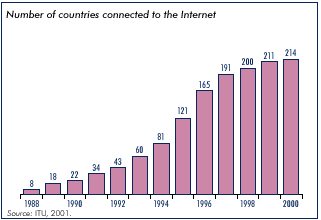
At the dawn of the new millennium, almost every country in the world was connected to the Internet. Back in 1988, only seven countries were connected to the US National Science Foundation Internet backbone. This had grown to 200 countries a decade later. Most countries already had an Internet connection by 1997. Today, less than a half a dozen economies remain unconnected, primarily for political reasons. The beauty of the Internet is such that the first connection, no matter how slow, brings the whole of its riches. And first-mover advantage also matters: of the seven initial countries to have been connected to the US-developed Internet — Canada, Denmark, Finland, France, Iceland, Norway and Sweden — all except France currently rank among the top ten in terms of Internet penetration.
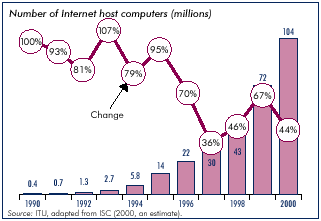
The Internet consists of a maze of permanently interconnected computers plus temporary connections that users create when they log on. The former are referred to as hosts and numbered over 100 million at the beginning of 2001. Hosts are the central nervous system of the Internet, keeping it alive by routing traffic, exchanging e-mails, and providing information. The host computer growth rate dropped in 2000, possibly a reflection of the downturn in the dot-com economy. The most popular host suffixes are “.com” with 33 million and “.net” with 23 million; together they account for 60 per cent of all hosts. The country suffix with the most hosts is Japan (.jp), which had 3.4 million in July 2000. On a per capita basis, the nation with the most hosts using its country code, is the tiny Pacific Island of Niue (.nu) with almost five hosts per person, though few of these are located in that territory.
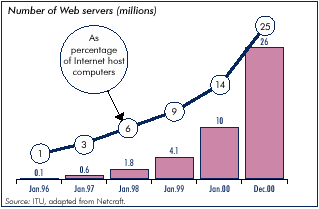
A Web server is a particular kind of host computer — one that provides information in the popular World Wide Web format used by browsers such as Explorer or Netscape. The growth of Web servers has been dramatic — rising from 75 000 at the end of 1995 to over 25 million by the end of the year 2000. Growth in the year 2000 was 158 per cent, the highest since 1998. Web servers now account for some 25 per cent of all Internet hosts. Web servers terminating with the sought after “.com” suffix number 15 million and account for 57 per cent of the total. The country domain suffix with the most Web servers is the United Kingdom (.uk) at 1.7 million, or 7 per cent of the total. The most popular websites are those of Yahoo!, the Internet portal, visited by some 90 million unique users in November 2000. The average user spends almost one hour per month surfing Yahoo! websites, and around 900 million Yahoo! Web pages are viewed each day.
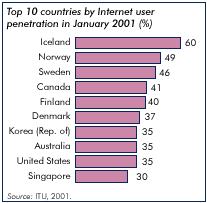
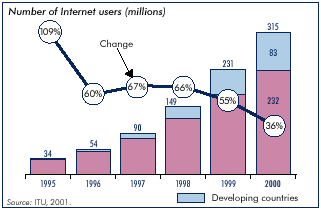
Some 80 million new people began using the Internet in the year 2000, bringing the total number of users to an estimated 315 million. Around 5 per cent of the world is now online. One disturbing trend is that the growth rate in the number of users declined to its lowest level ever (35 per cent) in 2000. This is partly due to the downturn in the Internet economy, reflected by the sharp fall in dot-com stock prices. It also suggests approaching saturation. In many developed markets, those who want to be online already are. In developing markets, affordability, awareness and relevance are placing limits on Internet growth. Though developing markets grow at about twice the rate of developed ones and now account for around one quarter of all Internet users, the digital divide remains huge. While almost a third of people in developed countries are online, this figure is less than 2 per cent in the developing ones. It is no surprise that the birthplace of the Internet, the United States, is the world’s largest Internet market with almost 100 million regular users at the beginning of 2001. The next largest is Japan with some 39 million users, of which over half can also access the Internet from mobile phones. China has exhibited remarkable Internet growth for a developing country and now ranks third with 23 million users. Tiny Iceland is the world’s most wired place with some 60 per cent of its population using the Internet. Geographic isolation combined with an intense interest in all things new, good knowledge of English, cold weather and high-income may explain Iceland’s lead. Like Iceland, all the other Nordic countries have high levels of Internet penetration. Canada, ranked fourth, has a higher penetration than its southern neighbour, the United States. Two Asian countries make the top ten, the Republic of Korea and Singapore.
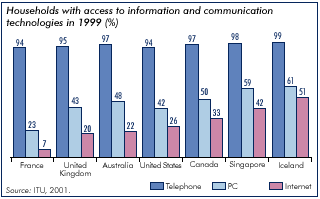
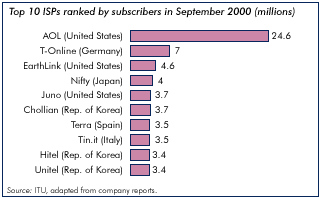
The indicator percentage of households with a telephone is used by policy-makers to gauge the development of universal telephone service. The percentage of households with Internet access is a measure of universal Internet service. Among countries that collect this statistic, Iceland ranks first, with over half its households having access to the Internet (at the end of 1998). It is important to compare the number of households with Internet access to those with personal computers and telephone service since these are prerequisites for dial-up Internet access. In Singapore, which has the second highest home Internet access level in the world, the incumbent telephone operator provides all its telephone subscribers with an Internet account. In reality, only the 59 per cent of the households in Singapore with a personal computer can make use of this.At the beginning of the year 2000, there were some 120 million Internet subscribers around the world, or just under a third of the estimated number of users. Revenues from Internet access amounted to USD 45 billion in 1999 or just over 30 dollars per subscriber per month.Though there are approximately 15 000 Internet service providers (ISP) around the world, there is a high degree of market concentration with the top 20 serving approximately 45 per cent of the market. The world’s largest ISP is America Online of the United States with more than three times more subscribers than the second largest, Germany’s T-Online. Market concentration is expected to increase with bigger ISPs buying up smaller ones and larger ISPs merging. Telephone companies in many countries are major beneficiaries of dial-up Internet traffic since they earn revenue from telephone usage charges. Of the top ten ISPs in the world, half emerged from telephone companies.
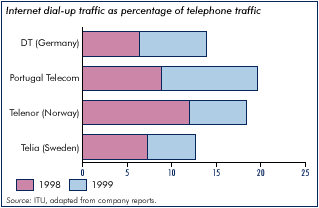
Not many countries collect data on the volume of Internet traffic, but among those that do, it is growing rapidly. In many European countries, Internet dial-up traffic accounts for around one-third of local telephone traffic. In most countries, Internet dial-up traffic far exceeds international telephone calling. There are significant differences in the amount of time users log on in different countries. The differences are partly explained by tariffs — users in countries with no local telephone usage charge tend to log on longer. According to one survey of 18 economies, in October 2000, people in the Hong Kong Special Administrative Region (SAR) were the most intensive users of the Internet, averaging over ten hours per month. The least intensive users were the Irish; they logged on an average of just four hours per month.
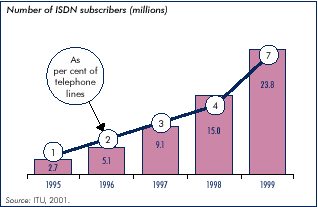
Demand is growing for faster Internet access speeds. The initial response for meeting demand for higher bandwidth was integrated services digital network (ISDN) lines. ISDN works over conventional telephone lines. Basic rate ISDN provides two lines and has been a big hit for users who do not wish to tie up their telephone while surfing the Net. It provides only marginally faster speed (64 kbit/s) than conventional dial-up access. By the beginning of the year 2000, there were some 24 million ISDN subscribers in the world, primarily in North America, Western Europe and Japan, accounting for 7 per cent of all telephone lines in service then. Less than three per cent of Internet subscribers had broadband local access fferings such as asynchronous digital subscriber line (ADSL) or cable modem at the end of 1999.
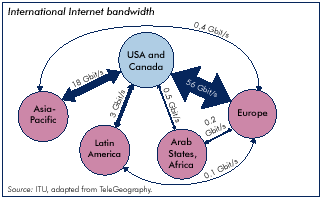
The year 2000 was an historic one for international Internet capacity. It marks the point at which Internet capacity exceeded international telephone circuit capacity for the first time. Worldwide international Internet capacity was close to 300 Gbit/s, almost five times greater than in 1999. One noticeable aspect of the geography of the international Internet is the pre-eminence of the United States. For historical reasons, many countries route Internet traffic to the United States. Unlike international telephone cables, where countries on both sides of the link pay for half the cost, countries wishing to connect to the United States must pay for the full cost of the circuit. In October 2000, a new ITU-T Recommendation (D.50) called on companies to negotiate with each other more equitable ways of sharing the cost of international Internet circuits.
Internet pricing is an important determinant of access. There are two components to a dial-up Internet price.
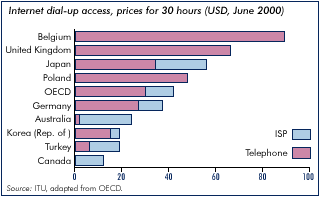
The first is the ISP price. This can be a flat-fee for unlimited use or a certain number of hours or it can vary with time. The second component of the price is usage charges for local telephone service. In some countries local calls are not charged; a flat rate is applied. Countries such as Canada without local telephone charging tend to have the lowest tariffs and high levels of Internet penetration. At the other extreme, countries such as Belgium with so-called «free» Internet access — meaning there is no separate ISP charge — may actually have very high tariffs if the local call charge is high. The average price for 30 hours of dial-up access among the 30-odd member countries of the Organisation for Economic Co-operation and Development (OECD) was USD 56 in June 2000.
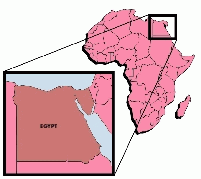
The Arab Republic of Egypt is located in northeast Africa. With an area of just over one million square kilometres, the country is divided into two by the north flowing Nile River. The capital and largest city is Cairo.
Telecommunications in Egypt began in 1854, when telegraph services were introduced in Alexandria. During the ensuing period, the government itself carried out the provision of telecommunication services. In 1982, telecommunications were separated from the government department. In April 1998, the process of corporatization progressed a step further with the creation of Telecom Egypt as a joint-stock company. There are plans to sell 20 per cent of the company to the public. The same law that created Telecom Egypt, also established the Telecommunication Regulatory Authority (TRA) as an independent regulator. It is expected that TRA’s independence will be confirmed by a new law, currently being drafted. The sector was further revamped in 1999, when responsibility for telecommunications, which had previously rested with the Ministry of Transport and Communications, was transferred to a newly-created Ministry of Communications and Information Technology.
Egypt is the largest country in the Arab-speaking world with some 62 million inhabitants. Unsurprisingly, it is home to the largest fixed network in the Arab region, accounting for almost a quarter of all the telephone lines. Growth of main telephone lines averaged around 15 per cent per year, between 1995-2000, and fixed-line teledensity almost tripled between 1990 and 2000. Egypt’s current fixed teledensity of almost 11 is just above Algeria and Morocco and just below Libya and Tunisia. It is estimated that around one-fourth of Egyptian families have a telephone.
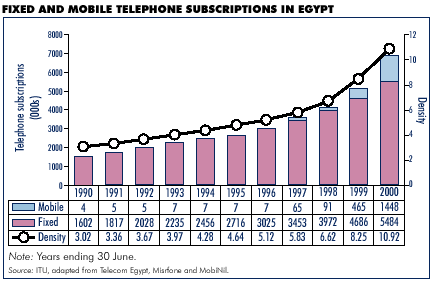
While the growth rate in the number of main telephone lines has been high, it has not been sufficient to keep ahead of demand. The waiting list has remained fairly static, at around 1.2 million for most of the 1990s. At current rates of line growth, this converts to an average waiting time of just over two years but the goal is to increase growth to one million lines annually in the early years of the 21st century. It is likely that the phenomenal growth of mobile communications will also reduce the level of the waiting list for fixed service.Unlike most other Arab States, Egypt was slow to introduce digital mobile cellular service. The first GSM network was launched in November 1996 by Telecom Egypt. In April 1998 it was sold for USD 515 million to the MobiNil consortium headed by France Telecom. A second network, the Misrfone consortium led by Vodafone of the United Kingdom, started in November 1998. At the time, this made Egypt only the second country in the Arab region to introduce mobile competition. Mobile growth has been spectacular, due to the commencement of services by the second operator and the introduction of pre-paid service. By the start of 2001, there were more than two million subscribers and the cellular market shows little sign of slowing.
In 1999, Egypt emerged as the largest Arab Internet market. With an estimated 400 000 users at the end of 2000, Internet growth has been solid. A lack of awareness and computer literacy are bottlenecks. The ISP market is one of the most vibrant in the Arab world, with over 50 companies providing access. Egypt is one of the ITU Internet Case Studies; additional information about the country can be found at www.itu.int/casestudies.
© ITU TELECOMMUNICATION INDICATORS UPDATE