Preparations are broadly on track for the World Summit on the Information Society in 2003 (WSIS-2003). Consultations for the venue are well under way and a host country should be selected by year-end 2000.
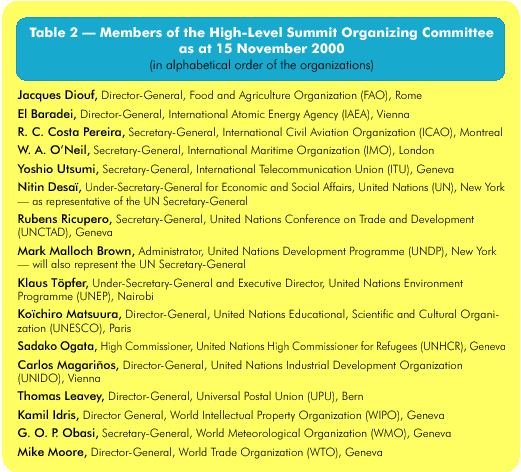
Much has happened to shape the Summit preparations since ITU's governing body, the Council, gave its go-ahead for this massive undertaking in July 2000. In particular, a High-Level Summit Organizing Committee (HLSOC) has been set up under the patronage of the Secretary-General of the United Nations, Kofi A. Annan, in his capacity as Chairman of the Administrative Committee for Coordination (ACC)*. ITU Secretary-General, Yoshio Utsumi will serve as Chairman of HLSOC.
The creation of HLSOC follows on the heels of a meeting between the two leaders in New York at the end of September 2000. Both stressed the need for Heads of State, executive heads of United Nations agencies, industry leaders, non-governmental organizations (NGO), media representatives and partners from civil society to be part of the Summit and to shape the future.
WSIS-2003 will address, among other issues, ways of bridging the digital divide and building on major international initiatives to mobilize information and communication technologies (ICT) for development. This will include follow-up on the outcome of events such as the United Nations Economic and Social Council (ECOSOC-2000), which focused on the role of ICTs in sustainable development.
Expectations are running high. The Summit must offer a chance to all members of society to define together a roadmap to bridge the digital divide! The private sector is expected to play an important role in the Summit and partnerships are being actively sought for this purpose.
|
* The ACC is a forum that brings together annually executive heads of the UN system. |
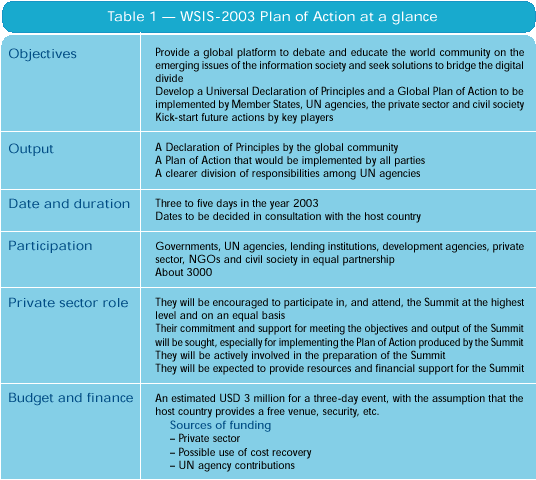
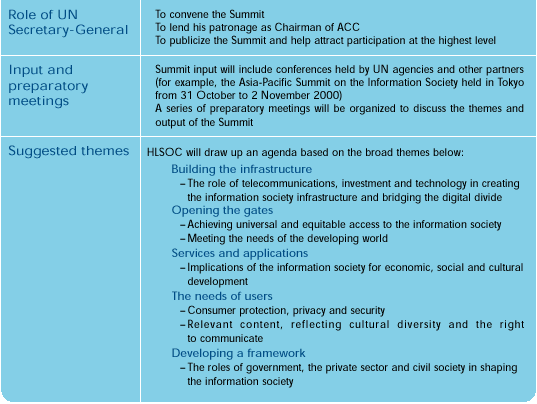
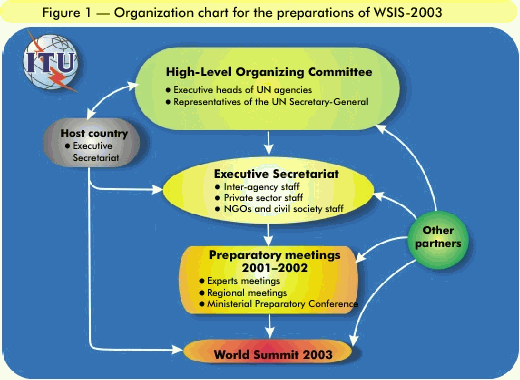
At the end of October 2000 Mr Utsumi, who was accompanied by Mr Harbi, Head of ITU's Strategic Planning, External Affairs and Corporate Communication Units, informed ACC of the positive reaction from the public and private sectors to the decision of the ITU Council to convene WSIS-2003. He also spoke of the next steps and presented a draft Plan of Action (see Table 1), along with an organization chart (see Figure 1) and the mandates for HLSOC and its Executive Secretariat, which will be set up in early 2001. Many executive heads of international organizations have already accepted membership to HLSOC (see Table 2).
Highlighting the preparations for the Summit, Mr Utsumi remarked that the lead-time would provide an opportunity for extensive regional consultations and allow as many actors as possible to take part in the process. He proposed that the Summit be convened by the UN Secretary-General, and indicated that the event's anticipated outcome would be a declaration of universal political will and a concrete action programme for achieving the goals of the Information Society.
ACC was pleased with the draft Plan of Action and has stressed the importance of an early decision by ITU on the venue of the Summit.
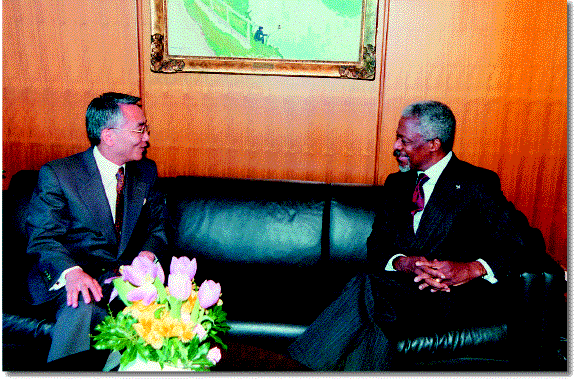
Yoshio Utsumi (left) and Kofi Annan (right) stressed the need for Heads of State, executive heads of
United Nations agencies, industry leaders, non-governmental organizations, media representatives and partners from
civil society to be part of the Summit
(ITU 000063)
What they say…– I believe very strongly in the power of information and communication technologies (ICT) to help bridge the knowledge divide and leverage all efforts of the development community. As a reflection of this commitment, we already have many activities going on in this area at the World Bank Group. I would be very happy, therefore, to support your proposal for a World Summit. I would be willing for the World Bank to provide inputs as you go forward in preparing for this Summit. — James D. Wolfensohn, President, The World Bank. – The world is now facing new challenges resulting from the development of ICTs. The recent high-level segment of the United Nations Economic and Social Council (ECOSOC), as well as the G8 in Okinawa, which discussed these challenges, have shown that the ITU proposal for a Summit was a useful and timely initiative, which I fully support. — Mike Moore, Director-General, WTO. – I welcome ITU's timely initiative for a World Summit on the Information Society and have pleasure in confirming the support of the United Nations Conference on Trade and Development for this endeavour, as well as our willingness to actively participate in the preparations for the Summit. I concur with the importance ITU attaches to enabling individuals and communities to improve their lives through the advent of new ICTs. — Rubens Ricupero, Secretary-General, UNCTAD. – The World Intellectual Property Organization extends its warmest congratulations to the International Telecommunication Union for the resolution passed by its governing body, the Council, to prepare for a World Summit on the Information Society in 2003 in close cooperation with interested United Nations agencies. WIPO stands ready to collaborate and cooperate fully in the preparation of this Summit. — Kamil Idris, Director General, WIPO. – I fully support the aim of the Summit, which is to articulate a clear statement of political will (Declaration of Principles) and a concrete Plan of Action in this area. I also take note, with great satisfaction, of ITU's intention to work in close cooperation with interested United Nations agencies, as well as with the private sector and civil society. The United Nations Educational, Scientific and Cultural Organization will be happy to join ITU in taking up this important and difficult challenge, and to participate actively in the preparation of the Summit. — Koïchiro Matsuura, Director-General, UNESCO. – I look forward to developing close partnership between ITU and the United Nations Development Programme in bridging the digital divide, particularly through collaboration at the country level. Certainly, the perspective I would expect to bring to the High-Level Summit Organizing Committee would be that of a field-based organization dedicated to strategic policy advice to national authorities, as well as pilot efforts to promote the use of ICTs at the country level. Furthermore, as funder and manager of the Resident Coordinator System, I would be keen to address, from the very beginning, the issue of how the entire UN system can be mobilized at the country level to facilitate national preparations for, and follow-up, to the Summit through coordinated operational activities in the ICT area. — Mark Malloch Brown, Administrator, UNDP. – Among the topics to include on the Summit agenda, the United Nations Environment Programme would certainly want to see greater use of ICT to advance the environment and sustainable development. This is an issue that we pursue through our Global Telecoms Initiative, with the ITU as a close partner. — Klaus Töpfer, Under-Secretary-General and Executive Director, UNEP. |

This interview is the third in a series of articles published in this new column, the aim being to gauge reactions to the work of the Council Working Group on ITU Reform (WGR) one year after its first meeting in December 1999.
ITU reform is a key topic of conversation to which we have devoted several articles. How do you see it?
ITU reform will take centre stage at the 2002 Plenipotentiary Conference in Marrakesh (Morocco), and is becoming an increasingly hot issue as we head towards that milestone. The past few years have witnessed a radical change in the telecommunication environment, and the increasingly dizzying pace of this change is putting tremendous pressure on ITU. Reacting to new developments only after they occur is not enough. As I see it, ITU's ambition should be to anticipate future developments, as it has done so very often in the past, even if that ambition is now more difficult to fulfill than it used to be. The Union has no option but to adapt to the new context, and the more speedily the better — not an easy task for a member of the United Nations family of organizations, with the weighty historical, cultural and structural heritage that this implies.
Does ITU's status as a United Nations specialized agency represent an obstacle to reform?
I don't think so. We should not forget that it is by virtue of this status that ITU has been able to open its doors to private industry. Hundreds of operators and manufacturers play an active and constructive part in its work, whereas the majority of United Nations agencies are the sole preserve of governments. Moreover, other United Nations specialized agencies, such as the World Health Organization (WHO) and the World Intellectual Property Organization (WIPO), have themselves had to review their working methods or make more space for representatives of the private sector. WIPO's efforts in this regard have been entirely successful and there is no reason why it should be otherwise at ITU, as long as it has the necessary resources and its membership, particularly the Member States, is united in its desire for change.
The task of introducing the necessary reforms has been entrusted to a working group of the Council, the ITU Secretary-General and the Directors of the three Bureaux. How do you think they are getting on?
To be quite frank, so far I am a little disappointed overall. I was looking forward to more spectacular breakthroughs, whereas what we have been seeing are discussions that often dwell on legal or institutional considerations with which very few experts really feel comfortable. Such discussions tend to obscure not only the changes and constraints which ITU's main players and constituents are having to face, but also the ultimate objective, which is to give ITU the flexibility it needs in order to respond to the demands being made of it. To put it another way, perhaps we are not seeing the wood for the trees.
I believe that the ITU Secretary-General, Yoshio Utsumi, saw this risk very clearly as soon as he took office. In my view, this is what led to his initiative to convene, on two occasions, a meeting of the informal high-level group known as the Reform Advisory Panel (RAP), in which I was kindly invited to participate. This group provided the opportunity for some 30 key decision-makers, whom I see as representing the broad panoply of interests at stake within ITU, to identify the challenges that lie in store for the Union and to bring forth highly constructive proposals that respect the organization's culture.
"The reform process must lead to the decompartmentalization of the three Sectors, namely ITU-T, ITU-R and ITU-D".
However, these proposals have thus far received only a very partial echo. WGR has even expressed strong criticism, without doubt exaggerated, regarding the Secretary-General's initiative, even though he has spared no effort to encourage transparency and visibility in ITU's work in the interests of making it a dynamic organization. WGR has been instructed by Council-2000 to take another look at the work of RAP, and I hope that it will on this occasion take a more positive stance. If not, ITU's image may well suffer a serious blow, particularly in the eyes of decision-makers in the private sector.
At the same time, a number of initiatives are being carried out in parallel within the three ITU Sectors, namely the Telecommunication Standardization (ITU-T), Radiocommunication (ITU-R) and Telecommunication Development (ITU-D) Sectors. Although it is all to the good that such reflection is taking place, we must not lose sight of the overall picture. The reform process should lead to the decompartmentalization of these three Sectors, not forgetting the General Secretariat. Yet it seems to me — although I may be mistaken — that what we are seeing happen is the opposite.
Nevertheless, WGR has not shied away from addressing a number of extremely important subjects...
I take it you are alluding to the setting up of the ad hoc group on the creation of a new standardization entity?
This is indeed one of the knots that ITU will have to unravel if it wishes to meet the challenges that lie before it.
The establishment of this group, which was no easy task, takes a large number of fundamental issues well and truly by
the horns. Some people are even questioning whether it is still necessary for an intergovernmental organization to be
involved in the production of telecommunication standards. The jury is still out on this. What we have to recognize is
that the needs of the industrialized countries and those of the developing countries are very different, and that ITU
has to cater to both in an equitable manner.

"ITU's status as a United Nations specialized agency does not represent an obstacle to reform".
Those of a more liberal persuasion are in favour of allowing market forces to operate freely within the private sector and of reducing to an absolute minimum any intervention by States or by the time-honoured international organizations, which hitherto have had a pivotal role to play. Others have not yet had the time to adapt a traditionally highly interventionalist policy to the new — much more arm's length — regulatory approach, particularly where telecommunications are concerned. Unlike their more liberal counterparts, and even if they are aware that things have changed and that there is a need to adapt, they perhaps fear that, not having sufficient time to "digest" the changes, they will be obliged to take hasty decisions concerning ITU. We have to take this concern into account and to hold fast to the principle of solidarity that has always prevailed within the Union between Members from different horizons.
And how do you personally feel about this new entity?
I personally believe that technological progress has a major bearing on all other forms of progress. And technological progress is happening at such a rapid pace, across such a broad range of domains, and to such degrees of specialization that ITU, and ITU-T in particular, cannot by itself keep up with all the new developments. Nor would it have the necessary resources to do so, even with the best will in the world from its membership, not to mention the fact that the Union operates at the international and global levels, with all the additional problems this implies.
This does not mean that ITU should abandon its technical standardization activities — far from it. But it must speed up the process, particularly by giving greater autonomy to ITU-T, and by considerably stepping up its cooperation, judiciously and wisely, with the various forums and organizations that are developing industry know-how on a large scale. In addition to this, it must focus on and continue to specialize in its own — very significant — areas of competence, particularly those relating to network interconnection and quality of service. Finally, if it wishes to ensure that its own specialist knowledge remains relevant, it must not neglect new developments, even those whose usefulness in the short term is not always obvious, in which regard it should allow its Sector Members a greater measure of freedom and initiative.
On the other hand, all of the effort involved in changing direction will have been a waste of time if ITU does not at the same time adopt more flexible and speedy working methods, as has been done in the private sector and by numerous government services. In October 2000, the World Telecommunication Standardization Assembly made a number of genuine improvements in the context of ITU-T, although confined to a few very specific areas. If those trials prove conclusive, they should be introduced across the board in order to increase the involvement of private industry representatives and expedite the approval of globally-recognized technical standards.
For its part, the industry, which wishes to benefit from the Union's image and from the confidence which ITU
Recommendations inspire, has to acknowledge the fact that the Union is an intergovernmental organization and therefore
accept that governments retain the right to have a say in its activities, including those of an essentially technical
nature, even if that right is reduced to the strict minimum. Who knows whether ITU will not one day be called upon to
provide its "good offices", for instance if the industry finds itself unable to agree on competing standards
in a market calling for greater coherence?

"The emergence of new forums which provide the industry with a very flexible framework necessarily brings into
question the role and structure of ITU".
Let us consider whether the establishment of a new entity is the best way in which to meet these challenges, so that we can decide on the matter in full knowledge of the facts. And above all, let us not lose sight of the fact that other problems lying outside the realm of standardization issues also need to be addressed. The satellite filing backlog that has accumulated in the Radiocommunication Bureau (BR) is equally disturbing. BR was not prepared for such a sudden proliferation of new projects, many of which will probably never come to fruition but nevertheless require the Bureau's full attention.
As if all this were not enough, ITU, in a broader context than the purely "technological" side of telecommunication development, must be capable of operating on a wider stage if it wishes to be at the heart of the development of the information society, as was made clear by the Secretary-General during the 2000 session of the Council.
Which of the Union's strengths would you like to see enhanced, and which of its weaknesses need to be corrected?
One of ITU's undeniable strengths is its representativity. Can you imagine any other organization being capable of bringing together 189 countries and three times as many representatives of the private sector? Against this diversity, the Union has managed to forge itself a reputation of impartiality and equity which has enabled it to limit conflicts between competing parties and has been conducive to innumerable cases of fruitful cooperation.
On the other hand, ITU would not be what it is had it not been for the crucial contribution made by private industry. The private sector is now complaining that its role is not sufficiently recognized, and this complaint is valid when we look at ITU's decisionmaking process on key issues such as, for example, its strategic policies or financial matters. I understand their grievances: while industry is defraying a growing proportion of the ITU budget, and particularly that of ITU-T, the debates on such matters remain the exclusive preserve of the Council and the Plenipotentiary Conference, in which the Sector Members are not represented.
We've touched on a delicate issue …
Yes, but the emergence of new forums, which in many cases are going from strength to strength and which provide the industry with a very flexible framework for the development of new standards, necessarily brings into question the role and structure of ITU. Governments generally have no say whatsoever in such forums. So it is absolutely vital for them not only to establish and consolidate a dialogue with such forums through ITU, but also to strengthen the level of dialogue within ITU itself by being more attentive to the grievances and wishes of the industry. The Union therefore still has a pivotal role to play, but if governments fail to recognize that fact they run the risk of leaving themselves offside.
Furthermore, when one looks at other international organizations one cannot help but wonder, for example, whether the Council is not taking on too much when it engages in discussions of a purely financial or administrative nature. One could very well imagine, for example, passing on much of this role to the Secretary-General, thereby enabling him to take decisions more rapidly. Another option would be to decentralize that responsibility to the advisory groups of each of the Sectors, or even to set up a Council advisory group responsible for such matters and to open it to Sector Members in order to place them on an equal footing with the Member States. Indeed, why not open up the Council in one way or another to Sector Members? This would meet one of the main grievances of the Sector Members, which is that they have very little say in the workings of ITU, while sparing the sensitivity of many Member States, which would still have the Plenipotentiary Conference to themselves.
"We are still at the stage of the effervescent tablet, where everything is fizzing and in apparent disorder, but which is fertile ground for new ideas. This phase must now be brought to a close and the main lines of action stabilized, even if a few bubbles continue to come to the surface here and there. A number of extremely important issues, such as the enormous workload that is weighing on BR and ITU-R in general, have hardly begun to be addressed. "
That brings me on to another question which seems to me to be just as essential — that of equality and the right to vote for all members. There are of course a number of spheres in which the Member States should enjoy certain prerogatives and additional rights, particularly where matters of a policy or regulatory nature are concerned. However, those matters boil down to a handful of key areas, which are fairly limited even though of very great importance. Thus, the right to vote should be introduced at all levels of ITU and for the entire membership, although on the understanding that recourse to a vote will only be had when all attempts at achieving a consensus have failed. At all events, the possibility that is open to a single Member State to block decisions, which is tantamount to the right of veto, should be removed in favour, if necessary, of other more appropriate safeguards.
Another group of players who have thus far not been included in the work of ITU are those involved at the grass-roots level of development of the Internet and the services it carries. It is not that they have failed to express an interest, but the financial investment that participation in ITU entails remains prohibitive for many such companies, which are often quite small. The status of Associate defined by Council-2000 is a first step, but more will have to be done in terms of lowering the threshold for joining ITU. The increased use of electronic tools is an additional means of making ITU's work more accessible.
If all of these measures were to be implemented, then there may be no longer any need to consider establishing a technical standardization entity separate from ITU.
Are you optimistic regarding the outcome of the work?
Indeed I am, but on condition that precious time is not lost. We are still at the stage of the effervescent tablet, where everything is fizzing and in apparent disorder, but which is fertile ground for new ideas. This phase must now be brought to a close and the main lines of action stabilized, even if a few bubbles continue to come to the surface here and there. A number of extremely important issues, such as the enormous workload that is weighing on BR and ITU-R in general, have hardly begun to be addressed. WGR's fourth meeting in Brazil in April 2001 is bound to be decisive. The participants at that meeting will have to reach agreement on decisions of principle in order to have the time necessary to put them into practice.
In its work, ITU has often advanced in stops and starts. Perhaps putting one's foot down is not always the right solution, but the cautious approach which WGR currently appears to be taking can also lead it into danger, and may well be fatal. There are times when, rather than applying the brakes, one must not hesitate to hit the accelerator and take to the main road. Even if the map direction is not perfect, there will always be a chance to correct it along the way.
In mid-October 2000, ITU Secretary-General, Yoshio Utsumi, visited Morocco at the kind invitation of the country's
State Secretariat for Posts, Telecommunications and Information Technologies. The purpose of the visit was to discuss
the preparatory arrangements for the next Plenipotentiary Conference, scheduled to take place in Marrakesh from 23
September to 18 October 2002. Morocco's invitation to host this top policy-making body was made at the last
Plenipotentiary Conference in Minneapolis in 1998. In July this year, the ITU Council endorsed the invitation and fixed
the dates of what will be the first Plenipotentiary Conference in this millennium.
(ITU 000079)
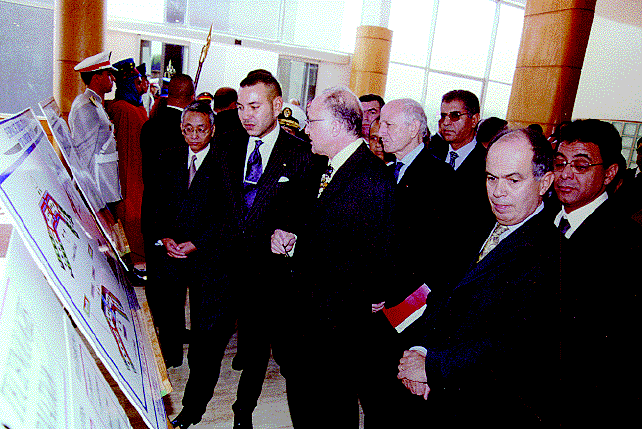
From left to right (in the foreground): Yoshio Utsumi, in the company of his Majesty King Mohammed VI of
Morocco, at the inauguration of Casablanca's information technologies complex
During his visit, Mr Utsumi was received by His Majesty King Mohammed VI of Morocco and the country's Prime Minister, Abderrahman Youssoufi. Morocco will be the first Arab State to host a Plenipotentiary Conference. "King Mohammed regards this as a tribute to the great strides his country has made in liberalizing the telecommunications market and in encouraging its successful development. The Prime Minister too was pleased that Morocco had become a pioneer in liberalization in the region and an advocate of best practices", the Secretary-General said upon his return.
Mr Utsumi met several other dignitaries: Nasr Hajji, Secretary of State to the Prime Minister in charge of Posts, Telecommunications and Information Technologies; Taieb Fassi Fihri, Secretary of State for Foreign Affairs and Cooperation; Mostafa Terrab, Director-General of the Agence nationale de réglementation des télécommunications (ANRT — National Telecommunications Regulatory Agency); and Abdeslam Ahizoune, Chairman and Chief Executive Officer of Maroc Telecom. He also visited the telecommunication facilities in Marrakesh, where he was met by the Governor, Ahmed Mjad.
"King Mohammed assured me of his country's full support for the Plenipotentiary Conference. This interest in our activities by a young monarch in tune with developments in telecommunications, and the strong interest of regulators in what was happening in ITU, show Morocco's continued commitment to the work of the Union", Mr Utsumi remarked.
This article is the third in a series to be published from ITU case studies on IP telephony in the run up to the third ITU World Telecommunication Policy Forum, scheduled for March 2001
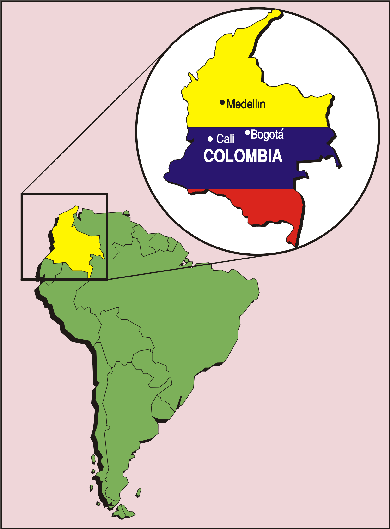
Colombia's entire telecommunication sector operates in a competitive environment. The country has more than 50
operators providing basic local telephone service, four cellular telephone operators, and over a 100 value-added
operators. Although the first provisions to liberalize the sector were put in place in the early 1990s, it took more
than seven years to open up long-distance service to competition.
In December 1998, Colombia became the first country in Latin America to offer long-distance service from mobile telephones using Internet technology. Value-added companies have very good prospects of entering the local IP telephony business, since they can also build and operate their own bearer or transport networks, as long as they have the proper licence.
Key factors in the emergence of IP telephony have been the steep advances in technology, the bold commercial moves on the part of one cellular company, Comunicación Celular SA (Comcel), and an apparent lack of clear regulations governing cellular and Internet telephony. For example, cellular service operators are required to use legally established operators and do not receive any compensation for intiating or completing an international long-distance call through companies that hold long-distance licences. Besides, billing is based on the "calling party pays" principle.
Existing provisions establish regulatory barriers which restrict access to international long-distance voice services via the Internet when such service is offered to, or from, a cellular telephone by operators other than those authorized to provide international long-distance service; or when the communication originates and terminates at a telephone. On the other hand, local telephony is completely open with no regulatory restrictions.
|
Colombia: IP Telephony and the Internet forms part of a series of telecommunication case studies produced under the New Initiatives Programme of ITU's General Secretariat. This case study was prepared by Gustavo Peña-Quiñones (gpenaq@col1.telecom.com.co ) and Agustina Guerrero (agustina@baedigital.com.ar) and directed by Ben A. Petrazzini (Ben.Petrazzini@itu.int), Telecommunication Policy Adviser in the Strategies and Policy Unit. Full texts of this and other case studies covering China, Peru and Thailand can be found at www.itu.int/iptel . |
In long-distance, Orbitel recently began testing a voice communication service that provides a connection to the operator from a computer, using Ericsson software. Empresa de Teléfonos de Bogotá (ETB) hopes to be able to offer long-distance IP service before year-end 2000. ETB is a new entrant in the provision of long-distance service and holds 29 per cent of the country's lines.
The introduction of IP telephony has not been painless. Companies that have already paid for a long-distance service licence, which costs USD 150 million, often try to keep the market closed to new entrants. Complaints that some operators were offering IP telephony illegally have led to investigations by regulatory and oversight bodies such as the Comisión de Regulación de Telecomunicaciones (CRT —Telecommunication Regulatory Commission), the Superintendencia de Industria y Comercio (SIC — Office of the Superintendent for Trade and Industry), the Superintendencia de Servicios Públicos Domiciliarios (Office of the Superintendent of Public Utilities) and Fiscalía (Office of the Inspector General). The Comcel case (see page16) is a good example of this.
Indeed in the second half of 1999, regulatory and oversight authorities investigated head offices of more than 20
operators legally established to provide value-added services. These investigations were carried out in response to
complaints by long-distance operators that certain operators were providing unauthorized international voice
transmission.
Colombia has about 500 000 regular Internet users, taking into account users who access the
Internet from cafés, or from universities. Existing Internet service providers have brought a great deal of
competition and, with it, a broad array of services, prices and special offers
Photo: Clarent Corporation (ITU 000080)
Apart from these challenges, agencies responsible for regulating telecommunications in Colombia also have to grapple with the task of promoting the development of the Internet as laid down in the National Development Plan. Indeed in February 2000, Colombia's President issued a document entitled: The Connectivity Agenda: The Internet Jump. In particular, the document presents a number of strategies and actions calling the country to embrace information technologies with the aim of constructing the information society as a national goal.
The number of Internet servers in Colombia has grown exponentially, rising from 63 in 1994 to 47 155 in July 1999. As of early 2000, there were some 162 000 Internet accounts, of which 18 000 were business accounts. Colombia has about 500 000 regular Internet users, taking into account users who access the Internet from cafés, or from universities, and those who have access through local networks in companies and organizations.
Many users still have limited access to personal computers and modems and are, at present, unable to acquire their own due to the low level of the average income and the high cost of such equipment. The good news is that existing Internet service providers (ISP) have brought a great deal of competition and, with it, a broad array of services, prices and special offers. For example, since January 2000 one company has been offering Internet access free of charge, a development that will surely lead to significant changes in the pricing scheme currently in force in the market. Another company has been offering a computer with an Internet connection for USD 50 per month under a locked-in three-year contract, and many firms are offering special rates for students.
The first Network Access Point (NAP) was established in early 1999 through the efforts of the Cámara Colombiana
de Informática y Telecomunicaciones (CCIT — Colombian Information Technology and Telecommunications Association).
NAP brings together the country's largest ISPs, with the aim of channelling and routing communications exchanged between
users on the various Internet access networks.
In December 1998, Colombia became the first country in Latin America to offer long-distance
service from mobile telephones using Internet technology. Key factors in the emergence of IP telephony have been the
steep advances in technology, the bold commercial moves on the part of one cellular company, and an apparent lack of
clear regulations governing cellular and Internet telephony
Photo: © 2000 PhotoDisc, Inc. (ITU 000041)

Of the 134 firms that hold a value-added licence issued by the Ministry of Communications, only the larger players like Telecom, Latinonet, Impsat, Cablenet, Empresas Públicas de Medellín (EPM), Telesat, Colomsat, Global One, Rey Moreno, and 54 others of various sizes, offer Internet connections. However, the bulk of market share in Colombia is divided between only a few of these ISPs (see Box 1).
In late 1998 Comcel, one of the operators holding a cellular mobile telephone service licence, concluded a contract with a value-added operator, Rey Moreno, to offer voice services via the Internet. Many in the telecommunication sector considered this service illegal. The companies that had just received licences to provide long-distance services, for which they had paid USD 150 million each, immediately raised formal complaints on the legality of the service offered by Comcel.
The conflict erupted when Comcel, of which Bell Canada International was the majority shareholder, published on 20 December 1998 in El Tiempo, a local newspaper, an advertisement announcing that it was offering its more than 500 000 users a new service based on IP telephony. The advertisement stated:
"Exclusively for Comcel users. Now it costs less to phone anywhere in the world with your Comcel cellphone than from a regular telephone. Using your Comcel cellphone you can call anywhere in the world and talk for just 770 pesos a minute, including value-added tax (VAT), any time, any day. Just dial #124 + country code + area code + telephone number + send."
Orbitel, one of the new long-distance operators, immediately accused Comcel of operating in breach of telecommunication rules and regulations.
The next day, CRT issued two resolutions. The first established that all companies other than basic service providers that provided telephony services or were preparing to provide telephony services, regardless of the technology used, were brought under the regulatory function of CRT and the oversight of the Office of the Superintendent of Public Utilities. The second ordered that an administrative investigation be started against Comcel to determine whether the service being offered by that company could constitute unfair competition or lead to a reduction of competition between public telecommunication service companies.
| *Although this case refers to Comcel, it in fact covers both Comcel and Occel.
Comcel purchased Occel in the first half of 1999, but the two continue to exist as separate entities as they
cover different geographic areas of the country.
|
Box 1 — Market leadersThe main Internet service providers in Colombia (1999) - Telecom entered the Internet business in 1994, offering service by means
of its digital microwave network to 1000 users in Colombia's main cities. By year-end 1999, Telecom had
35 000 residential subscribers — representing a thirty-fivefold increase in six years — and some 190
corporate subscribers. These figures make Telecom the country's largest ISP. Through its extensive IP
network, Telecom offers Internet services in more than 35 cities in the country. Thanks to its national
fibre-optic network, the company is positioning itself as the most technically advanced ISP in Colombia. In
1998, it began offering high-speed broadband connections for residential and commercial subscribers using
high-speed digital subscriber lines (xDSL). It plans to put a NAP into service. This NAP will be located in
Barranquilla at the landing point of the Pan American cable, where it will be linked to the company's
fibre network, and will serve ISPs not only in Colombia, but also in Ecuador. Telecom also has a national
synchronous digital hierarchy (SDH) microwave network. It uses a 50-teleport DOMSAT satellite system
as a back-up, and offers packet-connection services through the Instituto Técnico de Telecomunicaciones,
the arm of Telecom that is developing applications for distance education and other services.
- Colomsat, which is part of the NAP operated by CCIT, has been providing Internet access since 1995, offering dial-up access and dedicated connections by means of digital lines and integrated services digital network (ISDN) connections for residential and commercial subscribers. At the end of 1999, it had over 20 000 subscribers. In 1998, Colomsat entered into an agreement with CompuServe with a view to strengthening its corporate customer base and to provide integrated Internet solutions for corporate users. Colomsat offers microwave connections and local last-mile connections by cable in Bogotá. Its customers in Cali and Medellín can access this service through ISDN lines. The company uses its microwave infrastructure for domestic Internet transmission and an international Texcom satellite access to Florida to connect to the Internet infrastructure of MCI, based on a frame relay platform. The company has also concluded contracts for other international connections to double its transmission capacity. Speeds range between 33.6 kbit/s for dial-up access to 64 kbit/s and above for high-speed access. Colomsat does not offer its own content, but it does have a Web page that provides connections to a number of content and electronic commerce sites. - ImpSat began operations in Colombia in 1996, and has become another of the country's main ISPs. It was bought in August 1999 by the pan-regional El Sitio portal. The firm is now conducting IP voice tests. ImpSat has operating nodes in Medellín and Bogotá, and is in the process of installing network nodes in Viejo Caldas and Barranquilla. The average Internet access speed is 33 kbit/s, and most clients are migrating to 56 kbit/s. ImpSat uses its own international link for its Internet infrastructure. It does not offer any content of its own in Colombia, but it does now form part of the network of El Sitio portals. Source: Telecom, Colomsat and ImpSat. |
Box 2 — Convergence in actionHow the provision of international IP voice service from Comcel's cellular service works - The user: A user who is a subscriber to the service dials on his cellular telephone #124 + country code + area code + telephone number + send. The user hears a recorded message that says, "Welcome to Comcel 124. The cost of this service is 770 pesos plus VAT. Your transmission is being processed." Twenty seconds after this recorded message, the user hears a ringing tone telling him/her that the dialled number is ringing. The called party answers, and the communication begins, continuing until one of the two parties ends the call. The voice delay perceived by the parties during the communication is similar to the delay experienced in a conversation carried by a geostationary satellite link. - Comcel cellular network:The user dials on his/her cellular telephone #124
+ country code + area code + telephone number + send. The signalling reaches the current call meter (CCM) on
the control channel, the cellular handset is validated on the network, the user takes a voice channel and
the call is processed. The CCM filters out all dialled numbers of fewer than 13 digits or more than 18
digits, as well as all calls which immediately after the #124 include 57 (for Colombia) or the numbers 0 to
11 (which are country codes not used).
Calls filtered out in this way are routed to a recorded message which advises the caller that an error has been made in dialling. Calls not filtered out are routed to a recorded message that says, "Welcome to Comcel 124. The cost of this service is 770 pesos plus VAT. Your transmission is being processed." The calls are then sent to one of Rey Moreno's trunk lines and delivered by means of two E1 satellites with Colombian R2 signalling without being sent to automatic number identification — ANI (although they could be sent to ANI if the called party were to request it). For the number of the called party, the entire number dialled by the cellular user is sent, except for the initial character #. When the called party answers, an answering signal is sent on R2 to the CCM from Rey Moreno. The call is over when one of the two parties ends the communication, freeing the voice channel. Each call generates its corresponding record of charges at the CCM, which is processed in Comcel's billing system. - The value-added service operator: The value-added service operator receives a call on its two E1s coming from Comcel, with the corresponding signalling on R2 indicating 124 plus the international telephone number. When it reaches a multimedia cellular server (MMCS) switch, it is routed by an outgoing E1 trunk line and the signalling is converted to R2 international. From the switch, the voice passes through a device, where it is compressed, packed, and converted to IP protocol, together with its signalling. The information is sent by means of an IP session to the correspondent in the United States by means of a 640 kbit/s satellite link leased from INTELSAT, and the correspondent in turn delivers it to its destination by means of a direct or indirect connection to the international telephone network. The IP address used by Rey Moreno is 10.10.3.1, which belongs to an intranet and does not have an assigned Internet address. The MMCS system has the ability to charge for and differentiate between services using the first digits of the number it receives. When the communication is ended by one of the parties, the session is ended and the links are freed at both ends. Source: Adapted from the Dossier of the Comcel case, CRT. |
The Ministry of Communications also opened a preliminary investigation on 22 December 1998. Its purpose was to determine whether there were grounds for Comcel being considered in breach of the telecommunication rules and regulations, and in particular in breach of the system for licensing the mobile cellular telephone service, by providing IP voice service for long-distance communications.
Finally, SIC opened an investigation as well to determine whether Comcel had engaged in unfair competition or had obtained an illegal competitive advantage. SIC is responsible for detecting and controlling restrictive and unfair practices in the area of competition in telecommunication services of a non-domestic nature.
From the standpoint of the user, Comcel offered inexpensive international calls to any other telephone located anywhere in the world. Furthermore, the quality of the service, which often undermines IP telephony services to the public, seemed to be quite reasonable according to the investigation carried out by CRT.
The arguments presented by Comcel, Occel and Rey Moreno to defend their service were oriented towards demonstrating that Rey Moreno was providing its service to a specific group of users of the basic Comcel and Occel support service, and that Rey Moreno was adding value. The communications in question were neither basic switched international long-distance telephony nor cellular mobile telephony (for a technical description of how the service was carried out, see Box 2).
For these reasons, the cellular companies had, in various ways, restricted long-distance service from cellular telephones. Not all users can access domestic or international long-distance service. In the case of Comcel, only 3 to 5 per cent of its subscribers have the service because subscribers must make a separate application for it, must demonstrate their ability to pay and must complete other procedures, making it cumbersome and difficult to obtain the service.
When Comcel started offering its new service in December 1998, this coincided with the start of operations of the new companies that had obtained their long-distance licences a year earlier.
Both the new long-distance operators and the established provider did a great deal of advertising suggesting that international long-distance charges were falling, and this caused an increase in the amount of traffic on cellular networks connecting to long-distance services. This brought about an increase in the amount of long-distance traffic being carried on cellular services, yet without the cellular services receiving any compensation for it. This distortion altered the structure of the cellular companies' revenues and expenses.
After nearly nine months of operation, Comcel's IP telephony service was suspended at the initiative of the value-added operator. Comcel's purchase of Occel may have been a determining factor in the decision to suspend the service, alongside the pressure from regulatory and oversight bodies that have been called upon to resolve these delicate conflicts arising from operators with value-added licences offering IP telephony services.
In February 2000, the Ministry of Communications and the Superintendencia de Industria y Comercio wound up two of the three investigations. In the first of these cases, the penalty imposed on each of the two cellular operators (Comcel and Occel) and the value-added operator (Rey Moreno) was a fine 1000 times the monthly minimum wage (equivalent to some USD 140 000). In the second, a fine was imposed while the long-distance operators were given 15 days to present a claim for the damages caused by the conduct of the IP telephony service provider. The Superintendencia de Industria y Comercio imposed a penalty, only on Comcel, in the form of a fine 2000 times the monthly minimum wage. Comcel appealed against these decisions. Some of the appeals had been resolved in the company's favour by the end of October 2000.
In the process of opening the Colombian market to competition, telecommunication legislation has become very complex. As new services emerge the legislation often has to be amended or supplemented with opinions. This usually raises controversy and debate among value-added, long-distance, and cellular operators.

On 9 November 2000, ITU Secretary-General, Yoshio Utsumi, announced that the Government of the Republic of South Africa will host ITU Telecom Africa 2001 at the Gallagher Estate in Johannesburg from 12 to 16 November. This will be the fifth international telecommunication Exhibition and Forum to be organized by ITU for the African region, and the 25th event since the launch of World Telecom in Geneva in 1971.
"ITU is delighted to have the opportunity of staging an event as important as ITU Telecom Africa 2001 in South Africa", Mr Utsumi said, announcing the event. "Africa is the region of the world still most in need of telecommunications development, and it is my hope that the Africa 2001 event will enable us to take another leap forward in this most important of areas", the Secretary-General added.
ITU received invitations with very attractive conditions from a number of countries in the region to host Telecom Africa 2001; it was not therefore easy to decide on the host country. After many consultations and a series of negotiations, Mr Utsumi accepted the offer of the Government of the Republic of South Africa to host the event.
Gallagher Estate offers advanced forum facilities and over 28 000 m2 of gross exhibition space. Furthermore, it is ideally located at Midrand, between Johannesburg and Pretoria, and is close to South Africa's largest concentration of hotels. It is on the basis of these particular considerations of infrastructure, accommodation, transport and conference and exhibition facilities that South Africa was selected.
ITU and the Government of the Republic of South Africa officially launched the event in Johannesburg on 23 October 2000. At the launch South Africa's Minister for Communications, Ivy Matsepe-Casaburri, said: "Our country is particularly honoured and exalted to be able to make this important announcement and to host one of the biggest landmark events for the global communication sectors. The event represents an opportunity of untold proportions. It will give the African continent a launch pad for the development of infrastructure based on information and communication technologies [ICT]."
The launch event was attended by some 350 people, including government ministers, regulators, industry representatives and the media. Ministers responsible for ICTs from all sub-regions of Sub-Saharan Africa were present at the launch of Africa 2001, showing the support for the event from across the continent.
Previous Africa Telecom events took place in Johannesburg in 1998, Cairo in 1994, Harare in 1990, and Nairobi in 1986. Africa Telecom 98 was attended by 443 exhibitors, nearly 20 000 participants from 117 countries, and 475 VIPs, comprising ministers of communications, delegates from administrations, ambassadors, directors-general, chairmen and chief executive officers of major companies.
Celebrated under the theme of "African Renaissance", the event was hailed as a triumph by many of Africa's leaders. Africa Telecom 98 was notable for the commitment and tremendous spirit of optimism expressed by government ministers, exhibitors, Forum speakers, delegates and the world's media.