The International Telecommunication Union signed a Memorandum of Understanding on electronic business, joining three
leading international standards-setting organizations already party to the MoU, namely the International
Electrotechnical Commission (IEC), the International Organization for Standardization (ISO) and the United Nations
Economic Commission for Europe (UN/ECE). In addition to the four signatories, CALS* International and NATO CALS
participate in implementation of the MoU as registered international user groups.
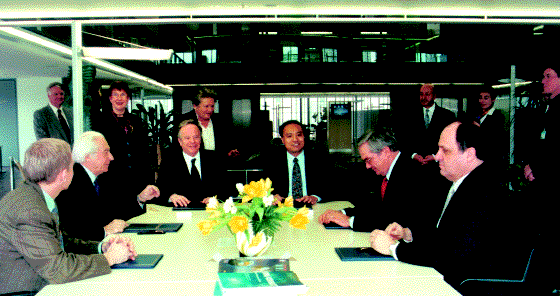
From left to right (seated): R. Herreman for Lou Kratz, Chairperson, NATO CALS Management
Board; R. Esposito, Chairman, CALS International; Y. Berthelot, Executive Secretary, UN/ECE; H. Zhao,Director,
Telecommunication Standardization Bureau; L. D. Eicher, Secretary-General, ISO; A. Amit, General Secretary, IEC
Photo: A. de Ferron (ITU 000027)
"The purpose of the MoU is to minimize the risk of divergent and competitive approaches to
standardization, avoid duplication of efforts and avoid confusion amongst users", said Houlin Zhao, Director of
ITU's Telecommunication Standardization Bureau (TSB) when signing the agreement on 24 March 2000. "The MoU will
also provide greater intersectoral coherence in the field of electronic business, an important step considering the
uptake of e-commerce", he added.
Yves Berthelot, Executive Secretary to UN/ ECE, stressed that the participation of ITU is essential to secure the
interoperability required by the network economy. "When countries adopt international standards and harmonize their
technical regulations worldwide, everybody stands to gain. Moreover, the development of technical instruments shared by
all countries facilitates and strengthens their involvement in harmonious economic relations. This vital role of
international standards as the technical foundation for the global market is explicitly recog nized by the World Trade
Organization", he said.
|
* Continuous Acquisition and Life-Cycle Support (CALS) is defined as a strategic management concept that
uses the best available information technology, management methods and international standards to increase
the effectiveness of organizations. It allows enterprises to be integrated on a worldwide basis thereby
facilitating electronic commerce within and between organizations. |
The MoU establishes a coordination mechanism under a unique cooperative model to produce mutually supportive
standards required in business transactions (data interchange and interoperability) as well as products design and
manufacturing to meet the urgent needs of both the industry and the end-users. Electronic business covers the
information definition and exchange requirements within and between enterprises, including customers. Given that it
provides the vital framework for e-commerce, the MoU is intended to support this rapidly changing and fast growing
business sector.
ISO Secretary-General, Lawrence D. Eicher, commented: "This MoU is an excellent practical example of greater
partnership between the governmental and private sectors. It lays the foundation for a healthy future development of
e-commerce to the benefit of all stakeholders."
Under the MoU, the four organizations undertake to review their standardization activities and develop a joint,
coordinated programme for standards development and publication which will benefit the market-place.
The MoU is open to other international, regional, governmental, industry and consumer organizations whose core
mission involves standards-setting.
|
For more information, please contact:
- Sophie Clivio, Technical Programme Manager, ISO (Tel.: +41 22 749 7284. Fax: +41 22 749 7349.
E-mail: clivio@iso.ch).
- Gabriel Barta, Head of Technical Coordination, IEC (Tel.: +41 22 919 0283. Fax: +41 22 919 0300.
E-mail: gb@iec.ch).
- Georges Sebek, Engineer, Telecommunication Standardization Bureau, ITU (Tel.: +41 22 730 5994. Fax:
+41 22 730 5853. E-mail: sebek@itu.int).
- Jean Kubler, Trade Division, Economic Commission for Europe, UN (Tel.: +41 22 917 2774. Fax: +41 22
917 0037. E-mail: jean.kubler@unece.org).
|
Study Group 7* of ITU's Telecommunication Standardization Sector (ITU-T) approved a new edition of Recommendation
X.509. This recommendation is a broadly accepted standard suitable for many environments, providing an economy of scale
that allows e-commerce transactions and communications to be secured as rigorously as needed — from consumer
transactions with limited risk, to mission critical business-to-business transactions.
Recommendation X.509 is viewed throughout the information technology (IT) industry as the definitive ref erence for
designing applications related to public key infrastructures (PKI). The elements defined within Recommendation X.509 are
widely utilized, from securing the connection between a browser and a server on the Web to providing digital signatures
that enable electronic transactions to be conducted with the same confidence as in a traditional paper-based system.

Houlin Zhao
Photo: A. de Ferron (ITU 000028)
The elements defined within Recommendation X.509 are widely utilized, from securing the connection between a
browser and a server on the Web to providing digital signatures that enable electronic transactions to be conducted with
the same confidence
"The ITU is pleased that study has begun towards enriching Recommendation X.509 to better support the use of
public key and attribute certificate frameworks in both resource constrained such as wireless communications and
business-to-business environments including Web-based e-commerce as well as business-to-business services and
protocols", said Houlin Zhao, Director of TSB.
| * This study group, where work on the new standard was carried out, is the Lead
Study Group for open distribution processing (ODP), frame relay and communication systems security. It is
also responsible for studies concerning data communications, data networks and open system communications. |
Recommendation X.509, in specifying public key and attribute certificate frameworks, is also one of the premier
elements of the X.500-series of directory recommendations.
This new edition, developed in close cooperation with ISO/IEC and ISOC/IETF (Internet Society/Internet Engineering
Task Force), supersedes and replaces the 1997 edition. It contains specific enhancements to public key certificates to
support the correct processing of certification paths that involve multiple certification authorities within multiple
enterprises, as well as enhancements in the area of certificate revocation.
It also contains a significant enhancement to attribute certificates and definition of the framework for privilege
management infrastructure (PMI). Attribute certificates will play a major role in addressing the complex security issues
of access control and authorization globally. They are a standardized mechanism for defining user access privileges in a
multi-vendor, multi-application environment. These issues are just now coming to the attention of IT planners, as
organizations move their mission-critical business relation ships to the Web.
"As the Recommendation X.509 was there anticipating the rapidly growing needs of electronic commerce, we expect
that this new edition will be critical in meeting the need to protect enterprise resources. It will likely be a best
seller among ITU-T recommendations", said Hoyt L. Kesterson II, chair of the working group that develops the
X.500-series recommendations.
"The addition of a framework for PMI, and refinements to certification path processing will play a major role in
establishing the foundation for business-to-business electronic commerce growth. This telecommunications standard has
been universally adopted by the computing industry and we believe it is one of the ITU-T's single most important
works", said Sharon Boeyen, the editor of Recommendation X.509.
|
For further information, please contact:
- Herbert V. Bertine, Chairman, ITU-T Study Group 7 (Tel.: +1 732 949 4022. Fax: +1 732 949 1196.
E-mail: hbertine@lucent.com).
- Richard Jesmajian, Chairman, Working Party 4, ITU-T Study Group 7 (Tel.: +1 732 420 3669. Fax: +1
732 368 1909. E-mail: rwj@att.com).
- Georges Sebek, Engineer, International Standardization Bureau, ITU (Tel.: +41 22 730 5994. Fax: +41
22 730 5853. E-mail: sebek@itu.int).
|

Brian Moore
(ITU 000029)
The ITU has approved an important new standard specifying the transport of Internet Protocol structured signals over
public networks based on the asynchronous transfer mode (ATM) technology.
The new standard known as ITU-T Recommendation Y.1310 (Transport of IP over ATM in public networks) is the second
major IP-related standard issued by the ITU-T Study Group 13*. In 1999, the study group completed Recommendation Y.1540,
which defines performance parameters for quantifying IP network performance.
|
* This study group, where work on the new specification was carried out, is the Lead Study Group on
IP-related standards activities responsible for standards development in the area of general network
aspects. |
"This important new standard was achieved through the cooperation of all industry sectors and incorporates
selected protocols developed by the ISOC/IETF [Internet Society/Internet Engineering Task Force]. It provides a common
basis for interworking Internet and IP-based applications between different networks and different vendors in the public
domain", said Brian Moore, Chairman of Study Group 13.
These standards are a major step forward for the ITU-T in moving telecommunication networks towards integration with
the Internet, and other IP-based networks, to improve global opportunities for integrated voice, data, image and video
communication. They form part of a Y-series of recommendations devoted to IP-related issues including architecture,
access, transport, performance and signalling aspects.
"This important new standard was achieved through the cooperation of all industry sectors and incorporates
selected protocols developed by the ISOC/IETF. It provides a common basis for interworking Internet and IP-based
applications between different networks and different vendors in the public domain", said Brian Moore
|
For further information, please contact:
- Fabio Bigi, Deputy Director, Telecommunication Standardization Bureau, ITU (Tel.: +41 22 730 5860.
Fax: +41 22 730 5853. E-mail: fabio.bigi@itu.int).
- Brian Moore, Chairman, ITU-T Study Group 13 (Tel.: +44 1206 762 335. E-mail: brian@bwmc.demon.co.uk).
|
Back to top