
Jerry Skene
(ITU 000012)
Jerry Skene
(ITU 000012)
The Standardization Sector of the International Telecommunication Union, better known as ITU-T, recently appointed Jerry Skene, Tellabs' Standards Director, to the position of Rapporteur of a new question responsible for developing an international standard for Voice over Internet Protocol (VoIP) gateways.
The VoIP gateways have become a hottopic recently, and Tellabs' new role herewill help contribute their considerable experience in speech quality issues to this important new area of telecommunications technology.
In the past, international telephone calls typically were placed over circuit-switched networks that assign a fixed amount of transmission capacity in each direction for each telephone call for the full duration of the call.
Recently, packet-based networks using IP increasingly are being used to carry international voice traffic. IP-based networks allow efficient sharing of transmission capacity amongst multiple calls, and transmit information only as needed. This minimizes the transmission requirements compared to circuit switched networks and can lead to potential cost savings.
In addition, voice and silent intervals are often compressed in IP networks, further increasing bandwidth efficiency. Interconnection between the legacy circuit-switched networks and these new VoIP networks is performed using a Voice-over-IP gateway.
The ITU-T is developing, in Question 21 of Study Group 15 (Transport networks, systems and equipment), a new Recommendation (G.799.1), that will specify certain functions and characteristics of these VoIP gateways. This will help ensure a level of speech performance of such gateways and will preserve the high quality of international voice services. It will also make it easier for VoIP carriers to determine whether new gateways fully meet new requirement specifications.
Key areas in which performance requirements are being defined include switched circuit bearer interfaces, IP bearer interfaces, signalling protocols, echo cancellation, end to end delay, handling of voice-band data such as fax and data modems, effects of cell loss, methods of avoiding tandem speech coding, and control and configuration interfaces.
VoIP gateways contain several specialized functions, for example, signalling interfaces, speech compression/decompression, and packetization. The recommendation being developed specifies which functions, such as echo cancellation and speech coding are required, and which other key ITU-T Internet Protocol recommendations need to be supported, such as H.248 and H.323. Figure 1 illustrates some of these functions.
Figure 2 illustrates where the VoIP gateway fits into the overall network model.
The new Recommendation G.799.1 is expected to be completed by April 2000.
Figure 1 — VoIP gateway block diagram
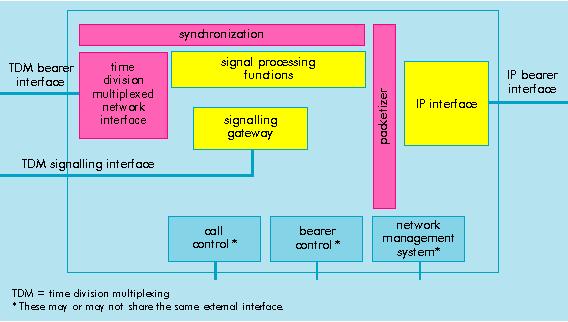
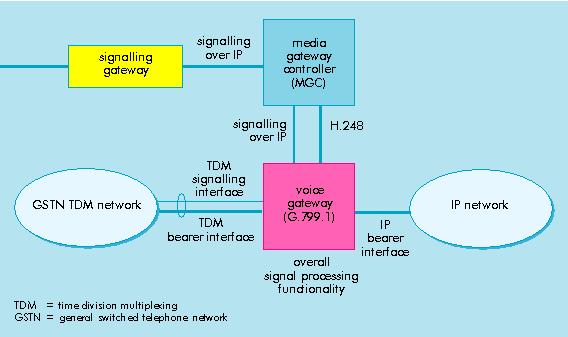
Figure 2 — Location of G.799.1 VoIP gateway in overall network