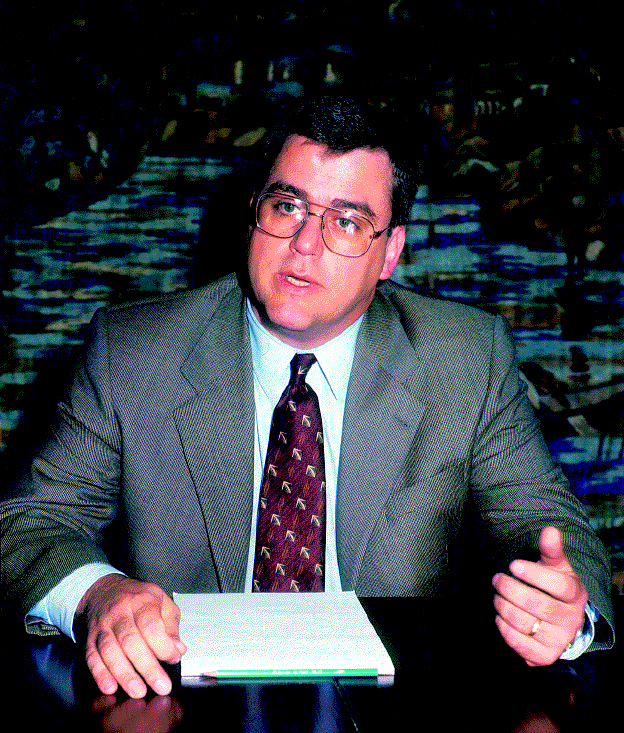
Fred Cate: "How do you know who you are dealing with on the internet?"
(ITU 000007)
Interview with Fred Cate and Arthur Levin
Fred Cate: "How do you know who you are dealing with on the internet?"
(ITU 000007)
F. Cate: The issues we discussed in the High-Level Meeting of Experts can be subdivided into two sets: broad and narrow. The broad issues concern electronic authentication. How do you know who you are dealing with on the Internet? How do you know that a document is authentic, or that the signature is authentic? These questions apply no matter what industry or subset of the population we talk about.
Whether you are buying a book on the Internet or authenticating yourself so that you can vote electronically or whether you are purchasing something expensive, for example, a flat in Geneva (I could not think of anything more expensive) knowing who you are dealing with and knowing that the terms of the contract are what you agreed to are critical issues. But it is not just these broad issues. Neither is it simply making the technology work. It is also the broad ramifications linked to those issues. What about countries which have much lower Internet use than Western Europe or North America? What about economic disparity issues?
The narrow issues specifically concern telecommunications. In many instances, they are not all that different from those I have just mentioned, but they fall within the special purview of ITU. If ITU does not deal with them, who else will in the telecommunications industry? Let me give you some examples. Telecommunication companies provide the key link (i.e. the conduit) that most people use to access the Internet and the World Wide Web. In addition, the telecommunications industry was one of the earliest providers of authentication measures, including serving as certification authorities. As a result, they have a lot of experience on what works and what does not. However, harnessing that experience so that it can be used in the telecommunications industry and elsewhere is a key issue.
As the main conduits for electronic commerce, telecommunication operators have a direct stake and critical role in the growth of e-commerce. But not enough attention has been given to such matters as the potential risks and liabilities of the operators for abuse of electronic signatures and digital certificates.
Finally, the telecommunications industry itself relies on authentication measures in its dealings with suppliers and customers. We can learn from that experience too, but a lot of international cooperation is needed because these companies literally span the globe.
Arthur Levin (left)
and Fred Cate
(ITU 000008)
F. Cate: Many participants noted the wide variety of approaches to electronic signatures and certification authorities reflected in national and State and provincial law, including recent enactments by Argentina, Chile, Denmark, Germany, Italy, Malaysia, and in much of the United States. These enactments often differ on a number of important points, for example: in the definition of digital signatures, effect of meeting a statutory definition, purpose of digital signatures, scope of application, digital certificates, certification authorities and cross-border recognition.
Let me expand a little on some of these points. If we look at the question of definition, some legislation defines digital signatures by technology, while another defines them by attribute or functional criteria (such as "is unique to the person using it" or "is capable of verification").
If we look at the effect of meeting a statutory definition, some legislation requires that a digital signature conform to a specific definition to be valid; authentication measures not within that definition are invalid under such laws. Other legislation creates a presumption of validity if a digital signature meets the legislative definition, but recognizes that other authentication measures may also be valid.
Now, if we look at the purpose of digital signatures, legislation reflects many different purposes for digital signatures: verifying identity, authenticating the text of a document, ensuring the integrity of the text of a document, indicating consent, establishing the legal effectiveness of a document, etc.
Some legislation explicitly limits the scope of digital signatures to transactions with the government or to exclude wills and testamentary dispositions.
On the question of certification authorities, some legislation regulates these authorities: who can be a certification authority; how does one become a certification authority; what specific activities are required of, or prohibited by, a certification authority; what is the role of the government, if any, in registering, auditing, bonding, and otherwise monitoring certification authorities; and what is the liability (or limit on the liability) of a certification authority.
It should also be remembered that the majority of nations have taken no action to facilitate the use of electronic authentication measures.
F. Cate: Let us step back a little and think about what we mean by "harmonize". One thing I do not think anybody is going to be able to do is to make all the different legal systems work in harmony. There are big differences between national legislation.
Even within the European Union there are very different approaches between, say, Germany and the United Kingdom. But what we cannot probably do is make all of these laws work in harmony. What we can do is make the areas in which they differ less problematic. For example, if one law says "Here is how you authenticate identity" and another law says "Here is how you do it", ITU can serve as a clearing house to bridge the gap through technical standards. For example, if the German law says you have to do A, B and C, and the British law says you have to provide a technologically appropriate method, the ITU can say "here is something that satisfies both, here is a technological bridge between these two laws". This is important because in the next generation of laws, when countries come around to revising their laws, they will have learned from each other. They will ask the question: "what did we do well, what did we do wrong, what can we do better?"
While the two-day meeting did not provide sufficient time to reach consensus on precisely what form, if harmonization was desirable or achievable, many participants suggested that, at minimum, harmonization must include facilitating the use and recognition of authentication measures across borders. At the same time, many of the participants recognized that harmonization could not and should not entail efforts to achieve uniformity among authentication measures.
A. Levin: One aspect that ITU can look at is the issue of giving recognition to a certificate across a national border. This is not necessarily a question of harmonization, but rather one of hopefully reaching a global understanding of the conditions under which one country will give recognition to certificates issued in another. There is already some work under way on this issue at other organizations. However, the ITU is unusual among international and intergovernmental organizations. Its work is universal, as its membership includes almost every country in the world (189 Member States) and that means that ITU efforts have significantly broader coverage than those of others that are looking at these issues. Throughout its history, the ITU has developed extensive expertise establishing global standards for interoperability of networks and services and has facilitated telecommunications development throughout the world.
Also, the ITU is one of the few intergovernmental organizations where government and industry work closely together. Its accomplishments reflect this experience of working closely with industry as well as national governments and other multinational organizations. With this unique expertise and experience, ITU is well placed to help foster a global dialogue on authentication measures.
A. Levin: First of all, we were delighted and appreciative that many of the leading experts in the world, from the legal, policy and technical areas came to this meeting, and at their own expense. Many of these experts were new faces at the ITU, and they spent two days working hard to try to advise ITU on what it can do to facilitate the use of authentication as a tool for the growth of electronic commerce. At the end of the two days, the expert group agreed on a set of recommendations for what the ITU should be doing in this area. Of course, the ITU is already at work on some aspects of authentication in the area of technical standards. The Recommendation ITU-T X.509 constitutes one of the bases for certificates and there are other ITU recommendations in the process of development that address other technical issues. But one of the key questions discussed by the meeting was what can be done beyond the techni-cal issues to ensure that these authentication measures can be used globally.
F. Cate: The fact that there was such broad consensus on so many important issues in only two days is noteworthy. Let me offer some additional recommendations that flow from our discussion and expand on the consensus recommendations.
The activities which ITU should pursue vigorously, with regard to authentication in the context of telecommunications should include efforts to better understand and facilitate the telecommunication industry's own use of authentication measures, not just in the context of the Internet but also related to other telecommunication services, such as authenticating the identity of a user of a mobile network.
They should also include the negotiation of flexible legal instruments, such as memoranda of understanding, to address pressing issues that threaten to restrict the development, provision, and use of authentication measures, as well as other digital information services, within the telecommunications industry.
Although this meeting addressed authentication issues, it is important to note (as many participants did), that the telecommunications industry provides many people's essential link to the Internet. Regulations and unresolved issues that threaten the viability of providing that link, such as the potential threat of liability for carriers for digital content of which they are not aware and over which they exercise no control, impose costs on service providers and users and threaten the availability of both authentication measures and information services more generally.
All of these reasons highlight the importance of ITU taking a leadership role in crafting the voluntary standards that can serve as the technical basis for national and regional enactments concerning the recognition of foreign digital certificates. Those standards, typical of ITU recommendations, would not address the legal effect of a digital certificate, but instead, would provide the essential technical foundation for the operation of those national laws.
The ITU is known throughout the world as the source of information about international telecommunication issues
While the ITU should pursue this activity in close cooperation with other organizations, it is important to recognize that the wide variety of international activities concerning authentication measures does not create a disincentive for ITU involvement. Rather, the wide array of disparate activities heightens the importance of active ITU participation to provide leadership and a truly global and inclusive forum.
One of the major obstacles to the harmonization of authentication systems is the lack of centralized information about technologies, national laws, international initiatives, model agreements, private sector initiatives, and the like. In addition, for current public key infrastructure systems to work, there needs to be reliable access to accurate information about certification authorities, digital certificates (valid and revoked), and public keys.
The ITU is well-placed to serve as a central repository of such data, making them available through the World Wide Web and other means, and incorporating them into the Union's own educational efforts concerning authentication and other digital information issues. The ITU is known throughout the world as the source of information about international telecommunication issues. Expanding that role would provide a great service to national governments, industry, other organizations and initiatives involved in this area, academics, and ultimately to the public.

|
by Fred Cate The technologies for providing electronic signatures and certification are many and complex, exceeded perhaps only by the variety of terms used to describe the operations they perform. The concepts, however, are comparatively straightforward, and this brief introduction is intended to help clarify the subject of the High-Level Meeting of Experts. Encryption "Encryption" is a way of encoding a message to hide its content. In the context of computers, encryption is the process of applying a mathematical algorithm to a readable message to generate an unreadable, encoded message. The encoded or encrypted message will appear as gibberish to anyone who should intercept it, but it can be reconverted back to a readable message by anyone who has the appropriate mathematical algorithm. That algorithm is known as the "key" and is usually measured by its length in bits. A longer key (e.g., a 64-bit key) generates a more secure message than a shorter key (e.g., a 40-bit key). Private key encryption There are two primary forms of encryption systems in use today. "Private key encryption", also known as "symmetric" or "single key encryption", relies on a single key to both encode and decode the message. Therefore, anyone with the key can both create encrypted messages and read encrypted messages created with that key. Public key encryption "Public key encryption", also known as "symmetric" encryption, uses two different keys: one (the "public key") to encrypt the message, the other (the "private key") to decrypt it. The two keys are mathematically linked, but the public key cannot be used to discover the private key (much like two numbers can be multiplied to determine a third number, but knowing that third number does not necessarily make it possible to derive the original two numbers). In a public key system, if A wants to send B an encrypted message, A first obtains B's public key from B or a directory of public keys. A then uses B's public key to encrypt the message, which he/she sends to B. B uses his/her private key to decrypt the message. Electronic signatures An "electronic signature" or "digital signature" (these terms are often used interchangeably) is a way to authenticate the source and, in many cases, the text of an electronic message. One of the most common ways to do this today uses the public key encryption system ("public key infrastructure"), but in reverse order. If A wants to digitally sign a message that he/she is sending to B, A first runs the message through a "one-way hash function" — a mathematical algorithm that creates a unique "message digest" for the message. Every time that algorithm is applied to that message it will generate the same message digest. If, however, the message is altered, when the algorithm is applied it will generate a different message digest. As described above with public key encryption, however, knowing the message digest will not allow one to recreate either the message or the algorithm. Having created the message digest, A then encrypts it with his/her private key, attaches the original message (which can be unencrypted or encrypted using B's public key), and sends both to B. A has now digitally signed his/her message to B. B uses A's public key to decrypt the message digest. The fact that A's public key decrypts the message digest shows B that A's private key was used to encrypt the message digest: this helps B verify that A is in fact the sender of the message ("identity authentication"). B can perform the same one-way hash function on A's message to verify that it generates the same message digest. If it does, then the text of the message has not been altered ("content authentication"). Other forms of electronic signatures are also in use and under development, such as the use of biometric identifiers (retinal scans, fingerprints, etc.). These can be used to authenticate the source of the message, but generally not the content. Certification authorities and digital certificates One critical issue with all current forms of electronic signature systems is establishing a physical connection between the sender (or the signor) and the signature. In the public key example above, the fact that B can use A's public key to decrypt the message digest encrypted with A's private key, tells B that the two keys are linked, but it does not actually tell B who A is (just as when a consumer countersigns a traveller's cheque, the fact that the signatures match only tells the merchant that the signor is the same person who signed originally, not who the signor is). This is where a "certification authority" comes in. A "certification authority" is a trusted third party that issues a "digital certificate" attesting to the fact that A is who he or she claims to be and verifying that A's public key does in fact belong to A. Certification authorities must authenticate the identity of their customers (much like a notary must verify the identity of the person whose signature he is notarizing), and must themselves be perceived as reliable. Repositories For both public key encryption and electronic signatures to work in their current form, there must be one or more "repositories" where digital certificates and public keys can be found. Today, repositories are generally maintained by certification authorities. In addition to providing information about valid digital certificates, repositories also need to include information about revoked certificates to prevent the continued use of stolen public keys. Summary All of these functions may sound cumbersome, but they take place electronically, usually automatically, in real-time, and without any direct action by, or even knowledge of, the user. When used together, electronic signatures and certification authorities greatly facilitate e-commerce by making it possible to authenticate both the identity of the sender of a message and the content of that message. The ability to do both is critical to conducting high-value transactions via digital networks, especially between parties who have no pre-existing or face-to-face relationship. Electronic signatures and certification authorities have other potential uses, for example, in facilitating electronic voting, or providing authentication of identity and/or message content in many other contexts. The methods described above are not the only ways available for authenticating identity and content. As a result, rather than focus on specific applications of electronic signatures and certification authorities, it is more accurate to speak of "authentication" measures generally — and that is how the participants in the expert's meeting generally conceived of their topic. |
From 3 to 7 April 2000, the Working Group on ITU Reform (WGR) will hold its second meeting to continue the debate on reforming the International Telecommunication Union. Having laid the groundwork for this task at its first meeting (Geneva, 15-17 December 1999), WGR can now focus on the real mandate assigned by the Plenipotentiary Conference (Minneapolis, 1998). In broad terms, WGR is required to review the management, functioning and structure of the Union as well as the rights and obligations of Member States and Sector Members. It is also to review the contribution of Sector Members towards defraying the expenses of the Union.
|
Rapporteur groups Analysis and synthesis of ITU activities: Identifying strengths and weaknesses of ITU products and services, and options for strengthening the role of ITU Rapporteur: Mr Bruce Gracie, Senior Adviser, International Organizations, Industry Canada Associate rapporteurs: Ms Valerie D'Costa, Head, International Affairs, Infocomm Development Authority (Singapore), Messrs Pierre-André Probst, Director, External Relations, Swisscom and João Carlos Albernaz, Head, Technical Advisory Unit, Agência Nacional de Telecomunicações — ANATEL (Brazil) Management and structure of ITU Rapporteur: Ms Mette J. Konner, Head, International Section IT and International Relations Secretariat, National Telecom Agency (Denmark) Finance and budget Rapporteur: Mr Richard Thwaites, General Manager, National Office for the Information Economy, Department of Communications, Information Technology and the Arts (Australia) |
In his opening remarks to the December meeting, ITU Secretary-General, Yoshio Utsumi, underlined some of the major changes transforming the industry, making reform imperative (see pages 11-13). These include:
WGR's Chairperson, Lyndall Shope-Mafole, Plenipotentiary Minister of Communications at the Embassy of South Africa in Paris, said that the survival of ITU in the new millennium was not a luxury but an imperative, particularly for developing countries.
Ms Shope-Mafole called on the working group to recognize this imperative in interpreting its mandate so that its recommendations can help the Marrakesh Plenipotentiary Conference [scheduled for 2002] reach decisions that will make ITU not only "the focal point for all matters relating to telecommunications in the global information economy and society, but also, the tool for the elimination of the ever-deepening information gap between the haves and have-nots".
WGR used the first meeting to organize its work and has, to this end, set up three rapporteur groups (see box below) and a Bureau (see Table 1), which in their composition have very experienced members of the telecommunication sector in general, and the ITU in particular. All Member States and Sector Members shall participate in WGR on an equal footing.
The April meeting is expected to prepare an interim report to the ITU Council (Geneva, 19-28 July 2000). WGR plans to hold three other meetings, tentatively scheduled for November 2000 and April and November 2001. The conclusions of each meeting will be circulated to all Member States and Sector Members.
Table 1
Bureau of the Working Group on ITU Reform
| chairperson | L. Shope-Mafole (South Africa) | |
| vice-chairperson | Pierre-André Probst (Swisscom) | |
| members of the Bureau | ||
| United States | Region A | Richard Beaird, Senior Deputy Coordinator, Communications and Information Policy, Department of State |
| France | Region B | Patrick Olivier, Head, Office of Multilateral Affairs, State Secretariat for Industry (DIGITIP), Ministry of the Economy, Finance and Industry |
| ETNO* | Region B | Pierre-André Probst |
| Russia | Region C | Alexander I. Kushtuev, Vice-President, Rostelecom |
| Morocco | Region D | Abderrazak Berrada, Permanent Mission of Morocco |
| Senegal | Region D | Cheikh T. Ndiongue, Director, Studies and Regulation for Posts and Telecommunications |
| Japan | Region E |
Manabu Kanaya, Director, International Organizations Office, International Affairs Department, Ministry of Posts and Telecommunications |
|
Saudi Arabia |
Region E | Fareed Y. Khashoggi, Director-General, International Affairs, Ministry of Post, Telegraph and Telephone |
| Jamaica | Ambassador Anthony Hill | |
| chairperson TSAG* | Gary Fishman, Technical Standards Director, Lucent Technologies, Inc. | |
| chairperson RAG* | Michael Goddard, Director, Spectrum Policy Radiocommunications Agency (United Kingdom) | |
|
chairperson TDAG* |
Jong-Soon Lee, Executive Director of the Asia-Pacific Telecommunity (APT) | |
|
*ETNO = European Public Telecommunications Network Operators Association |
||

Arguably, the most pervasive change which our industry is undergoing is the shift from a monopolistic to a competitive market. Back in 1992, just one third of international traffic originated in competitive markets. Today, that figure is more than three-quarters. Furthermore, the nature of competition has changed, from duopolies and triopolies to virtually unrestricted market entry in many domains.
For players in the market, there is little time to pause or reflect. Major competition is also coming from companies that barely existed a few years ago. As technological change has lowered the barriers to market entry, the new players do not generally have large skyscraper headquarters and five-year business plans; rather they are more likely to have "dot com" after their name and a market valuation which reaches the stratosphere.
A few years ago, it would have been possible to estimate the total of public telecommunication operators worldwide simply by counting the number of ITU Member States; now the number of operators is in the thousands. Many of them are active in the mobile and Internet sectors. If ITU's membership is to continue to be inclusive, we must make every effort to invite these new players to join the Union.
Along with market liberalization has come the requirement for separation between regulatory and operational functions. The majority of ITU Member States now have a clear separation between the functions of the policy-making and regulatory bodies on one hand, and the public telecommunication operators on the other. Regional bodies, such as the European Conference of Postal and Telecommunications Administrations (CEPT) in Europe, have also split the functions of operators (ETNO) and regulators (ECTRA — European Committee for Telecommunications Regulatory Affairs). However, this separation has not yet been fully implemented in the work of ITU.
ITU will increasingly need to reach out to the newly-formed regulatory agencies and enhance its role as a forum for coordinating policies and for tackling new regulatory issues
For instance, in the International Telecommunication Regulations, the term "administrations" is used with little precision as to whether this refers to operators or regulators, or both. An expert group has been established to advise on the reform of the Regulations.
Similarly, in Study Group 3 of ITU's Telecommunication Standardization Sector (ITU-T), which deals with tariff and accounting principles, regulatory bodies sit alongside the operators they regulate. This may no longer be appropriate.
If ITU is to change to serve the needs of this changing constituency, it will increasingly need to reach out to the newly-formed regulatory agencies and enhance ITU's role as a forum for coordinating policies and for tackling new regulatory issues. The expert workshop held on 9 and 10 December 1999 on Electronic Signatures and Certification Authorities (see ITU News, No.1/2000, pages 16-19) as part of the "New Initiatives" programme, is a good example of this new role ITU can play.
The development of the Internet
A second change which is transforming the industry is the emergence of the Internet, not only as a new service in its own right, but increasingly also as the basic platform for existing telecommunication services. Within the last few years, a remarkable change has taken place whereby the volume of international voice telephone traffic has been overtaken by Internet traffic. Furthermore, an increasing share of voice traffic now passes over the Internet at some point, in order to gain from the cost savings which IP networks can generate.
The impact of the Internet is both vertical and horizontal, affecting all three sectors:
Computing, communications and broadcasting convergence
In a recent vote by viewers of CNN as to the most important innovations of the 20th century, the telephone, the PC, the television, and the mobile phone all appeared in the top ten. In the 21st century, arguably those devices might merge into one. The Internet, which also appeared in the top ten, is likely to become the dominant service platform. By the end of the decade, there will be many more mobile phones than fixed-line ones. By that time, it is likely that a majority of the devices accessing the Internet will have wireless as well as wired capability. Furthermore, the Internet may well be the preferred delivery mechanism for the delivery of video and audio content.
It is important that the structures of ITU adapt to reflect the underlying changes in the structure of the industry. For instance, it may be more appropriate to have sectors which reflect the different roles of regulators and operators rather than ones which reflect outdated differences between fixed-line and radio-based technologies or, more boldly, to revisit the definition of the mission of ITU to include convergence of telecommunications with broadcasting and information technology.
The changing development gap
One of the most significant changes made in the 1992 reform of the ITU was the creation of the Telecommunication Development Sector. Since that time, there has been a significant narrowing of the gap between the developed world and middle-income developing countries, especially measured in terms of the statistical distribution of the world's telephones and mobile phones. However, there has been a widening of the gap between the middle-income developing countries and the very least developed countries. Furthermore, while the telecommunication development gap may have narrowed in "quantitative" terms, it may have grown in a "qualitative" dimension. The gap between rich and poor is much wider in the distribution of Internet access than for other communication services.
While the Development Sector is the youngest of the three ITU Sectors, it is not immune from the requirement for change. There needs to be a closer focus on the needs of the very poorest countries. Furthermore, whereas ten years ago it may have been technical assistance that was requested from the Development Sector, today it is more likely to be regulatory assistance and information-sharing. This requires a shift in the skills base of the staff of ITU.
 New generation wireless Internet services which were trumpeted so loudly at Telecom 99
(ITU 000010)
New generation wireless Internet services which were trumpeted so loudly at Telecom 99
(ITU 000010)
The speed of these changes
Recently, these changes have accelerated even more and to cope with them we have been called upon to radically change our working methods. While we are proud of the fact that we have reduced the average processing time for a new technical recommendation from four years to nine months, we need to go further still, notably through reform of the approval process itself.
The annual meeting of the ITU Council does not provide a role model for a lean, efficient and decisive organization. Equally, the failure to make decisions on key issues means that much important work is left to the Plenipotentiary which, itself, is often unable to make progress. While it is important to retain democratic and inclusive governance structures it is necessary to take a bold step forward towards greater efficiency.
In addition, if the ITU Secretariat itself is to become more effective and efficient so as to be able to meet the many great challenges before us, its fundamental structure must be seriously reviewed.
The Government of the Federal Republic of Nigeria has ratified the above-mentioned Constitution and Convention as well as the amended Instruments.
The instrument of ratification was deposited with the General Secretariat of the Union on 24 December 1999.
The Governments of Denmark and the Slovak Republic have accepted the above-mentioned Instruments amending the Constitution and Convention.
The Governments of Australia, Canada and the Kingdom of Tonga have ratified the above-mentioned Instruments amending the Constitution and Convention.
The instruments of acceptance and ratification were deposited with the General Secretariat of the Union on 22 and 16 December 1999, 13 January, 8 February and 4 January 2000, respectively.
The Government of Australia has approved the above-mentioned Acts.
Egyptian High Tech Association (EHITA) (Cairo), FLAG Telecom Limited (London), Guyana Telephone & Telegraph Company Ltd. (Georgetown), InTouch Communications Services, S.A.E. (Cairo), Middle East Telecom & Electronics Co., Ltd. (METE) (Amman) and TELECON Consultants (Cairo) have been admitted to take part in the work of this Sector.
Alcatel UK (Camberley, United Kingdom), and Teledesic UK Limited (Horsham, United Kingdom) have been admitted to take part in the work of this Sector.
8x8, Inc. (Santa Clara, CA), Capital One Services, Inc. (Glen Allen, VA), Covad Communications Company (Santa Clara, CA), Element 14 (Cambridge, United Kingdom), Guyana Telephone & Telegraph Company Ltd. (Georgetown), NeuStar, Inc. (Washington, D.C.) and Nuera Communications (Farnborough, United Kingdom) have been admitted to take part in the work of this Sector.
Ascom Tech AG, which participates in the work of the Standardization Sector has changed its name. The new denomination is: Ascom Management AG.
Hewlett-Packard Company, Agilent Technologies, which participates in the work of the Radiocommunication Sector has changed its name. The new denomination is: Agilent Technologies.
LCC International, Inc., which participates in the work of the Standardization Sector has changed its name. The new denomination is: Ericsson NetQual, Inc.
Pan African Telecommunications Union (PATU), which participates in the work of the Development, Radiocommunication and Standardization Sectors has changed its name. The new denomination is: African Telecommunications Union (ATU).
SkyBridge L.L.C.C., which participates in the work of the Radiocommunication Sector has changed its name. The new denomination is: SkyBridge LP.
SOCRAT Equipements, which participates in the work of the Development Sector has changed its name. The new denomination is: Groupe CIRCET S.A.
SPT TELECOM, a.s., which participates in the work of the Development and Standardization Sectors has changed its name. The new denomination is: CESKY TELECOM,a.s.
Stanford Telecom, which participates in the work of the Radiocommunication Sector has changed its name. The new denomination is: ITT Industries, Inc.
Stentor Canadian Network Management (SCNM), which participates in the work of the Radiocommunication and Standardization Sectors has changed its name. The new denomination is: Bell Canada.
Telecommunications Techniques Company UK (TTC UK), which participates in the work of the Standardization Sector has changed its name. The new denomination is: TTC UK.
Wandel & Goltermann GmbH & Co., which participates in the work of the Standardization Sector has changed its name. The new denomination is: Wavetek Wandel Goltermann Eningen GmbH & Co.
Telenor AS (Oslo), which participates in the work of the Development, Radiocommunication and Standardization Sectors has not changed its name (see ITU News, No. 1/2000, page 20).
A circular letter (via facsimile) which has been sent to all Member States and Sector Members of the Union announces the following vacancy:
one post of Administrator, Voluntary Funds, grade P.1, to be filled in the General Secretariat, Finance Department, as soon as possible for one year with possibility of extension (circular letter No. 44 of 17 February 2000; vacancy notice No. 1-2000 ITU; final date for submission of applications: 17 April 2000).
Detailed applications with ITU personal history form should be submitted to the General Secretariat of the ITU, Place des Nations, CH-1211 Geneva 20 (Switzerland), no later than the final dates mentioned above.
Vacancy notices and personal history forms are available on the ITU website, under the "ITU General Secretariat" section: http://www.itu.int/.