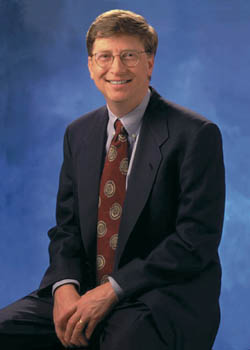
* This is an extract from the remarks by Bill Gates during the Interactive Summit Opening at Telecom 99 (12 October).
* This is an extract from the remarks by Bill Gates during the Interactive Summit Opening at Telecom 99 (12 October).
There is more going on with communications companies today than with any other kind of partner. The kind of empowerment we will be able to provide to workers around the world by bringing software and great communications together is very exciting.
Empowering people anytime, anywhere, and on any device
Microsoft's original vision of a personal computer (PC) in every home and on every desk has made incredible progress. But in some ways, even that breathtaking vision does not encompass what is going on today. For the first time in our twenty-five-year history, we actually changed our vision statement to talk about empowering people in an even broader fashion: any time, any place, on any device.
People will not have to think about moving their information around. Any files or favourites or messages that they are interested in should just immediately show up wherever they are, whether it is the television that will be connected to the Internet, their mobile phone, their computer in their car, or their PC in all its various forms.
In order to make this happen, we are completely dependent on forming strong partnerships with telecommunication companies. That is why, in 1998, not a week went by without some new announcement of how we were working with a great telecommunications partner or bringing software to provide new services for end users.
This combination is very similar to the collaboration that existed between the hardware industry and Microsoft in creating the PC business. Companies like Intel and Compaq were the key partners in those years. Today, our work with telecommunication companies, is equally important to those kinds of partnerships.
|
Stop press! Bill Gates, who founded Microsoft Corporation in 1975, has relinquished his role of Chief Executive Officer (CEO) to Steve Ballmer. Mr Gates made this announcement on 13 January 2000, adding that he would remain Chairman of the company's board and that he would take on a new role as Chief Software Architect. |
Our role as a software provider is to take this idea of the PC, where people are building digital documents, and extend it to digital photography, digital music, video conferencing, or stored digital meetings. We will take all of those things and extend them to all the ways that people access communications. That is why you see partnerships for broadband communications.
Increasing the bandwidth is very important. Certainly the business-to-business connectivity is moving at an incredible pace. The one place that is still a challenge is getting high-speed connections into every home. I believe that DSL [digital subscriber line] will explode in the years to come, even though the volumes today are quite modest, and we will continue to see phenomenal growth in cable modems. Those will be the primary ways that we reach out to homes as well as businesses and give people access to all this information.
We have a number of partnerships aimed at taking our software and applying it to that broadband environment. Some of the applications, are perhaps not anticipated. For example, we are able to monitor someone's PC and support them in a whole new way. If they need advice or want help on anything, by using that high-speed network we can immediately look at their screen and guide them to the option that they need. The whole notion of support and reliability are raised to a new level with that broadband connection.
Other partnerships have to do with mobile data services. It is an exploding area, but it is going beyond just voice to having access to the Internet itself through the mobile phone. Bringing together Internet, XML and wireless standards is one of our roles, working through the standards groups.
Knowledge workers are working in a different way today than in the past. The idea of electronic mail is really taken as a starting point. The kind of advanced collaboration or learning that we will have on top of that is already being shown off in pioneering companies.
The PC continues to surprise analysts. Each year for the last four or five years, people have had very conservative forecasts for the PC, saying that maybe this was the year that PC sales would actually be down. In fact, the installed base of PCs has grown very rapidly. Not only has the price gone down and the volume gone up; the actual power of the device continues to increase. Examples of this are: the expandability through the universal serial bus, more and more use of flat screens that will have the resolution to allow us to move to a paperless environment, more and more wireless connections so you will be able to take that PC and carry it around your business, or even out into the world at large, and still have access to new messages or data changes that you are interested in.
So the PC is not to be underestimated. The volume today is well over 100 million units a year, and that has driven the software industry to create some very exciting things.
However, when you think about your PC today, you still have too many things that you have to move around yourself. If you have two PCs and are moving the files back and forth, it is a lot of work. Making sure that when you go home, you have access to the information you had at work; that requires special steps.
What we have to do here is work with telecommunication providers so that all that information (business databases, files, contacts) shows up automatically as soon as you authenticate who you are. We have quite a range of devices that are part of this information any time, anywhere. We have the full-blown PCs that have the screen size that lets you create and annotate documents. This idea of annotating and collaborating is also exploding, whether it is voice notes or handwritten annotations. The ability to share those across the Internet with all your co-workers is an important productivity improvement.
At the low end, we have very simple devices like a light switch or a pager or a simple phone with just a micro-browser, but we need to develop a very simple layer of software, relying on the servers to do the actual hard work. This is a new area for us, including the smart card capabilities that are being offered now for the GSM phones or for PC authentication.
Each of these devices will connect up to the Internet and get rich services. Authentication is the first one that is necessary, but beyond that you need directory capabilities, unified messaging capabilities, all of which run on the Internet and the user does not have to think about where those things actually are.
We believe these scenarios will excite users, so that in the same way the PC took off by word of mouth, the demand for these things will really explode without needing a lot of marketing. It requires end-to-end solutions. It requires integrated solutions. Some communication centres today, if you work with them on the mobile side, you get one mailbox. If you work with them on their broadband capability, you get another mailbox. And that is a different mailbox from the one you may have at home and different from the one you have at work. So you are forced to be the coordinator of all those pieces.
If we can get rid of that and make it seamless to see the information on the mobile phone or the new devices that will have even larger screens, that is where we will really see the demand take off and see the full potential of information any time, anywhere.
We are very pleased to see the evolution taking place of the wireless standards and the Internet standards. Bringing those together has been a mammoth task over the last few years, and we are getting really excellent standards for the wireless connections. The 802.11 and the so-called "Bluetooth" will be built into many of these devices, and so they will automatically discover what services or other devices are around.
If you take your phone into your home environment, you will even have advertising on the wireless network that will say "there is a television there you could control" or you could select music and direct that to any of the speakers in your house. To have the phone itself be a control device in these wireless networks is something that the higher-level protocols will guarantee.
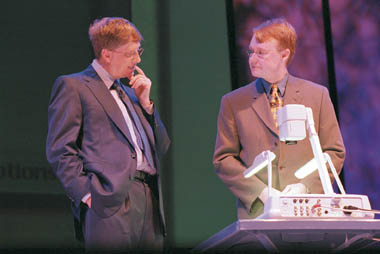
Bill Gates and Ian Ferrell (right)
(ITU 000001)
I. Ferrell: Hi, Bill. This is a prototype GSM smart phone that we built back at the Microsoft laboratory. It is a Windows CE-based device that has an integrated GSM radio module. If you like, I can show you how it works.
B. Gates: Yeah, let us see if it works [laughter].That is a beautiful screen.
I. Ferrell: Yes, this is a colour screen. People definitely like the high fidelity on these smaller devices. What we have here is similar to what you see with a traditional cell phone, the carrier information with the battery and signal strength, but there is also additional information that is on this device, such as mail messages and upcoming appointments. We also have a start menu with smart buttons. The start menu will allow me to access my applications. With the options button, I can bring up the phone option [pause]. We just got a message alert. What we have done is with the tie-in with exchange, e-mail is sent directly to the device. I do not have to worry about having multiple e-mail accounts at this point. The e-mail is broadcast directly to the phone.
B. Gates: So that person did not have to think about sending the message to your mobile phone. They just sent it to your normal address, and you set up rules that control which messages would be passed to the phone.
I. Ferrell: Correct. When you send a piece of e-mail to somebody, you do not have to think, "Now, am I sending it to their work? Am I sending it to their phone?" You just send it. This device becomes kind of just another Outlook client, another window onto your Exchange information.
B. Gates: Now, let us say I want to respond to this. What kind of options do I have?
I. Ferrell: You have a lot. Let us open up the mail message. One of the quick options that I have is I could certainly reply back and send a text message if I wanted to. Another quick way, since this is a phone, is that I could just press the talk button and call the person directly.
B. Gates: Instant messaging.
I. Ferrell: Instant messaging. There are some other options as well. I could just reply back with a voice message if I do not want to disturb them, or I could send them a fax message.
B. Gates: Okay. So if I send a voice message, if they are running on their PC, how will that show up? Will they be able to play back the voice?
I. Ferrell: Yes. It will show up just as a ".WAV" attachment that they can double-click on, and the information will be played over their speakers. We could try it. Would you like to see?
B. Gates: Okay, let us give it a shot.
I. Ferrell: I am selecting "Reply by voice." The mail message was asking me where we are going to have food after this meeting. I am going to look for some food and will let you know the location as soon as possible. Here we have put a ".WAV" attachment onto the mail message. A lot of times when you have a phone, you do not want to spend a lot of time entering text. It is just much quicker to make a voice recording and send that off to the user. So you can simply press the send button and the message goes off.
B. Gates: Well, and do we have access to the Internet here? What kind of information services can we get to?
I. Ferrell: We can definitely get to the Internet. In fact, we can go back to the question of where we can get some food. Let us see if we have got a website we can go to. Let us go to a website that our MSN mobile team has set up. This is some city information on Geneva. So what we are doing right now is creating a dial-up connection to the Internet and downloading a Web page with some Geneva-specific information onto the phone.
B. Gates: Now, this Web page can use just standard HTML. It does not have to be a different offering environment. It is the same as the normal Internet.
I. Ferrell: Correct. This is a traditional Internet Explorer. It has got all the full Internet standard support like HTML and scripting.
B. Gates: I see you have got accommodations there. I do not think we need to look there. We know there is nothing available within about 50 miles [laughter]. So let us try restaurants.
I. Ferrell: Okay. What we will do is go to a restaurant page that will allow us to search for a restaurant of our choice. Let us get some Italian food. Would you be willing to pick up the bill?
B. Gates: Sure.
I. Ferrell: Okay, we will go four-star then [laughter]. What this is doing is an over-the-Internet connection back to an SQL database. Based on our criteria, they are returning a list of actual restaurants that match that. The little icons to the side [points to them] are giving me some additional information on these restaurants, such as whether I can dial them directly from the phone, whether there is a map available. This first entry, the Trattoria, has an icon. That means that they support e-commerce.
B. Gates: Fantastic. Let us give it a shot.
I. Ferrell: What we will do is connect to the Trattoria website and place our order. Again, we are going back over the Internet and booking this. We have got an order confirmation back, and the Microsoft wallet on the phone has thoughtfully put in my credit card information.
B. Gates: Now, that credit card. What kind of security problem would you have if you send it across the wireless network?
I. Ferrell: You would definitely want to be concerned. But in this case, the Web browser supports SSL. So we are in a fully secure end-to-end Web transaction at this point. The same thing applies to corporate data, if you are accessing the corporate or website over the Internet. Because the browser supports SSL, you are well protected. So let us actually submit this order and get our pizza on the way [pause]. They have received the order and will be delivering the pizza. Another thing is that because this is a personal device you will be carrying around with you, you will want to carry some subset of the data that you normally have in Exchange today.
B. Gates: That is fantastic. It is great to see it all running on a mobile phone.

(ITU 000002)
That is a level of power that even the PC itself did not have a few years ago. By working with telecommunication companies, that is something that millions of people will be taking advantage of in the year 2000.
We even have people that are going to be hosting thousands of websites on a single machine. But the one question they are always left with is what about scale? Having your website stay up 24 hours a day and be totally reliable and have high responsiveness is very important.
There are two different strategies for attacking the scale challenge. One is to build bigger boxes, and that is called "scale up". The progress there is pretty fantastic. We have gone from 2000 transactions a minute to over 40000. In fact, that can handle the enterprise resource planning software for even the biggest businesses.
With the Web we are going to have to go even further. This scale up approach with faster chips and faster buses over the next eighteen months will more than triple in speed. So we will go up over 100000 transactions a minute. What this means is that the PC environment will match the performance of even the most expensive mainframe or UNIX environments.
Telecom 99 [was] very well-timed, because it [let] us herald the importance of all these different partnerships we are building with communications companies. I have shown some of the headlines of what is going on. What this represents is a belief by Microsoft that the demand for advanced communications has been greatly underestimated, whether it is broadband out of the home, or getting data onto your mobile phone.
We have made a bet that these things will really explode. We have taken our software R&D budget and really aimed at these integration scenarios, integrating the television, the mobile phone and the PC, and letting people get information in a way that they do not even have to think about where it is located.
It is important to note that we stay focused on what we are good at, which is building software. Any of the investments we make are minority investments. We do not seek any kind of controlling position, because we want to get up every day and think about software, think about the horizons out there; such as the voice recognition that will be part of those servers and make that mobile phone scenario even more exciting.
Tackling those tough software problems is the thing that has caused us to continually increase our R&D budget to now over USD 3 billion a year.
But even building great software does not provide a full solution unless we focus on partnerships. That is the big reason why we [were] at Telecom 99 to highlight that progress and our commitment to work with these telecommunication partners.
We look forward to seeing these solutions rolling out as we work with our partners.
During 1999, leading mobile operators committed hundreds of billions of dollars to international takeover bids. A year that opened with Vodafone's absorption of AirTouch for USD 74 billion closed with a Vodafone AirTouch bid which was in excess of 125 billion for German operator Mannesmann (see Table 1).
According to Mobile market leaders, a new report from telecommunications consultancy Analysys, this internationalization is being driven by the pressures on operators in their domestic markets, together with the perceived opportunities overseas. Established operators in well-developed home markets are facing some difficult choices.
Fierce competition continues to drive prices down as more licences are awarded and markets mature. The imperative is for new sources of revenues and profits. The attraction of overseas ventures is that less mature markets still offer good returns, while in established markets there are opportunities to add value by offering a genuinely international service.
The pace of consolidation is picking up, and the number of possible moves for joint venture, partnership or takeover are more and more limited. Operators will increasingly be confronted with a stark choice — to buy or be bought.
As players jockey for position, old alliances will be disrupted and new ones formed. Operators will find that they are competing in some markets and cooperating in others, which will place new and challenging demands on their management.
While the leading mobile operators have been on the internationalization trail for some time, their efforts are now taking on a new urgency as national markets open to foreign players. There is also a growing realization that, in order to enjoy the full advantages of internationalization, it is desirable to control, rather than merely invest in, overseas operators.
Apart from internationalization, the Analysys report discusses five other critical technical and business issues which have assumed importance for today's mobile operators: tariffing, branding, fixed-mobile convergence, mobile data services and preparations for third generation (3G) systems.
The report also highlights the 30 largest and most innovative players (see box above) that are driving these dramatic changes in the mobile market. — Analysys.
| deal | month of announcement in 1999 | reported value (USD billions)1 |
status at November 1999 |
| Vodafone Group's acquisition of AirTouch Communications | January | 73.7 | completed on 30 June 1999 |
| Deutsche Telekom's acquisition of One 2 One | August | 13.6 | awaiting approval by Deutsche Telekom Board and the European Union |
| combination of United States mobile operations of Bell Atlantic Corp. and Vodafone AirTouch | September | 702 | accepted by Boards; awaiting completion |
| Mannesmann AG's acquisition of Orange plc. | October | 32 | offer made to shareholders; press speculation that rival bids will be lodged |
| Deutsche Telekom's acquisition of West Media One's Eastern European mobile operations | October | 2 | awaiting approval by respective regulators |
| Vodafone AirTouch's hostile offer to take over Mannesmann | November | 1253 | turned down by Mannesmann |
|
1 Values are for the acquired company unless otherwise stated. Source: Analysys (1999) |
|||
|
Operators profiled in "Mobile market leaders" AT&T Wireless BCE Mobile Communications Inc. (Bell Mobility) Bell Atlantic (Mobile Operations) BellSouth Corp. (Mobile Operations) BT Cellnet DDI Corp. (Mobile Operations) Deutsche Telekom MobilNet GmbH (T-Mobil) France Télécom (Mobile Operations) Mannesmann Mobilfunk GmbH Mobile Telephone Networks (Pty) Ltd. (MTN) Nextel Communications Inc. NTT Mobile Communications Network Inc. (NTT DoCoMo) Omnitel Pronto Italia GSM Orange plc. RadioMobil AS SFR (Société française du radiotéléphone) Singapore Telecom Ltd. (SingTel) (Mobile Operations) SK Telecom Corp. (formerly Korea Mobile Telecom) SmarTone Telecommunications Holdings Ltd. Sonera Oy (Mobile Operations) Sprint PCS Swisscom (Mobile Operations) Tele Danmark A/S (Mobile Operations) Telecel Comunicações Pessoais (Portugal) Telecom Italia (Mobile Operations) Telefónica (Mobile Operations) Telia Mobile AB Telstra Corp. Ltd. (Mobile Operations) VimpelCom (Bee Line Network) Vodafone AirTouch (formerly Vodafone Group plc. and AirTouch Communications Inc.) |
Most of Western Europe's telecommunication markets were opened to competition bearly two years ago. But already, incumbents and new entrants are scrambling to reduce their exposure in core markets through acquisition and merger.
According to the fourth edition of New network operators in Western Europe, a report from telecommunication consultancy Analysys, the combined forces of falling prices, intensifying competition and rapid technological change are shaking the foundations of the fixed telecommunications industry. The new environment is forcing players to reassess their original business propositions, formulated in anticipation of a very different market to that which now confronts them.
In fixed telecommunications, careful positioning is crucial to survival
As value falls out of core telephony markets, operators are looking for where the sustainable value lies. They are trying to cover all the bases while waiting to see whether bit transport, ownership of local loop infrastructure, supply of value-added services or content will be the profit generators of the future. The result is rapid consolidation to achieve the scale and portfolio breadth that will enable new entrants to compete with former monopoly operators before margins in the fixed voice market get too low.
Consolidation is being driven by four major trends.
Much of the consolidation has an international element, reflecting the trend towards globalization and operator interest in establishing a cross-border presence. This trend is typified by Global TeleSystems Group (GTS). In March 1999 it purchased Esprit Telecom, a pan-European operator. Two months later, it finalized the take-over of French operator Omnicom, and in August 1999 it acquired the Belgian reseller InTouch. GTS has also absorbed the international carriers' carrier Hermes Europe Railtel during 1999.
Interestingly, and perhaps ominously for the new entrants, the incumbent operators are also participating in much international acquisition activity, with BT, France Télécom and Swisscom being particularly expansionist (see Table 1).
Soon, distance will no longer command a premium in Western Europe
The report reveals that more than 1000 licences have been awarded across Western Europe — 500 of these in the United Kingdom, with France and Germany accounting for another 230. However, the large number of licences masks the degree of consolidation which is taking place. In the United Kingdom, for example, just eight companies control almost 90 per cent of the market share which has been taken from BT.
In Germany, the merger of o.tel.o and Mannesmann Arcor in April 1999 created the largest alternative operator to Deutsche Telekom, controlling roughly one third of the telephony market share taken from the incumbent.
Profiles of the former monopoly operators look, in detail, at the impact of competition on their performance and prospects. — Analysys.
| incumbent operator | shareholdings in new network operators |
| Belgacom | Belgacom France, 100%; Tritone Telecom (Germany and Netherlands) 40% |
| BT | Albacom SpA (Italy), 23%; Arrakis (Spain), 100%; BT Telecomunicaciones SA (Spain), 100%; BT (Worldwide) Ltd (Belgium), 100%; Cegetel (France), 26%; Ocean Communications Ltd (Ireland), 50%; sunrise communications AG (Switzerland), 24.4%; Telenordia AB (Finland and Sweden), 33.3%; Telfort (Netherlands), 50%; VIAG Interkom (Germany), 45% |
| Deutsche Telekom | MetroHoldings Ltd (United Kingdom), 25%; Multilink SA (Switzerland), 50%; WIND Telecomunicazioni SpA (Italy), 24.5% |
| France Télécom | Casema [Dutchtone Group] (Belgium), 100%; EITele Ost (Norway), 34%; Lince Comunicaciones SA [Uni2] (Spain), 69%; Lyonnaise Câble (France), 17%, via France Télécom Câble; MetroHoldings Ltd (United Kingdom), 25%; Mobilix A/S (Denmark), 54%; Mobistar (Belgium), 51%; Multilink SA (Switzerland), 50%; WIND Telecomunicazioni SpA (Italy), 24.5% |
| KPN Telecom | KPNQwest (pan-Europe), 50%; SIRIS (France), 33.3%, held through Unisource; Unisource Belgium, 100% |
| Sonera (formerly Telecom Finland) | Axxon Telecom Netherlands, 40%; HanseNet Telefongesellschaft (Germany), 50%; Sonera Belgium NV, 100%; Sonera Nederland BV, 100%; Sonera Sverige(Sweden), 100% |
| Swisscom | Communications Network Services [Communikationsnetze Süd-West GmbH & Co. KG] (Germany), 50%; debitel AG (Belgium, Denmark, France, Germany, and Netherlands), 74%; ESTEL (France), 50%; SIRIS (France), 33.3%, held through Unisource; tesion Communikationsnetze Südwest GmbH & Co. KG (Germany), 50%; UTA Telekom AG (Austria), 50% plus one share |
| Tele Danmark | Connect Austria [One], 15%; sunrise communications AG (Switzerland), 37.2%; Talkline GmbH (Germany and Netherlands), 100%; Telenordia AB (Sweden), 33.3% |
| Telecom Italia | 9 Telecom Réseau [formerly 9 Telecom SA] (France), 89.4%; Madritel[formerly CYC Telecomunicaciones Madrid SA] (Spain), 23%; Euskaltel (Spain), 18%; Retevisión SA (Spain), 28.67%; Cable i Televisió de Catalunya SA [CTC] (Spain), 26.25% |
| Telenor | Connect Austria [One], 17.45%; Telenordia AB (Sweden), 33.3%; VIAG Interkom GmbH & Co. (Germany), 10% |
| Telia | SIRIS (France), 33.3%, held through Unisource; Telia A/S (Denmark) 100%; Telia Finland Oy, 100%; Telia Norge AS (Norway), 100%; Telia Stofa A/S (Denmark), 100% |
Source: Analysys (1999).
The free Internet service provider (ISP)phenomenon, where the traditional monthly subscription charge is dropped in favour of alternative revenue sources, is a critical milestone on the path of the emerging Internet economy.
Flat-rate or unmetered access is critical for pervasive Internet economy
According to International Data Corporation (IDC), this market will continue to develop beyond the simple substitution of access with "free" access, leading eventually to low- or no-cost Internet access within the context of a broader, Internet commerce-based consumer economy.
The free ISP model initially flourished in the United Kingdom. A combination of higher local call charges and advantageous revenue sharing allowed United Kingdom ISPs to construct their business around call revenues rather than service subscriptions.
Free access has now become the standard business model in the United Kingdom with many traditional ISPs launching free services. The free ISP model is, however, not without flaws. As dial-up prices decrease, ISPs will be forced to look elsewhere for revenue, the obvious alternative source being advertising. The provision of value-added services, such as online banking, shopping or trading, will also compensate for the loss of call revenues.
Non-subscription services have now been launched in most Western European countries and pan-European free access services are even beginning to appear. However, despite the apparent success of free ISPs in Europe, the model that made the United Kingdom market lucrative for free providers does not exist to the same extent in many other countries.
The provision of value-added services, such as online banking, shopping or trading, will also compensate for the loss of call revenues
In some countries, such as Spain and Italy, where the national public telephony operators (PTO) operate the major free ISPs, high proportions of existing customers have quickly made the change to free services.
While PTOs are able to provide free access to a large number of users in ways that are uneconomical to external providers, they have done so at the expense of competition. In these cases, competing ISPs are forced to explore alternative revenue sources with which to fund subscription-free access.
Despite the strong growth of free services and the rapid conversion of major ISPs to free access models, it is unlikely that all services will "go free". Due to the lack of a formal contract between the user and ISP and the absence of payment, churn is inevitably higher.
Users of free ISPs have little reason to remain with an under-performing provider other than reliance on that provider's value-added services or unwillingness to change e-mail address and/or URL. Additionally, again due to the lack of ongoing subscription charge, accounts can be underused. Faced with high churn rates and lack of service use, free ISPs must confront the problem of driving up site traffic via advertising, commerce and pay-for value-added services. - IDC.