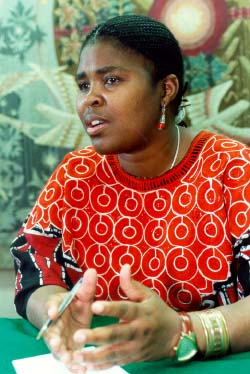
Lyndall Shope-Mafole
Photo: A. de Ferron (ITU 990040)
There is one poster that many of you may have seen which has a simple but profound message that I would like to share with you. It is the UNICEF [United Nations Children's Fund] poster in which a child is asked: "What would you like to be when you grow up?" The child responds: "Alive".
We cannot afford the luxury of wondering whether what is happening to millions of people around us has anything to do with us. Let us not wonder to whom the challenge by the children on the UNICEF poster is posed, it is posed to us. In these words, Lyndall Shope-Mafole, the first woman ever to chair the Council, opened the 1999 session of the Union's governing body (see "Editorial", ITU News, No. 5/99) — likening the task ahead to Ernest Hemingway's classic: For whom the bell tolls.
And so for ten days (16–24 June 1999), the Council ploughed through its heavy agenda with a sense of urgency, reaching important conclusions. One of them was the endorsement of the Secretary-General's new initiatives to strengthen the Union's policy role. These initiatives include:
Two new groups were set up. One is a group of experts made up of 20 members with the mandate to assist the Secretary-General in the preparation of a study on the impact of changes in the regulation and operation of international telecommunication services on the International Telecommunication Regulations, which were last updated at the World Administrative Telegraph and Telephone Conference in Melbourne in 1988.
The other is a Working Group on ITU Reform open to both Member States and Sector Members with the mandate to not only review the management, functioning and structure of the Union and the rights and obligations of the entire membership, but also to consider ways of strengthening the Union's financial base. A 15-member bureau was approved to coordinate the work of the Reform Group and will be chaired by Ms Shope-Mafole.
On the question of cost-recovery, a schedule of fees for different classes of satellite network filings was approved. The status quo was maintained with regard to other products and services identified by the Union in recent years as possible candidates for cost-recovery. A number of global services (ITU ATM end system addresses, universal international premium rate numbers and universal shared cost numbers), for which a registrar function may be required in the not-too-distant future, were noted as the next candidates for cost-recovery.
On the holding of a World Summit on the Information Society the preliminary actions taken by the ITU Task Force were endorsed and a report on the outcome of a feasibility study will be submitted to the next session of the Council for a decision.
A cooperation agreement was endorsed between ITU and the United Nations Educational, Scientific and Cultural Organization (UNESCO). On the other hand, a framework was established for further negotiations for a cooperation agreement between ITU and the World Trade Organization (WTO).
As for the holding of the Radiocommunication Assembly (RA-2000) and the World Radiocommunication Conference (WRC-2000), the Council agreed to continue its consultations by correspondence to agree on the dates and venue.
"Mobile cellular communications: challenges and opportunities" was chosen as the theme to mark the year 2000 World Telecommunication Day.
The interviews published in this issue capture the mood of the Council. A more detailed report is available at http://www.itu.int/newsroom/press/council/pressreport99.html. For those without access to the Internet, a copy can be requested from the "ITU Press Office. Tel.: +41 22 730 6039. Fax: +41 22 730 5939. E-mail: pressinfo@itu.int".
Lyndall Shope-Mafole
Photo: A. de Ferron (ITU 990040)
Ms Shope-Mafole, this is the first time in the history of the ITU that a woman has been elected to chair the Council. What was the biggest challenge for you as the first woman at the helm of the Union's governing body?
The biggest challenge for me was perception. All the delegates know that difficult and important issues are discussed at each Council session. So, on the one hand, there were many people wondering if I could do the job. But on the other hand, there was an even stronger expectation that I could rise to the occasion. Many people saw me as a role model for women, and for younger women in particular as I am only 41. Given my age, they really wanted me to succeed, which created tremendous pressure. Personally, I was very determined to answer people's perceptions whether they were positive or negative, to prove that I could do a good job and that people's trust and confidence in me were not misplaced.
Did you have any preconceptions about chairing the Council before you arrived in Geneva? If so, how did reality differ from your expectations?
There were some difficult issues facing the Council. But I was pleasantly surprised at the level of cooperation between delegations, perhaps in spite of their wanting to fight for more. I was also pleasantly surprised at the number of expressions of support and the cooperative attitude I received from many of the male delegates. That surprised me a little, as some delegates love to remind the secretariat that it exists to serve them, and the Chairperson that he or she is there to chair the meeting, not to tell them what to do.
At first, many people were a little nervous about my position, and expressed that nervousness by offering lots of advice. Sometimes I seem younger than 41, so I guess they were concerned that such a young person was playing such a difficult and important role. In some cases, there was the assumption that I could never have handled anything like this before. In fact, I have worked for some time in the United Nations system, and have represented my country before. Defending a position is, therefore, nothing foreign to me. Let me just give you an example. I was once a regulator under South Africa's Regulatory Authority, and as many people know, our parliament can be aggressive, so I was not overawed by this new challenge. But as this is the first time I have been selected for such an eminent and visible position, while I was confident that I could manage from my experience, I was still a little humbled by this "new" experience.
In your opening address, you gave the Council a theme taken from a UNICEF poster in which a child is asked "What would you like to be when you grow up?" The child responds "Alive". How has the Council responded to this theme, and to the needs of the millions of children and adults who have never made a phone call?
Initially, some people did not understand the relevance of this theme, but realized later in our discussions that that statement was indeed relevant to what we were doing. I was pleased when two councillors referred to the theme. No matter how hard we try to say that ITU is apolitical, it is up to us to decide whether something is political or not. What we do is very important. The ITU is an intergovernmental body that tries to play a role that will make life better for all people, even more so nowadays with the new services and technologies that could rapidly improve quality of life in the developing countries. That in itself is a political act which, in my view, brings an extra dimension into the Council's deliberations.
After all, I think that this is the first time a person who has been an exile has chaired a meeting of an international organization. So my being here is a political statement. There are so many children without a home, without a country, without a flag — but here was one chairing such an important meeting.
I mentioned in my acceptance speech at the Minneapolis Plenipotentiary Conference that, without the international support which South Africa received during its struggle, my country would not be what it is today. Also, I would not be Chairperson.
It was international solidarity that educated me in various countries while I was exiled. The years I spent in the Czech Republic, Tanzania and Cuba helped me to get here, and I hope that the delegations from those countries think that their support for my education was worthwhile.
Whilst the Minneapolis Plenipotentiary Conference may not have changed the ITU into the Union of the 21st century, it gave the necessary instructions and mandates to the Council. Do you think that this session of the Council has taken steps to make the Union fit for the next century?
Absolutely. We have taken some steps in the right direction, and none of that would have been possible without the spirit and results of the Minneapolis Conference. You will have noticed in particular that delegates were consciously trying to make the meeting as efficient as possible. Speeches were kept short and the amount of documentation was kept to the essentials. At the same time, there is a feeling of impatience. A working group has been set up to look at ways of reforming the ITU, with myself as Chairperson.
Many delegates feel passionately about the need for the Union to take the leading role in the telecommunication sector. They have high expectations from this new working group. This session of the Council has taken decisions that will change the character and appeal of the ITU in a profound way.
As Chairperson, is there a message that you would like to send to the various parties involved in the Union's activities?
To the Council, the ones with the power to move things forward, I would say "keep an open mind". In a way, I am lucky to come from a country that has witnessed so many changes and seen things which I never thought I would see happening. I am used to change and to seeing new ideas become reality. That is why it is important to keep an open mind. The Council needs to be sensitive, to take people seriously, to operate in an atmosphere of mutual trust, to evaluate contributions fairly, and not to assume that there is always a hidden agenda.
The Council will be receiving a lot of reports between now and the next Plenipotentiary Conference in 2002. It will need to comment on these reports and to adopt some of them ¾ only an open mind will allow the ITU to move forward.
To the elected officials and the ITU management, I would say that they will need to restructure the ITU to meet the challenges of the future. In doing so, they should always remember that they are dealing with human beings, not with numbers. The best way to achieve change is to include people in discussions about the changes needed — employ good change management tactics and involve people.
To Sector Members who perceive the ITU as slow and heavily bureaucratic, they must remember that with 188 Member States, it does take time to reach decisions
To the staff, my message would be that they need to understand that change is the only constant. The ITU will change in the future, and everyone will need an open mind. The best strategy I can recommend towards change is to welcome it and adapt to it. In South Africa, we saw some very interesting things when changes started taking place. For example, when many companies were privatized. In those companies where the management worked with staff to make change work, there were fewer strikes, and the companies have flourished. Clearly, it is necessary to have an open mind, because change is not necessarily a bad thing. We need to understand that change is largely inevitable, but that it is possible to embrace it, and to survive and even thrive on it.
To Sector Members who perceive the ITU as slow and heavily bureaucratic, they must remember that with 188 Member States, it does take time to reach decisions. Many of our Member States are concerned about the changes which will result from the development of the global information economy. Member States from the developing world still have national laws which need to be respected. Understandably, many of them are nervous about the role to be played by Sector Members, many of whom are from the developed world. This reluctance is not because Member States do not like Sector Members; they are just reluctant to move too quickly, since we are talking about sovereign governments with their own ways of doing things. But it could be worse. The membership is moving, and has recognized that ITU needs to change to remain relevant in today's world. It is absolutely possible to create something special, within the UN system, out of today's ITU. We are fortunate to be in a "fashionable" industry. I am committed to finding a way for the public and private sectors to work together for the good of humanity and for mutual benefit.
The problem at the moment is that, even if we get more people involved in the ITU, there will always be those who need the ITU but who do not know it; and there will be those who know the ITU but do not think they need it. Our job is to make the ITU relevant to each section of society, be it in the private or public sector, and to meet the challenge of the global information society as technologies and industries converge.
On a general note to Member States and Sector Members, I would like to appeal to them to find ways of involving more women in the work of ITU — especially younger women. To the women themselves, I would encourage them to seize the opportunity to become involved. This requires work — not just following the activities of the ITU, but keeping up to date with developments in the industry as well. It does pay off. I am living proof of that.
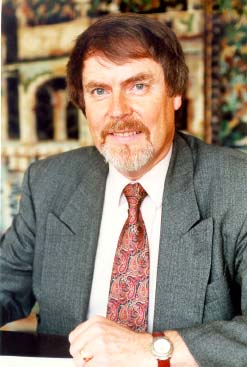
Bruce Gracie
Photo: A. de Ferron (ITU 990041)
As the new Chairperson of the Council's Standing Committee on Finance, how would you describe the budget approved for the Union for the years 2000 and 2001?
The Council approved a biennial budget of CHF 332.6 million for the years 2000 and 2001. This amount reflects exactly the ceiling of CHF 333.2 million established by the Plenipotentiary Conference (Minneapolis, 1998), taking into consideration the fact that the exchange rate between the United States dollar and the Swiss franc was different when that ceiling was established. That difference has been absorbed within the budget itself and the Council was able to approve a zero nominal growth budget in accordance with Decision 5 of Minneapolis, which deals with the expenditure of the Union for the period 2000 to 2003.
Furthermore, efforts undertaken to diversify the income base of the Union, principally through the mechanism of cost recovery, have resulted in the lowering of the amount of the contributory unit for both Member States and Sector Members.
Unlike in previous years, the Union's budget for the years 2000 and 2001 was presented differently to the benefit of the ITU membership. In particular, the various components of the budget were laid out clearly, making it more transparent and more easily understood. The ITU's new management team has undertaken particular efforts, given in part as a result of the discussions that took place in Minneapolis, concerning the need for increased transparency in presenting the Union's financial situation.
Among the initiatives agreed in Minneapolis was the need to link the financial planning process with both operational and strategic planning. With this approach, we have a much clearer understanding of the need to establish the linkage between the priority activities and the financial credits that are available. So the onus, of course, is on the General Secretariat and on the three Sectors of the Union (Radiocommunication, Standardization and Development) to manage their budgets in such a way that the high priority activities are financed properly, but at the same time they will have to make decisions where the lesser priority activities may not receive the financing that they did in the past. This of course was the approach decided in Minneapolis and the way in which the budget was presented is fully consistent with that approach.
The decisions taken on cost recovery, as far as satellite network filings are concerned, was an important step in the process of stabilizing the financial base of the Union
We need to congratulate the management team for taking the bull by the horns and presenting the membership with a much more transparent and balanced budget and with a realistic financial basis from which we can finance properly what we consider, as Members of the Union, to be the most important activities that need to be undertaken in the future.
Is a zero nominal growth budget in step at all with the current growth of the telecommunications industry?
It was very clear from the budget that a number of the new initiatives agreed in Minneapolis to reflect the changes in the telecommunication environment needed to be financed. There was also a clear indication as to how much those new initiatives would cost. At the same time, there was a presentation of the fact that some activities would need to be either down-scaled or even curtailed altogether to ensure that those new initiatives which were considered to be of high priority were financed properly. Again, I come back to the question of the linkage between financial, strategic and operational planning. With these management tools at the disposal of the new management team, it will be easier to make the kinds of decisions that will be necessary in order to maintain the zero nominal growth budget.
What are your thoughts on the new concept of cost recovery on certain ITU products and services as a way of strengthening the financial base of the Union?
The introduction of this new concept in ITU is, in some sense, the culmination of a process that really began with the High Level Committee and evolved through the decisions taken by the Additional Plenipotentiary Conference in Geneva (1992) and the Plenipotentiary Conference in Kyoto (1994). We need to recall that Resolution 39 of Kyoto specifically focused on the need to find ways and means of strengthening the financial base of the Union and resulted in the establishment of an informal group and later, the ITU-2000 Group. I think this is a milestone, based on how the discussions that have taken place in the past have evolved.
Indeed, the decisions taken on cost recovery, as far as satellite network filings are concerned, was an important step in the process of stabilizing the financial base of the Union. There was a clear expectation at the Kyoto Plenipotentiary Conference and in its Strategic Plan that the contributions from Member States and Sector Members had reached a plateau and were likely to decline. The fact that those contributions declined by 3.4 per cent after Minneapolis is a clear testimony to that expectation.
So we really need to continue to explore ways and means of stabilizing the financial base of the Union in future. In this respect, the decision of the Council to establish a new Working Group on ITU Reform has recognized, within its terms of reference, the importance of considering ways of improving the budgetary system of the Union and strengthening its financial base, including the review of the contributions of both Member States and Sector Members.

P. G. Touré
Photo: A. de Ferron (ITU 990042)
Mr Touré, you successfully chaired a working group on the regional presence. What were the issues involved?
As you know, the Plenipotentiary Conference (Minneapolis, 1998) adopted Resolution 25 on strengthening the regional presence of the International Telecommunication Union (ITU). In this regard, the conference instructed the Council not only to define more clearly the role, functions and objectives of the regional presence but also to take the necessary measures to implement that resolution.
In particular, Resolution 25 instructs the Council to include the regional presence as an item on the agenda of each session of the Council, in order to examine its evolution and adopt decisions for its continuing structural adaptation and operation. The aim is to enable the regional presence to meet the requirements of both Member States and Sector Members, to give effect to the decisions adopted at meetings of ITU and its world conferences and assemblies, to improve coordination between ITU and regional and subregional telecommunication organizations and, finally, to ensure complementarity between the activities of the ITU and these organizations to avoid duplication and inefficient use of their resources. In the group set up by the Council and which I chaired, we devoted ourselves to considering each of these points with a view to interpreting them and finding specific responses to them.
What was the result of your negotiations?
The result was quite encouraging. If I apply your question strictly to the work we were asked to do as a group set up to fulfil a precise mandate, we proposed a resolution that was adopted unanimously and without reservation as Resolution 1143 by the Member States of the Council. This resolution is based on the following considerations:
The regional presence is often confused with the establishment of regional ITU offices, whereas in fact this presence represents a global function, or indeed a global project, which includes both headquarters activities and those of the regional offices. In Resolution 1143 we stressed that the regional presence, as an integral part of the Union's overall activities, should reflect a "project management" approach based on operational processes that are coordinated between headquarters and the regional offices.
To this end, the regional offices must draw up their draft operational plans, taking account of the specific conditions of each region, within the framework of the operational plan and guidelines of the Telecommunication Development Bureau (BDT), and indeed of the ITU Telecommunication Development Sector (ITU–D) in general. These guidelines are set out in Resolution 71 of Minneapolis, concerning the Strategic Plan for the Union for the period 1999–2003.
We decided that the functions of the regional presence stemming from ITU's dual role as a United Nations specialized agency and executing agency must be clarified. Similarly, the activities described in the Union's Strategic Plan for 1999–2003 must be made clear and implemented.
In the context of the regional presence, we want to see the enhancement of developing country and Sector Member participation in all the activities of the Union, including those of the Telecommunication Standardization Sector (ITU–T) and Radiocommunication Sector (ITU–R).
What are the Council's expectations with respect to BDT?
Resolution 1143 instructs the Director of BDT, in collaboration with the Secretary-General and the Directors of the Radiocommunication Bureau (BR) and Telecommunication Standardization Bureau (TSB), to accomplish a number of tasks. Let me just highlight three of them.
One is to establish closer contacts with Member States, ITU–D Sector Members and various telecommunication operators from each region in order to gain a clearer understanding and take account of what they expect from the regional presence.
The second is to draw up and submit an action plan to the Telecommunication Development Advisory Group (TDAG), to give effect to Resolution 25. I would recall that this resolution instructs the Director of BDT to set the end of the year 2000 as the time-limit for strengthening of the regional presence, under an action plan for gradual adjustment of the existing structure of the regional presence, and to ensure a better balance of work between headquarters and the regional offices in accordance with the Valletta Action Plan.
The third is to make the necessary adjustments to BDT's structure, both at headquarters and in the field, in order to balance the strengthening of regional resources (including through the transfer of resources from headquarters to the regional offices) with improved competence in the areas of backstopping, monitoring and coordination at headquarters.
The Council also requests that the results of the work implemented be taken into account in setting the objectives for the year to come. This means that each year the Council will be able to monitor systematically the progress of the work of the regional presence as a whole.
BDT is doing a great deal, but perhaps communication to the Council is not always very clear. Drawing up the objectives and gearing action plans to them will now enable the Council to have a clearer picture of what has actually been achieved.
Can you describe some of the activities expected from the regional presence?
Yes, gladly. We have defined a number of generic activities which are set out in an annex forming an integral part of Resolution 1143. In particular we expect the regional presence to:
What budget appropriation has been passed by the Council for all of these activities?
Overall, the amount earmarked for the 2000–2001 biennium is CHF 11.3 million. This is a small increase by comparison with the previous biennium which does not allow all the decisions already taken in the context of strengthening the regional presence to be implemented. However, I think that we are fortunate to have a new team at ITU headquarters which has shown great willingness and a firm intention to optimize resources and ensure that those concerned are able to do a lot more with the resources available.
The Director of BDT has already made a start, by giving greater responsibility to the regional offices, asking them — for example with regard to Centres of Excellence and other activities — to draw up projects themselves including joint projects with the Members from their respective regions, international, subregional and regional organizations, and submit them as an integral part of the plans that BDT is implementing, in particular the Valletta Action Plan.
Although Resolution 1143 makes no claim to being revolutionary, it does define an effective mechanism which will allow an activity report on the regional presence to be placed before the Council each year.
The definition of this new mechanism coincides with the entry into office of an ambitious and hard-working new team. This gives ITU a great opportunity to enhance its leading role at the forefront of global telecommunications.
|
European telecommunication operators welcome ITU Council decisions The European Public Telecommunications Network Operators' Association (ETNO), which represents 46 telecommunication operators from 33 European countries, has welcomed the initiatives taken by the ITU Council and the Secretary-General, Yoshio Utsumi, to enact a number of the resolutions passed by the Plenipotentiary Conference (Minneapolis, 1998). Examples include the introduction of greater transparency in the 2000–2001 budget, and the transfer of financial resources from the General Secretariat towards the individual Sectors of the Union (notably the Telecommunication Standardization Sector). In addition, the Council has agreed to establish a working group to examine further reforms. The value of these initiatives will of course depend on the final results. ETNO as an organization, and its individual members, intend to play a constructive role in a number of areas, particularly in the Working Group on ITU Reform. As part of this effort, close liaison will be maintained with other interested organizations representing both Member States and Sector Members. The continued reform of the ITU is considered by ETNO as vital for the future of the Union, as it and its membership face up to the challenges of the next decade, not to mention the next millennium. To further strengthen the relationship between ITU and ETNO, a meeting is to take place between ITU's elected officials and ETNO representatives in September 1999. ¾ ETNO press release, 4 August 1999. |
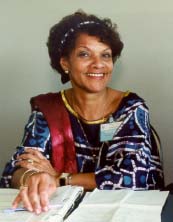
A. E. V. King
Photo: A. de Ferron (ITU 990043)
I would like to extend my best wishes to the ITU Council in its deliberations on the issue of integration of a gender perspective in its work and pay tribute to Yoshio Utsumi, ITU Secretary-General, and Roberto Blois, Deputy Secretary-General, for their support and personal commitment to gender issues.
It is encouraging to see that ITU is on the right course in mainstreaming gender in its activities. A strong political commitment was made at the Plenipotentiary Conference [Minneapolis] and the World Telecommunication Development Conference [Valletta] in 1998. An institutional framework has been created: a Group on Gender Issues established, and a Focal Point appointed.
For the first time, in 1999, ITU participated in the fourth meeting of the Inter-Agency Committee on Women and Gender Equality (IACWGE) of the Administrative Committee on Coordination (ACC), which I chair. ITU's initiatives in mainstreaming a gender perspective in its work related to community telecentres, telecommunications and rural development and the gender impact of telecommunication policies deserve special attention.
[...] One of the greatest divides in the world today — between rich and poor — is that developing countries, especially the least developed ones and their peoples not only lack capital but lack the knowledge and information required to climb out of poverty.
Barriers continue to confront women and girls seeking training in science and technology. In the North and the South, women are excluded from the design and shaping of information technology.
Bearing in mind the importance of advances in technology which created an instant global communication network with a direct impact on the lives of women and men of all ages, the Beijing Platform for Action set a number of targets
in the area of telecommunications. These include: women whose skills, knowledge and information technology need enhancement; whose participation in decision-making in new technologies should be encouraged and expanded, and whose educational and training programmes on the use of new technologies of communication, cyberspace and satellite should be developed.
Gender equality means equal empowerment, access and participation of both sexes in all spheres of public and private life. Although de jure gender equality heralds equal rights, opportunities and treatment, it does not automatically lead to de facto equality. We need to adopt an approach focussing on women's and men's roles and responsibilities as an integral part of policy analysis.
Within the United Nations the systematic application of a gender perspective in all policies and programmes is the primary strategy for ensuring that women's as well as men's concerns and experiences are integral to the design, implementation, monitoring and evaluation of policies and programmes in all spheres.
The Beijing Platform for Action calls on governments and other actors "to promote an active and visible policy of mainstreaming a gender perspective in all policies and programmes, so that before decisions are taken, an analysis is made of the effect on women and men respectively". Gender mainstreaming is thus the process of analysing women's and men's socially ascribed roles and responsibilities — their gender roles — to see an impact on their enjoyment of rights, access to opportunities and resources, and participation in decision-making at all levels.
The Economic and Social Council (ECOSOC) took this policy a step further in 1997 highlighting several aspects. It emphasized the responsibility and accountability of senior managers, the importance of adopting mainstreaming policies and strategies and institutional directives, and encouraged the improvement of tools for gender mainstreaming, such as gender analysis, data desegregated by sex and gender-sensitive budgeting.
The mainstreaming approach to gender is increasingly apparent throughout the work of the United Nations system. At its 1999 session [July], for example, ECOSOC [was to consider], in its high level segment, the role of employment and work in poverty eradication: the empowerment and work and advancement of women.
At the interorganizational level, in its 1998 Commitment for Action on Gender Equality and Mainstreaming — the ACC, comprising heads of agencies under the Secretary-General, as chair — committed itself to ensure that organizational policies, budgets and resource allocations reflect their commitment to gender equality. Thus, the responsibility for translating gender mainstreaming rests at the highest level.
The gender mainstreaming approach and gender issues were discussed in depth by ITU on International Women's Day (8 March 1999), marked for the first time in the Union's 134-year long history. A candid dialogue on ITU's achievements and challenges set the stage for future action. What are the needs of women in telecommunication? What are the targets and expected results? What are the most suitable policy areas? How do we use tools such as gender analysis and planning, sex desegregated statistics, surveys and forecasts, gender impact assessments, performance indicators, etc.? How do we hold management and staff accountable?
This brings us to a critical issue of resources for gender mainstreaming. No matter how enthusiastic staff and management are about gender mainstreaming, without sufficient resources, such an undertaking would be impossible.
Gender mainstreaming should guide all stages of the policy and wide-ranging programme of ITU activities. It is probably impractical to begin in all programmed areas at the same time. It might diffuse resources and weaken the process. The starting area or areas must be well chosen so as to ensure a strategic focus and lead to a successful completion. Sufficient resources and capacity building are essential conditions for success. The benefits, however, of empowering women, who represent half of the world's population, greatly outweigh the initial investments and the efforts involved in gender mainstreaming.
|
* This message was delivered to the ITU Council on 22 June 1999, on behalf of Ms King, by Hanne T. Laugesen, Chief of the Conferences Department and Focal Point for Gender Issues in ITU. |