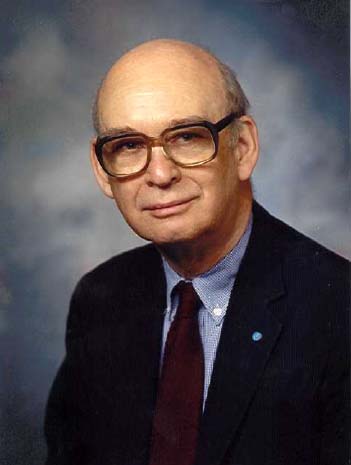
Wilbur L. Pritchard, a pioneer in the field of satellite systems engineering, died in Bethesda, Maryland (United States) on 18 March 1999. He had over fifty years of experience in technical design, systems engineering, management, and international negotiations.
He was President of W. L. Pritchard & Co., Inc., a Washington D.C. consulting engineering firm, doing technical and economic studies in telecommunications and specializing in satellite communications for clients around the world. The company intends to honour his memory by continuing to grow the business he formed.
Wilbur was formerly Chairman of the Board and CEO of SSE Telecom, Inc., which included Satellite Systems Engineering, Inc. and SSE Technologies, Inc. He founded Satellite Systems Engineering, Inc. in 1974 to provide direction and systems engineering in satellite communications to governments and private companies. He was also Professorial Lecturer at George Washington University where he taught courses in satellite communication, and Adjunct Professor of Electrical Engineering at the Polytechnic University of New York.
Wilbur worked at Raytheon Company's Equipment Division as Manager of the Wayland Laboratory. He then created the engineering department of Selenia (Italy), which continues today as Alenia Spazio S.p.A. In 1962, he joined the Aerospace Corporation to direct the team that produced DSCS-1, the first operational military satellite system: the United States TACSAT satellite system, and the United Kingdom Skynet system. He came to Communications Satellite Corporation as the founding Director of COMSAT Laboratories and later as Vice-President of the corporation. While at COMSAT, he also served as United States delegate to the Technical Subcommittee of the International Telecommunications Satellite Organization (INTELSAT) for four years.
He participated in the Kyoto (Japan) Plenipotentiary Conference in 1994. In 1995 he was a lead participant in coordination meetings with Japan. He recognized the need for a book on implementing intersatellite system coordination procedures developed through ITU, his company is preparing such a guide and a technical supplement with examples. They will be published later in 1999.
As an early innovator in the field of direct broadcast satellites, both video and audio, Wilbur founded two companies in that field, and was a consultant to several others.
He was member of a number of study groups and task forces on the uses of space: the National Academy of Sciences Panel to Study Broadcast Satellites (Chairman), the Snowmass Study as an expert on broadcast satellites as a member of the National Academy of Engineering's Space Applications Board, the Space Applications Advisory Committee of the United States National Aeronautics and Space Administration (NASA), NASA's Space and Earth Sciences Advisory Committee Task Force on the Scientific Uses of the Space Station, and the National Academy of Engineering's Task Force for the Voice of America.
In recognition of his contributions in the field of communication satellites, Wilbur has been honoured as Fellow of the Institute of Electrical and Electronics Engineers (IEEE), Fellow of the American Institute of Aeronautics and Astronautics (AIAA), and Fellow of the British Interplanetary Society. He was a Member of the International Academy of Astronautics. He received the AIAA Aerospace Communications Award for the direction of COMSAT Laboratories and the Lloyd V. Berkner Space Utilization Award of the American Astronautical Society, Inc., for contributions to the commercial utilization of space technology. In 1995 he was elected to the National Academy of Engineering and in 1997 he was inducted into the Society of Satellite Professionals International (SSPI) Hall of Fame.
Wilbur authored more than 50 papers published in the professional literature and conference records. He contributed
to four books, co-authored three, and edited one. His most recent book is Satellite communication systems engineering,
published by Prentice-Hall.
Back to top