What is so special about the Internet? The underlying technology, pricing, traffic flows and value flows. While it took the telephone close to seventy-five years to reach 50 million users, it has taken the World Wide Web (WWW) only four years to reach the same number, says a new report published by ITU in February 1999. On the supply side of the equation, the number of international carriers grew to more than 1000 in 1998 — but this is still a long way behind the estimated 17 000 Internet service providers that have mushroomed around the world.
Entitled Challenges to the network: Internet for development, the new report looks at the role of the Internet in economic and social development, with a focus on developing countries. It is the second report in the series, "Challenges to the network". The first was published in September 1997 and highlighted the challenges the Internet poses to public telecommunication operators (PTO).
The new report's seven chapters deal with:
A statistical annex to the report presents data on Internet development throughout the world (for example, the number of Internet hosts and their density, Internet access tariffs, estimated number of users in major economies). In addition, the report provides data on the status of the public telephone network, PC penetration and ISDN and data communications.
The following excerpts from the executive summary of the report give an overview of the situation today.
What can the Internet do for those regions of the world that have traditionally had only limited access to information and communication technologies? In theory, it can widen and enhance access in developing nations because it offers a relatively cheap, versatile and technically efficient service that complements standard telephony.
Furthermore, the Internet can allow businesses from developing nations to "leapfrog" into the development mainstream because Internet commerce will allow them to sell their wares and their services directly to customers. The Internet also offers considerable promise in facilitating the delivery of basic services, such as health and education, which are unevenly distributed at present. In this utopian view, the Internet is a way of levelling the playing-field and rendering less onerous the traditional disadvantages of the developing world. These include distance from markets, under-invested basic infrastructure and under-utilized capacity.
But how realistic is this viewpoint? As with other new technologies, the Internet has the potential to support
development activities, but, at the same time, it poses serious challenges and threats to pre-existing institutions. Is
there, for example, a possible "cost" of the Internet for PTOs of developing countries? In situations where
resources are limited, are hospitals or schools in developing countries justified in paying for an Internet connection?
|
* This report was prepared by a team of ITU staff led by Ben A. Petrazzini and comprising Laura Männistö, Tim Kelly, Michael Minges, Mugo Kibati, and Art Levin. It is available in English only at the price of CHF 100. Discounts are available for ITU Members and customers from least developed countries. To order your copy, please contact: "ITU Sales and Marketing Service. Place des Nations, CH-1211 Geneva 20 (Switzerland). Fax: +41 22 730 5194. E-mail: sales@itu.int". |
This report explores the current and likely impact of Internet development in a number of areas of social and economic concern, such as commerce, health, and education. It also analyses the features that make the Internet different from existing communication services as well as its current diffusion status around the world. Finally, the report explores the Internet's potential impact on the PTOs of developing countries and highlights some of the regulatory challenges posed by the unique nature of this new and revolutionary technology.
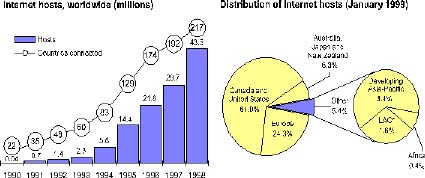
On a global scale, Internet growth has been little short of phenomenal. The network has increased from 213 host computers and several thousand users in August 1981 to more than 43 million Internet hosts by January 1999 (see Figure 1, left chart), supporting an estimated 150 million Internet users. Perhaps even more impressive is the number of countries connected to the global network. From just over 20 in 1990, there were more than 200 nations connected by July 1998.
Though these figures are impressive, a closer look (see Figure 1, right chart) reveals the great disparities in Internet hosts between high and low income regions. For example, there are more hosts in Finland than all of Latin America and the Caribbean, there are more hosts in three highly developed countries of the Asia-Pacific region (Australia, Japan and New Zealand) than all the other countries in the region combined and there are more hosts in New York than in all of Africa.
The majority of Internet hosts are in developed countries, suggesting that wealth and education are major factors driving Internet diffusion. Profiles of Internet users confirm that they are, on average, wealthy and educated as well as young, urban, and male.
Figure 1 — Growing but still unequal (installed base of Internet hosts, January 1991-January 1999, and distribution by region, January 1999)
Note: In the chart, data refer to January of the following year. A new method was used to calculate Internet hosts from January 1998 onwards. Data were adjusted, based on the new methodology, from January 1995.
* LAC = Latin America and the Caribbean.
Source: ITU. Internet host data adapted from Network Wizards (http://www.nw.com) and RIPE (http://www.ripe.net). Countries connected data sourced from Internet Society.
What are the barriers to increased Internet usage? The precise ranking of different obstacles differs, according to the level of economic and social development, but users around the world are unanimous in finding the price of Internet access to be a major constraint. Internet access prices for end users can be broken down into three components: hardware/software, Internet access provision and telephone service charges. In relative terms, the costs to get connected are much higher in developing countries. While prices may not differ drastically in absolute terms, there is a large gap between high and low income countries when costs relative to per capita income are considered.
A shortage of infrastructure, notably of telephone lines, is a further big obstacle to increasing Internet access in developing countries. The high visibility of the Internet and the growing awareness of the importance of information and communication technology for socio-economic development is driving policy changes aimed at increasing the supply of telephone networks.
Countries are tackling this problem through a variety of options including granting incumbent operators more freedom to reinvest their earnings and attracting fresh investment from the private sector by selling shares in State-owned telephone companies, and/or by allowing new market entrants.
The concept of electronic commerce (e-commerce) is not new. However, the rapid rise of the Internet has made the potential of e-commerce more promising. It is now widely stated that the Internet and e-commerce will transform traditional business and consumer life. By one estimate, Internet-based sales reached USD 43 billion in 1998. Many analysts expect online business to be worth more than 300 billion early in the next decade while the more optimistic estimates range between 1 and 3 trillion. Growth rates are also expected to be particularly high in Asia (see Figure 2).
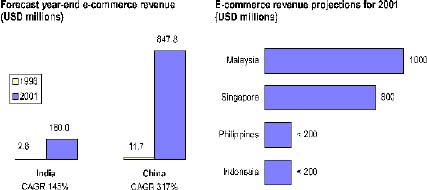
Figure 2 — E-commerce revenue projections in Asia (1998 and 2001, selected countries)
Note: IDC's revised projections for China's e-commerce revenues in 2002 total USD 1.87 billion, while the Republic of Korea is expected to generate USD 2 billion. CAGR = compounded annual growth rate.
Source: Left chart IDC, Market forecast for Internet commerce. Right chart IDC, as reported by CommerceNet.
The Internet enhances the possibility for developing and emerging economies to participate in the emerging digital economy. Internet-based e-commerce is likely to promote economic growth and welfare in developing countries significantly. New export opportunities should attract new foreign and domestic investment and thereby enhance growth. Most large industrial companies in developing countries already use the Internet, and what is perhaps surprising is that a growing number of small and medium-sized firms are also becoming users.
Internet commerce has not penetrated all economic sectors equally. Sectors that were expected to grow by more than 150 per cent in 1998 include: computer hardware and software, real estate, publishing and information services, finance, and Internet services.
Tourism, which is an increasingly important source of growth for developing countries, also looks set to be boosted by e-commerce. Analysts estimate that the travel industry accounted for some 20 to 30 per cent of total online revenues in 1997. Online travel sales are expected to grow to almost USD 9 billion by 2002. Financial services is another area of great potential growth in the online world and Internet banking is already available in many developing countries enabling customers to pay bills, check account balances, or transfer funds (see Figure 3, right chart).
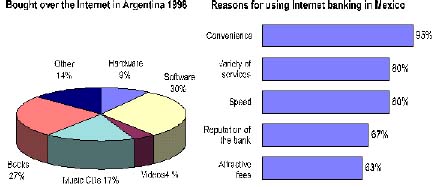
Figure 3 — Online shopping in Argentina and online banking in Mexico (what people buy over the Internet in Argentina and why they use Internet banking in Mexico)
Source:Secretaría de Comunicaciones of Argentina and Grupo TeleLink, S.A. de C.V.
What does Internet commerce mean for firms? The benefits of e-commerce are certainly compelling. Internet commerce can substantially improve productivity by lowering transaction and production costs, facilitating market entry, improving customer service, extending geographical coverage and enabling a new potential source of revenue.
Although Internet commerce potential appears promising, many challenges still remain. Barriers to Internet commerce are to some extent the same as those for Internet use in general. But several of the challenges are specific to e-commerce, and they include the need for a legal and financial framework for Internet transactions and the provision of market access and trade logistics.
What steps should policy-makers in developing countries take to ensure that the benefits of the Internet are as widely distributed as possible? Promote the industry, build infrastructure, expand access to infrastructure and services, promote growth of Internet access market, promote production of local content and stimulate usage. One way forward would be to provide reasonably priced access for schools, universities, libraries and other public service institutions.
The Task Force established at the end of April 1999 by ITU Secretary-General, Yoshio Utsumi, held its first meeting on 4 May to lay the ground work for the holding of a World Summit on the Information Society. This Summit is being organized in response to Resolution 72 of the Minneapolis Plenipotentiary Conference (formerly Resolution PLEN/13). It is expected to take place before the next Plenipotentiary Conference, scheduled in Morocco in the year 2002.
So far, this ITU initiative has won the support of the United Nations Administrative Committee on Coordination and its Organizational Committee (see ITU News, No. 4/99, pages 28-29), as well as that of the Global Information Infrastructure Commission (GIIC).
The Task Force, chaired by Mohamed Harbi, Special Adviser to the Secretary-General in charge of External Affairs and Corporate Communication, is moving quickly to establish the necessary conditions for the Summit to be held in the spirit of Resolution 72. At its first meeting, the Task Force discussed the nature of partnership needed to prepare the Summit and its outcome, as well as other organizational aspects: the level of attendance, financing, duration, venue and promo- tion of the event. It has shared preparatory tasks among its members (see box) accordingly. As part of the campaign effort, the Task Force has agreed to organize a special session on the proposed Summit during TELECOM 99 in October.
A key priority for the Task Force in the coming weeks will be to draw up a plan of action that will be circulated to
potential partners in the Summit; notably from the United Nations and its specialized agencies, ITU Member governments,
the private sector and the civil society.
Task Force membersChairperson: Mohamed Harbi. Members: Don MacLean (Strategic Planning Unit), Ben A. Petrazzini (Strategic Planning Unit), Fernando Lagrãna (TELECOM), Abdelkhalek Tazi-Riffi (Finance Department), Keith Allen (External Affairs and Corporate Communication), Pierre Gagné (Telecommunication Development Bureau) and Fabio Bigi (Telecommunication Standardization Bureau). |
The Government of Italy has ratified the above-mentioned Instruments amending the Constitution and Convention.
The instrument of ratification was deposited with the General Secretariat of the Union on 17 March 1999.
Instituto de Formação em Tecnologia (Brasilia) has been admitted to take part in the work of this Sector.
Millicom Luxembourg S.A. (Bertrange, Luxembourg) has been admitted to take part in the work of this Sector.
Copper Mountain Networks, Inc. (San Diego, CA) has been admitted to take part in the work of this Sector.
Alcatel Telspace (Nanterre, France), which participates in the work of the Radiocommunication Sector has changed its name. The new denomination is: Alcatel, Paris.
Bell Communications Research, Inc., Bellcore (Red Bank, NJ) which participates in the work of the Standardization and Development Sectors has changed its name. The new denomination is: Telcordia Technologies.
Nortel (Europe) (London) which participates in the work of the Radiocommunication and Standardization Sectors has changed its name. The new denomination is: Nortel Networks (Europe).
Société d'applications générales d'électricité et de mécanique (S.A.G.E.M. S.A.) (Paris) and Société Anonyme de Télécommunications (SAT) which participate in the work of the Development and Standardization Sectors have merged. The new denomination is: SAGEM S.A.
Spectrocan Engineering (Ottawa) which participates in the work of the Development Sector has changed its name. The new denomination is: AGRA Systems Limited.
Times Africa Publications Ltd. (London) which participates in the work of the Development Sector has changed its name. The new denomination is: Times Publications Ltd.
Circular letters (via facsimile) which have been sent to all Member States and Sector Members of the Union announce the following vacancies:
Detailed applications with ITU personal history form should be submitted to the General Secretariat of the ITU, Place des Nations, CH-1211 Geneva 20 (Switzerland), not later than the final dates mentioned above.
Vacancy notices and personal history forms are available on the ITU Web site, under the "ITU General Secretariat" section: http://www.itu.int/.
|
The following letters indicate the languages in which documents are published: F for French E for English S for Spanish R for Russian C for Chinese A for Arabic Prices are in Swiss francs (CHF). A comprehensive list of all the publications of the Union will be supplied, free of charge, from the ITU Sales and Marketing Service, Place des Nations, CH-1211 Geneva 20 (Switzerland). Fax: +41 22 730 5194. |
Challenges to the Network — Internet for Development (February 1999)
(92-61-07581-9)
Edition E only (CHF 100)
Final Acts of the World Radiocommunication Conference (WRC-97) (Geneva, 1997)
(92-61-07121-X)
Separate editions in F, E, S, R, A (CHF 120)
Rules of Procedure approved by the Radio Regulations Board (Edition of 1998, Geneva, 1999)
(92-61-07691-2)
Separate editions in F, E, S (CHF 86)
ITU-T Recommendation A.5 Annex B (09/98)
Generic procedures for including references to documents of other organizations in ITU-T Recommendations Annex B: Information specific to The ATM Forum documents
Separate editions in F, E, S (CHF 9)
ITU-T Recommendation E.169 (11/98)
Application of Recommendation E.164 numbering plan for universal international freephone numbers for international freephone service
Separate editions in F, E, S (CHF 17)
ITU-T Recommendation E.425 (11/98)
Internal automatic observations
Separate editions in F, E, S (CHF 9)
ITU-T Recommendation E.500 (11/98)
Traffic intensity measurement principles
Separate editions in F, E, S (CHF 12)
ITU-T Recommendation F.853 (11/98)
Supplementary services in the Universal Personal Telecommunication (UPT) environment
Separate editions in F, E, S (CHF 12)
ITU-T Recommendation G.142 (12/98)
Transmission characteristics of exchanges
Separate editions in F, E, S (CHF 12)
ITU-T Recommendation G.661 (10/98)
Definition and test methods for the relevant generic parameters of optical amplifier devices and subsystems
Separate editions in F, E, S (CHF 12)
ITU-T Recommendation G.662 (10/98)
Generic characteristics of optical amplifier devices and subsystems
Separate editions in F, E, S (CHF 12)
ITU-T Recommendation G.775 (10/98)
Loss of Signal (LOS), Alarm Indication Signal (AIS) and Remote Defect Indication (RDI) defect detection and clearance criteria for PDH signals
Separate editions in F, E, S (CHF 9)
ITU-T Recommendation G.832 (10/98)
Transport of SDH elements on PDH networks — Frame and multiplexing structures
Separate editions in F, E, S (CHF 12)
ITU-T Recommendation G.967.1 (06/98)
V-interfaces at the service node (SN): VB5.1 reference point specification
Separate editions in F, E, S (CHF 96)
ITU-T Recommendation H.222.0 Amendment 3 (02/98)
Information technology — Generic coding of moving pictures and associated audio information: Systems
Separate editions in F, E, S (CHF 9)
ITU-T Recommendation H.222.0 Amendment 4 (02/98)
Information technology — Generic coding of moving pictures and associated audio information: Systems
Separate editions in F, E, S (CHF 9)
ITU-T Recommendation H.225.0 Annex I (09/98)
Call signalling protocols and media stream packetization for packet-based multimedia communication systems Annex I: H.263+ video packetization
Separate editions in F, E, S (CHF 9)
ITU-T Recommendation H.247 (09/98)
Multipoint extension for broadband audiovisual communication systems and terminals
Separate editions in F, E, S (CHF 17)
ITU-T Recommendation H.262 Amendment 3 (02/98)
Information technology — Generic coding of moving pictures and associated audio information: Video
Separate editions in F, E, S (CHF 17)
ITU-T Recommendation H.262 Amendment 4 (02/98)
Information technology — Generic coding of moving pictures and associated audio information: Video
Separate editions in F, E, S (CHF 9)
ITU-T Recommendation H.310 (09/98)
Broadband audiovisual communication systems and terminals
Separate editions in F, E, S (CHF 34)
ITU-T Recommendation H.324 Annex F (09/98)
Terminal for low bit-rate multimedia communication Annex F: Multilink operation
Separate editions in F, E, S (CHF 9)
ITU-T Recommendation H.332 (09/98)
H.323 extended for loosely coupled conferences
Separate editions in F, E, S (CHF 17) ITU-T Recommendation I.460 (02/99)
Multiplexing, rate adaption and support of existing interfaces
Separate editions in F, E, S (CHF 9)
ITU-T Recommendation I.464 (02/99)
Multiplexing, rate adaption and support of existing interfaces for restricted 64 kbit/s transfer capability
Separate editions in F, E, S (CHF 9)
ITU-T Recommendation L.32 (10/98)
Protection devices for through-cable penetrations of fire-sector partitions
Separate editions in F, E, S (CHF 9)
ITU-T Recommendation L.33 (10/98)
Periodic control of fire extinction devices in telecommunication buildings
Separate editions in F, E, S (CHF 9)
ITU-T Recommendation L.34 (10/98)
Installation of Optical Fibre Ground Wire (OPGW) cable
Separate editions in F, E, S (CHF 9)
ITU-T Recommendation L.35 (10/98)
Installation of optical fibre cables in the access network
Separate editions in F, E, S (CHF 9)
ITU-T Recommendation L.36 (10/98)
Single mode fibre optic connectors
Separate editions in F, E, S (CHF 9)
ITU-T Recommendation Q.699.1 (05/98)
Interworking between ISDN access and non-ISDN access over ISDN user part of Signalling System No. 7: Support of VPN applications with PSS1 information flows
Separate editions in F, E, S (CHF 17)
ITU-T Recommendation Q.761 Addendum 1 (05/98)
Signalling System No. 7 — ISDN user part functional description
Separate editions in F, E, S (CHF 9)
ITU-T Recommendation Q.762 Addendum 1 (05/98)
Signalling System No. 7 — ISDN user part general functions of messages and signals
Separate editions in F, E, S (CHF 9)
ITU-T Recommendation Q.765.1 (05/98)
Signalling System No. 7 — Application transport mechanism — Support of VPN applications with PSS1 information flows
Separate editions in F, E, S (CHF 29)
ITU-T Recommendation Q.824.6 (06/98)
Stage 2 and stage 3 description for the Q3 interface — Customer administration: Broadband switch management
Separate editions in F, E, S (CHF 44)
ITU-T Recommendation Q.832.1 (06/98)
VB5.1 Management
Separate editions in F, E, S (CHF 22)
ITU-T Recommendation Q.850 (05/98)
Usage of cause and location in the Digital Subscriber Signalling System No. 1 and the Signalling System No. 7 ISDN User Part
Separate editions in F, E, S (CHF 17)
ITU-T Recommendation Q.932 (05/98)
Digital Subscriber Signalling System No. 1 — Generic procedures for the control of ISDN supplementary services
Separate editions in F, E, S (CHF 49)
ITU-T Recommendation Q.1200 (09/97)
General series Intelligent Network Recommendation structure
Separate editions in F, E, S (CHF 9)
ITU-T Recommendation Q.2766.1 (05/98)
Switched virtual path capability
Separate editions in F, E, S (CHF 17)
ITU-T Recommendation X.283 (12/97)
Information technology — Elements of management information related to the OSI Network Layer
Separate editions in F, E, S (CHF 96)
ITU-T Recommendation X.630 (09/98)
Efficient open systems interconnection (OSI) operations
Separate editions in F, E, S (CHF 17)
|
CONDITIONS OF SALE The ITU sells its publications on a non-profit basis. The prices quoted include packing costs and carriage by surface mail. All publications ordered from the ITU must be paid for in advance. Methods of payment Payments should be made in CHF:
Payments may also be made in other currencies, freely convertible into CHF, provided that, when converted by the bank, the price of the service in CHF is covered. The ITU does not accept letters of credit. Orders and cheques should be made to: International Telecommunication Union, Tel.: +41 22 730 61 41. A bookstall is open at ITU headquarters in Geneva from 08h30 to 12h00 and from 13h30 to 17h00. |