Nearly 350 delegates from around the world attended the first technical meeting of the third Generation Partnership Project, better known as 3GPP (see box), which was hosted by the European Telecommunications Standards Institute (ETSI) in Sophia-Antipolis (France) in December 1998. The high attendance emphasizes the significance of the 3GPP initiative to address technical specifications for third generation mobile systems.
Recognizing the importance of timely standards, the project's partners have set for themselves a streamlined working structure and processes for the 3GPP, including the use of the latest electronic working methods. The 3GPP specifications are expected to enable the first roll-out of third generation mobile systems by the year 2001.
Third generation mobile systems will build on, and be compatible with, the current GSM second generation system, and will offer data rates of up to 2 Mbit/s, with user benefits such as advanced multimedia services and next-generation mobile Internet. Standards bodies worldwide have already committed themselves to coordinating their work on third generation specifications by becoming organizational partners in the project. In this way, they are working to provide users with global roaming and seamless communications anytime, anywhere. This coordination is expected to give manufacturers and service providers access to new markets and benefits to users in the form of new services, high speed data, reduced costs and greater freedom of choice.
The results of the 3GPP will be transposed into relevant standards by the partners using their established processes.
The work will also be forwarded to the International Telecommunication Union (ITU) by the 3GPP members and
organizational partners and will support inter-working between IMT-2000 family members (IMT-2000 is the third generation
"family of systems" concept defined by ITU). The project is expected to accelerate IMT-2000 standardization.
The founding 3GPP organizational partners include:
ETSI introduced the partnership project concept in 1997 as part of its new working methods to enhance cooperation with similar organizations in specific market sectors. The Universal Mobile Telecommunications System Forum, better known as UMTS Forum, also joined the 3GPP in December 1998. As an open collaborative project, 3GPP welcomes new partners, irrespective of their geographical location. |
The December meeting launched four Technical Specification Groups to address:
For more details about the project, visit the ETSI Web site at http://www.etsi.org/3gpp or the 3GPP Web site at http://www.3gpp.org. — ETSI.
In December 1998, the 125th Meeting of the Board of Governors of the International Telecommunications Satellite Organization (INTELSAT) approved the purchase of a new satellite. The Intelsat-905 spacecraft, which is the fifth in the Intelsat-IX satellite series, built by SS/Loral, will be delivered in early 2002. It will provide additional capacity in the Atlantic or Indian Ocean regions, depending on the successful launch and deployment of the four Intelsat-IX satellites already on order.
The Board also decided to deregister a number of orbital slot registrations with the International Telecommunication Union (ITU). In the light of the important role INTELSAT plays as a major user of the geosynchronous orbital arc, the Board recognizes the need for the organization to set an example as a responsible and efficient user of scarce orbital resources. To this end, the organization will de-register certain satellite networks at 63, 64.9, 69, 91.5, 180, 186, 338 and 338.5° E.
Historically, INTELSAT has operated in a way that maximizes orbital resources, having implemented six-fold frequency reuse on the last few generations of satellites and co-locating satellites wherever possible. While incorporating frequency reuse in the design results in more costly spacecraft, INTELSAT allows much more efficient use of frequency spectrum at each orbital location, thereby minimizing the number of separate satellites at distinct orbital locations required to serve its customers around the world.
Following the decision, INTELSAT's Director-General and CEO, Conny Kullman, stated:
"I believe very strongly that INTELSAT must continue to set an example as a responsible citizen of the geosynchronous arc. I hope this move prompts other satellite operators to assess their current and future plans to determine if they, too, can make room for new entrants in the market by deregistering slots they no longer plan to use. Orbital slots are a scarce resource and we all have a responsibility to use them as efficiently as possible."
The United States-based satellite organization owns and operates a global communications satellite system, which provides voice/data, video, and Internet services to over 200 countries and territories. Its revenues for 1998 were forecast at some USD 1 billion. — INTELSAT.
The whirlwind of convergence is posing a significant threat to the future revenues and market share of telecommunication operators (TO), says telecommunication consultants, Analysys
Information technology (IT) companies are winning the battle with TOs to service the information and communications technology requirements of SMEs, according to a new report from Analysys.
The report entitled Marketing telecoms to small and medium-sized businesses, highlights the importance of the SME market as an engine of global economic growth. It concludes that it is IT companies, rather than TOs, that are successfully targeting the sector, which accounts for 99% of firms — some 30 million companies in the United States and Europe.
IT companies, such as IBM, Cisco and Microsoft, are said to have product integration and marketing skills which are way in advance of most TOs. They have grasped that complete solutions, taking advantage of converging technologies, are the way forward in the SME market.
The report examines the various marketing and business strategies of the TOs and their rivals to this market. Detailed case studies provide insight into the approaches to segmentation and marketing in the SME market adopted by TOs (MCI WorldCom Inc., o.tel.o communications GmbH & Co., Telecom Eireann and Sonera Oy), Internet Service Providers (Datanet International Ltd. and Verio Inc.), and IT companies (Cisco Systems Inc. and IBM Corporation).
"It is imperative that TOs compete vigorously to gain market share in the SME sector. Their success in this sector will be an indicator of how well they are coping in a business environment which is being hit by the whirlwind of convergence", said Susan Ablett, principal consultant and lead author of the report.
The forces feeding the whirlwind include market liberalization, globalization, and the technology revolution which is driving the convergence of fixed and mobile communications with IT and broadcasting.
The report says that TOs are looking at a gap in their revenues which only the successful provision of solutions to the SME market can fill. TOs therefore have little choice but to seek to ride the whirlwind.
Written by Susan Ablett and Katrina Bond and published by Analysys Publications, the report is available in paper format (price: USD 2330 or GBP 1295) or electronically (price: USD 2690 or GBP 1495) via the Web at: http://www.analysys.com/publish. — Analysys.
Over 30 000 new main lines are added to China's fixed-line network every day, says report.
China is not just famous for its Great Wall. Despite Asia's currency crisis, operators are investing in their networks in order to increase the value of their operations. Nowhere is this more evident than in China, according to Telecoms markets and strategies in China, a market research study published by Pyramid Research*. The study claims that every day, over 30 000 new main lines are added to China's fixed-line network.
The priority position of telecommunications will mean that China will add over 1% penetration annually through the year 2003, outstripping most of the rest of developing Asia.
China's data communication services market is also said to be maintaining significant growth. The Internet in particular is an area where the country's entrepreneurial spirit has shone: between 300 and 400 Internet service providers (ISP) competed with China Telecom, the State-owned operator for a market of 900 000 Inter-net subscribers at the end of 1997.
These ISPs together with ministerial and industrial sector "Golden" electronic information projects and private enterprise networks will all join forces to drive data communications service growth. Added to this will be China Telecom's initiatives to support a China-only version of the World Wide Web. Such efforts are expected to increase the number of Internet (or ChinaNet, as the case may be) hosts to nearly 320 000 by the end of 2003.
At the same time, China's telecommunication equipment market is exciting in its volume, if not its growth. Consumption in this market continues to increase, particularly as China throws more money into infrastructure spending to boost the economy.
The study, "Telecoms markets and strategies in China", offers an in-depth analysis of the Chinese telecommunication sector today and tomorrow. This analysis has been summarized in the article "China telecommunications: the ends justify the means", published in "Telecoms & Wireless Asia", 28 October 1998, Vol. 6, No. 10. The following is an extract from that article.
China's telecommunication markets are a glistening bright spot in the region, in part because of its reluctance to truly liberalize its service sectors. China continues to stay away from global trends of deregulating the provision of telecommunication services, relying instead on a centralized infrastructure policy from the government and near-infinite consumer demand to drive network development.
The country's equipment market, notable for its huge volume and steady, if not high-growth revenues, has been the
beneficiary of the determined efforts of China Telecom to build up China's installed base with future-proof technology
solutions. While service liberalization and the opening of markets to competition is generally seen as a catalyst to
growth, China goes against this model. China's centrally planned economy is guiding the development of its
telecommunications sector, as it plays a key role in the country's overall economic growth — particularly important in
the region's uncertain economic times. Although governed by strict regulations and dominated by China Telecom, the
country's telecommunications sector is steadily developing, and will continue to be Asia's largest market for network
infrastructure despite, or perhaps because of this approach.
|
* Pyramid Research (Cambridge, United States) is a division of The Economist Intelligence Unit. It specializes in telecommunications research in Asia-Pacific, Latin America, Africa/Middle East, and Eastern Europe/CIS (Commonwealth of Independent States). The study, "Telecoms Markets and Strategies in China" is a 250-page report available for USD 2850. For more information, please contact: "Andrew Elrick, Pyramid Research, 58 Charles Street, Cambridge, MA 02141 (United States). Tel.: +1 617 494 1515. Fax: +1 617 494 8898. E-mail: info@pyr.com ". |
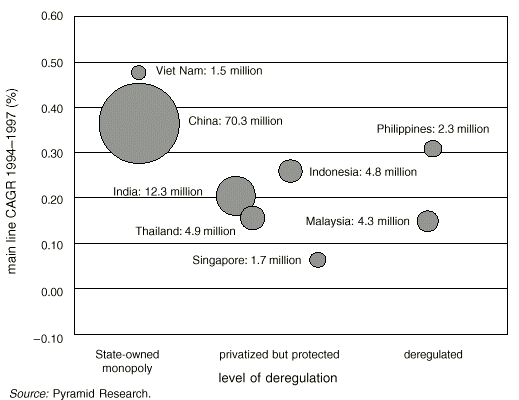
While China's telecommunications sector has not seen substantial regulatory restructuring, particularly when compared to other industrializing Asian economies, this has not dampened its markets. Despite being substantially farther back on the liberalization curve than its regional peers, China's network infrastructure has grown rapidly over the past five years, fuelled by State mandates to build up telecommunications as a key infrastructure sector. As a result, China Telecom now manages the world's largest telephone network, and has experienced Asia's highest main line growth after Viet Nam (see Figure 1).
Telecommunications is one of the key infrastructure-intensive industries that China used to boost its flagging national economic growth in its difficult bid to hit an 8% GDP target for 1998. In 1997, China Telecom invested USD 15 billion into post and telecommunications fixed assets, accounting for nearly 6% of the country's total fixed asset investment. Due to its parent-child relationship, the objectives of China's telecommunications can basically be considered China Telecom's plans. Buoyed by rapid economic growth and an insatiable demand for telephony, China Telecom has for most years easily met and surpassed these targets and is expected to achieve its five-year plan ahead of schedule (see Table 1).
|
|
China's telecoms scale will "rank among the most advanced in the world in terms of network scale, technology and quality of service" |
|
Overall communication capacity will double that of 2000, reaching 370 million main lines |
|
Service revenue will top USD 132.5 billion (RMB 1.100 trillion) |
|
Advanced equipment of 20-40 Gbit/s SDH or even higher speed technology will be deployed on the trunk optical lines |
|
Broadband multimedia communication network based on the ATM protocol will cover all cities above the prefecture level and all economically vibrant counties and villages |
|
Access network will be able to provide broadband access functions to both urban and rural users |
|
Supporting networks will achieve world-class standards in terms of intelligence and automation, efficiency, quality, safety and reliability |
|
Total number of fixed line subscribers will top 290 million, pushing main line penetration to 28% |
|
Mobile subscribers will reach 200 million with cellular penetration at 15% |
Source: Ministry of Information Industry/China Telecom/Pyramid Research.
 |
Source: Pyramid Research.
China Telecom has not been complacent despite the lack of real competition. In fact, the faint (and somewhat implausible) threat of competition from China Unicom has even served as a catalyst of sorts, prompting faster roll-out schedules and a slight reduction in tariffs. Governed by State policy and not the market, China Telecom's development strategy has been simple and consistent: cleaving to ambitious long-term network development plans, and then exceeding them.
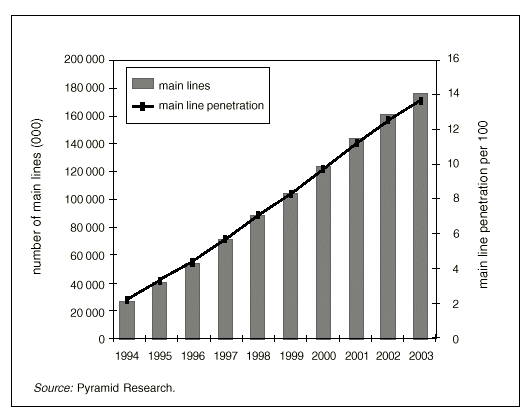
The carrier has added on average 14 million subscriber lines per year over the last five years, bringing teledensity up to 5.7% at the end of 1997 (see Figure 2). In 1998, China Telecom cleared the 7% teledensity mark, and is poised to be the primary service provider to the country's 177 million telephone subscribers in the year 2003. In June 1998, China Telecom reported a subscriber base of 80 million fixed lines on its network, an increase of nearly 10 million over the end of 1997. China Telecom's capacity of central office exchanges in June 1998 reached 119 million lines, an increase of 8 million as compared with the end of 1997.
The country is ranked second in terms of switching capacity in the world behind the United States. China Telecom
spares nothing in pursuit of best in class infrastructure, and has a lot to show for it as a result. A national
synchronous digital hierarchy (SDH) optical fibre backbone and the world's largest packet switched network (some 160 000
ports as of 1997) are but some of the fruits of this incessant drive for capacity.
 |
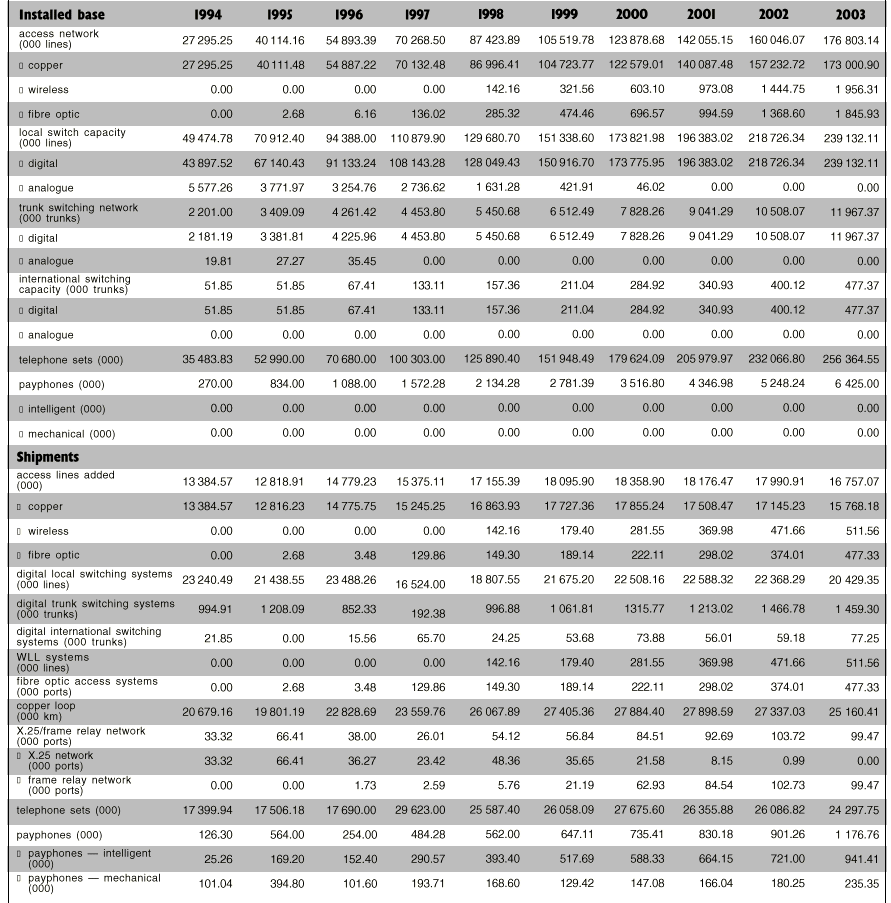
China's telecommunications equipment market is past its heady days of high-profit growth. However, it still offers both foreign and domestic suppliers opportunities through a steady stream of contracts generated by its high volume market (see Table 2).
China's telecommunications equipment market, while famous for its razor-thin margins, is still larger than the rest of developing Asia combined.
In 1997, China spent USD 3 billion on switching and transmission equipment, nearly three times that of India. The sheer volume and wide range of "best in class" technology that China requires means that numerous local and foreign vendors continue to dig their heels in, and cut prices to stay in. As a result, between 1994 and 1997, while equipment volume increased, the overall market witnessed a decline in revenues.
In 1994, total revenues for telecommunications infrastructure and terminal equipment amounted to nearly USD 17 billion. As China stepped up its development schedule, local and foreign vendors aggressively entered an increasingly volume-driven market, driving down prices and with them equipment revenues, to just over USD 14 billion in 1997.
However, China's telecommunications equipment consumption continues to increase as the country throws more money into infrastructure spending to boost the economy. Equipment revenues have risen in 1998 as a result, and are going to hit a steady stride, hovering around the USD 16 billion mark until 2002. China's renewed investments in pricey, next-generation data communications infrastructure will also help to buoy the market slightly.
Although the transmission market will level off as China Telecom nears completion on several major nationwide backbone networks, long haul and backbone transmission remains a long-term priority for the country's telecommunications infrastructure investment plans. China's demand for high-speed capacity continues unabated and with the nationwide "8 × 8" SDH backbone (some 75 000 km of STM16 fibre-optic transmission running the length and width of the country), China Telecom has already begun to upgrade major trunk fibre-optic routes to wavelength division multiplexing (WDM).
However, SDH still has a strong position in the market, as China Telecom brings it down to the junction level with high-speed urban ring networks. The carrier is also looking to boost capacity in its remaining microwave routes through SDH upgrades.
China's switching market is one of the most competitive in the world. High volume, localized production, and a crowded market have driven prices down to razorthin margins. While foreign vendors have multiplied over the past five years, most of the new competition has come from China's growing ranks of domestic switching manufacturers.
Foreign players are now seeing the switching market taken from them by domestic suppliers that have benefited from their investments and technology as well as preferential treatment from China Telecom. Having localized their manufacturing as well as research and development facilities, many foreign companies are realizing that 100% local is no longer local enough. However, this is only making them turn to product diversification to spur growth.
As domestic suppliers are keen to exploit the same opportunities, they are also looking to expand their product portfolios and one step behind their foreign competitors. Leading domestic manufacturers are also making inroads into overseas markets with their affordable pricing and acceptable products.
Annual growth in main lines is expected to average 21% over the next two years to reach nearly 124 million by 2000. The country's current main line penetration, at roughly six and a half main lines per hundred population, allows plenty of room for China's service network to expand well after the turn of the century. Even though prices in the country's switching market will continue to drop (central office switching is on average below the USD 70 per line mark, and falling), the sheer volume of equipment that will need to be supplied remains high.
China has also heavily invested in building a massive national data communications network in anticipation of bandwidth demand for data, and the fear of being left behind the curve as data communications technology rapidly evolves. However, this has compromised its ability to create a comprehensive service platform and has resulted in multiple — and overlapping — transport technologies. China Telecom is now trying to amend this through increasing its commitment to building an ATM-based broadband transport network that it hopes will integrate its previous efforts at constructing a national information infrastructure. As a result, ATM and frame relay network infrastructure will steadily take up most of data communications network spending over the next five years.
China Telecom is a cornerstone of China's centrally planned economy. The State-owned enterprise is a valuable source of much-needed communications infrastructure upon which to build the country's economy — and a channel into which funds to prop up the economy can be poured.
Moreover, self-sufficiency in the information technology industry is a broad plank in China's macro-economic platform, and China Telecom is a primary procurer of indigenously developed technologies.
There is enough of an impetus in meeting State objectives to move forward, and quickly, on telecommunications network development in China without liberalizing the sector. As a result, steady growth in expansion and main line penetration will be reached handily, despite the near-total lack of competitive services.
China's central government-fuelled infrastructure binge may be reactive, but it is sound. China's sagging domestic growth is worrisome to State planners, who have sought to use key infrastructure industries — transport and telecommunications chief among them — to perform economic triage on the country.
While this could soak up unemployment and boost government spending, China is still a country in desperate need of
airports, roads and telephone networks. Spending on telecommunications infrastructure now not only blunts the present
downward turn of the domestic economy, but also provides a vital resource for its long-term growth.
Restructuring China TelecomThe rumoured breakup of China Telecom has become more concrete since December 1998. The plan to split China's dominant operator has undergone major developments of late, but the Ministry of Information Industry (MII) is still reviewing the details of how and when the country's national carrier will be dismantled. It is clear that the MII's intent to break up China Telecom is serious, but the time frame and formal plans have yet to be announced. At the moment, all decision-making rests at the central level. China's telecommunications sector has been undergoing a centrally mandated restructuring process for well over a year, and China Telecom's restructuring has been in planning since November 1998. The overriding objective has been to create a more efficient China Telecom and, in the long run, to improve the country's telecommunications sector. Following its reorganization in early 1998, the MII proceeded to initiate reviews at all levels of the telecommunications sector. The MII first reinforced the ban on China-China-Foreign (CCF) joint ventures and then reviewed all existing CCFs contracts that the MII deemed illegal and inefficient. More recently, the MII announced that telephone installation fees would be lowered. Overall, the MII aims to make the telecommunications sector more efficient. The breakup of China Telecom does not have any short-term implications. At the moment, its paging and satellite businesses are already somewhat autonomous operations, and separating them from central control will not be a drastic change. The paging sector, with 2000 private paging operators, is already China's most competitive sector. Pyramid does not anticipate the breakup of China Telecom to result in greater competition in the telecommunications sector — at least not for the short term. — Pyramid Research, AsiaAlert, 3 February 1999. |
On 13 January 1999, FLAG Telecom Limited and Global TeleSystems Group, Inc. (GTS)* announced an agreement to
establish a 50:50 joint venture to build and operate the world's first transoceanic dual cable system designed to carry
voice, high-speed data and video traffic at speeds of up to 1.28 Tbit/s. The high-capacity fibre-optic link between
Europe and the United States, to be known as FLAG Atlantic-1, is expected to offer service in the year 2000.
|
* GTS is an independent owner and operator of telecommunication companies throughout Europe, with headquarters in Washington, D.C. FLAG Telecom Limited is a carriers' carrier with headquarters in Bermuda and regional offices in Dubai, Hongkong, New York and London. The existing FLAG network operation centre is located in Fujairah (United Arab Emirates) and is responsible for system performance monitoring, isolating and handling incidents along the cable route, proactive maintenance of the system and activating capacity. |
The joint venture plans to offer a direct link between London, Paris and New York (see Figure 1), with seamless connections to numerous other cities in the United States, Europe and other countries in the Middle East and Asia-Pacific. The project is subject to financing, the execution of related agreements and other conditions.
Construction of the initial 160 Gbit/s portion of FLAG Atlantic-1 will cost some USD 1 billion. Financing will be provided by a combination of equity contributions by the parties, customer sales and non-recourse bank debt. A contract to build the cable has been awarded to Alcatel Submarine Networks, as prime supplier. The system's design allows for 160 Gbit/s incremental upgrades as demand warrants.
FLAG Atlantic-1 will be a loop system, connecting the East Coast of the United States, with two nodes in midtown and downtown Manhattan, to two landings in Europe — one in Brittany (France) and the other in Cornwall (United Kingdom).
The entire FLAG Atlantic-1 system is planned to consist of three self-healing, high capacity loops with twin terrestrial access points connecting to the Hermes Europe Railtel (HER) network as well as to the existing FLAG cable system.
The current FLAG system entered commercial service in November 1997 and stretches over 27 000 km from the United Kingdom to Japan. This cable route traverses oceans, jungles and deserts and is said to be eight times longer than one of the world's seven wonders: the Great Wall of China. It is also the first intercontinental cable to land in China.
FLAG originates in the United Kingdom, "navigates" the Atlantic Ocean and the Mediterranean Sea, stretches onward through the Red Sea and the Indian Ocean and finally, under the South China Sea and on to Japan. It has two terrestrial sections, a 581 km dual land crossing in Egypt and 451 km in Thailand. The route is a record-breaker and has been listed in the Guinness Book of Records.
Spanning as it does many of the world's most populous regions and fastest-growing economies, FLAG provides high-capacity digital services to international carriers, resellers, and Internet service providers, offering direct connectivity to 75% of the world's population and providing customers with a world-class broadband superhighway. Privately financed at a capital cost of USD 1.5 billion, FLAG today carries traffic for over 75 of the world's leading carriers, including more than 20 of the top 30 international operators. FLAG currently boasts 14 operational landing points in several countries: the United Kingdom, Spain, Italy, Egypt, the United Arab Emirates, India, Malaysia, Thailand, China (including Hongkong), the Republic of Korea and Japan. Additional landings in Jordan and Saudi Arabia are planned for 1999. Each landing point is served by a nominated landing party, usually the sole or leading international telephone company in the country. These companies take responsibility for operating and maintaining the on-shore equipment.
According to FLAG Telecom, a transatlantic link was its natural next step. FLAG Atlantic-1 is expected to be highly resilient, with great reliability throughout the system. The network has been designed specifically to meet the level and speed of service demanded in today's market-place and the needs of the Internet. The cable system is privately financed so operators get all the benefits of cost-effective pricing and flexibility.
Customers on FLAG Atlantic-1 will be able to add traffic either at the landing stations or at the city nodes. The loop system will combine two sub-sea segments of approximately 5900 and 6350 km to form an overall system length of some 12 500 km upon completion. The joint venture will provide backhaul links from the European landings to the cities of Paris and London, where customers will be able to interconnect seamlessly to GTS Carrier Services and its HER network as well as to other networks of their choice.
Spanning 9200 km across Europe, the HER network currently serves telecommunication carriers and Internet service providers in 20 cities with the ability to activate four more cities along the network routes on short notice, depending on customer demand. The HER network is planned to exceed 18 000 km in the future.
FLAG Atlantic-1 will use laser-generated light to transmit digital information over four fibre pairs and is capable of carrying over one trillion bits of information per second.
This equates to one hundred hours of digital video per second, a 25-fold increase on the current transatlantic cable systems.
The cable system will be based on synchronous digital hierarchy (SDH) technology and will use dense wave division multiplexing. The all-digital system is expected to deliver high-speed, clear, secure throughput, as weather conditions or electromagnetic interference are said not to affect the cable. Broadband capacity accommodates new data-rich applications such as the Internet, videoconferencing, multimedia, medical and business imaging.
With the growing interest in FLAG Atlantic-1, the FLAG cable system networks will cover nearly 40 000 km and provide direct access to two of the world's largest telecommunications and Internet markets: the United States and Japan. — FLAG Telecom/GTS Carrier Services/HER.

Figure 1 — Cable system route of FLAG Atlantic-1