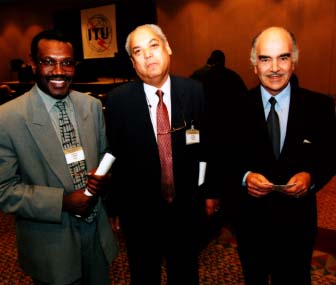
From left to right: Messrs H. Touré, R. Davidson and A. Laouyane
(ITU 980132)
|
* This article has been adapted from the Summary Record of the Special Meeting of the TDAG Subgroup (Minneapolis, 30 October 1998). |
At a special meeting of the Subgroup of the Telecommunication Development Advisory Group (TDAG) dealing with private sector* issues, which took place during the Minneapolis Plenipotentiary Conference, much determination was shown in the ongoing reform process in the telecommunication sector. Ronald Davidson of Final Analysis Inc., and Chairman of the Subgroup, introduced the topics for discussion: the need for stability in order to create an atmosphere conducive to investment, the need for flexibility in regulations, the factors that influence the decisions of private companies, the expectations of the developing countries, and the need to reach out to smaller companies in the developing world as well as to associations in both the industrialized and developing countries.
One year ago, the outgoing Director of the Telecommunication Development Bureau (BDT), Ahmed Laouyane, launched the concept of a strategic partnership for development, the aim of which was to promote cooperation between the public and private sectors and between private companies in developed and developing countries. In so doing, he also sought to create a broader-based partnership for development than in previous decades.
Opening the event, which was the second in a series of meetings planned for the Subgroup, Mr Laouyane stated: "Liberalization in developing countries should go hand in hand with investment; if it does not lead to an increased flow of technology and financial resources and transfer of technology in the developing countries, it will not have achieved its main objective." Also in attendance was the Director elect of BDT, Hamadoun Touré.
This article highlights some of the views expressed at the meeting.
The private sector will be the key to closing the gap in universal and information access by providing telecommunications to users at affordable prices, notably through joint ventures and strategic partnerships. In this connection, it is important to ask how ITU's Telecommunication Development Sector (ITU-D) can contribute to the liberalization of world markets for the benefit of all customers.
In many developing countries, when telephone markets are liberalized, there is a basic problem associated with legislation and regulation which sometimes hinders the liberalization process. In Lebanon, for example, the mobile telephone market has been opened up to two operators and demand for subscriptions is now so great that it can no longer be met because the contracts agreed with the two operators prohibit a third operator from entering the market. Although the restriction imposed by the two operators is justified given the risks of their venture, it is important to ensure that new operators can enter the market. Resolutions adopted at the Development Conferences and TDAG's recommendations should make it clear to Member States and Sector Members that regulation and legislation in developing countries need to be flexible and/or adapted regularly, in order to take account of the changing situation.
From left to right: Messrs H. Touré, R. Davidson and A. Laouyane
(ITU 980132)
Legislation and regulation are tools, not ends in themselves, and as such they have to be efficient. The main aim of the developing countries is to achieve development, but the same is not true of the developed countries. Strategic alliances, for example, are created for the purpose of conquering markets, whereas strategic partnerships are based on the willingness of the partners to work together towards development objectives. To that end, legislation and regulation have to be reformed in order to introduce stable rules with the necessary flexibility that will create greater competition, extend networks and make telecommunication affordable by the general public.
The work of ITU-D, in particular that of the BDT, must be adequately supported since what this Sector is trying to accomplish serves not only the developing countries, but also the developed ones. Although the large members of TIA are aware, most of the Association's small and medium sized members are unaware of the work of ITU-D, and of the fact that the Sector can open up market opportunities in developing countries.
The BDT should therefore be encouraged to provide opportunities for representatives of the private sector in developing countries to meet with the private sector in the developed world. For its part, TIA has an annual trade show which can serve as a good opportunity for the developing countries to familiarize themselves with the technologies and services that could help to meet their needs.
CITEL developed the Blue Book with the BDT/ITU which has served as a guide to the countries of Latin America and the Caribbean. As examples of liberalization and privatization, many countries in that region are in the process of privatizing their telecommunication systems. Brazil, for instance, has sold its operators in the various areas of the country for some USD 20 billion, which represent only the Government's share of some 20%. Countries at a similar stage in their development should share their experience.
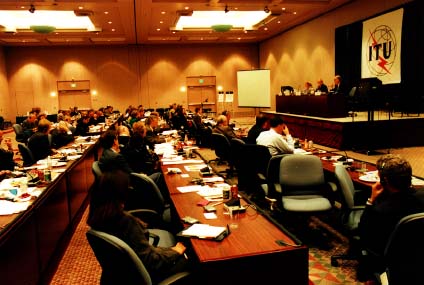
A view of the meeting room
(ITU 980133)
The key to both strategic alliances and partnerships is liberalization, which amounts to no more than a change of regulation. In the United States, for example, which is regarded as the prototypical liberalized market, there are probably more regulations at the present time than there had been before liberalization, and the same is true of the United Kingdom. Frankly, the profit motive remains the reason why players become strategic partners or set up strategic alliances. To that end, their first concern is the stability of the regulatory regime. Without such stability, companies are unwilling to take the risk of investing. But they do not necessarily seek to be the sole partners. Licensing should be devised in such a way that new players are encouraged to develop the market, not just to take a share of the existing one. BT, for example, lost market share in the United Kingdom with the arrival of some 70 new licensed operators, but it now carries 20% more minutes than two years previously because it has expanded its activities. The other factor of importance to private companies is the opportunity to take out profits at a suitable time.
This Japanese corporation has only limited experience of a few operations in South East Asia, and sees two sides to the coin: the stability required by the investor and the rigidity such stability could bring about, limiting the possibility of future expansion. The issue hinges on the parameters that are included in the initial licence and the details vary from case to case.
Growth and competition are what the developing countries need. From an ITU perspective, there should be closer cooperation between the three Sectors. There is sometimes a lack of understanding between them, which can lead to fear. The work of the Telecommunication Standardization Sector (ITU-T) is of great benefit to the developing countries. Most of its participants come from the private sector, primarily from the developed countries. If the Sector appears very dynamic and fast-moving, it is because it reflects the real world. But that should not be taken as a threat to the developing countries. On the contrary, the standards that are produced by ITU-T give the smaller countries the leverage they need to go to manufacturers and obtain the best price and quality by taking advantage of competition. Consequently, ITU-D should keep ITU-T constantly informed of the needs of the developing countries so that they can benefit fully from its work.
This law firm has effected a number of privatizations on behalf of both governments and investors. It is essential to start by analysing the requirements, because there can be trade-offs. From the standpoint of the investor, it depends on what commitments are being requested; they might dictate a period of more limited competition in the market. In the case of a fixed network, there is often a pattern of a limited number of operators for a few years, after which the market is opened up. But there is no one way of proceeding.
BDT/ITU should publish a set of guidelines indicating the factors that influence private companies when they are seeking to do business in a developing country, a "statement from the private sector" including what makes one country more attractive to investors than another. TIA members, for example, are particularly interested in equipment specification and ease of registration. Such a book could be issued by BDT/ITU in the form of recommendations addressed to the developing countries.
The next meeting of the TDAG Subgroup will be held in Geneva on 7 April 1999.
Palazzo J. L. (Argentina)
National consultant in legal aspects of telecommunication enterprises
(1.10.98-31.3.99)
Etienne P. (Switzerland)
Consultant in training
(1.11.98-9.11.98)
Cabello Araya O. (Chile)
Consultant in technical standards for wireless services
(17.11.98-21.11.98)
Dalmaz K. (Turkey)
Consultant in elaboration of telecommunication projects and investment
(14.11.98-17.12.98)
Milne C. (United Kingdom)
Consultant in numbering fundamental technical plan
(3.10.98-11.10.98)
Ekstedt G. (Sweden)
Consultant in CCITT Common Channel Signalling Sysem No. 7
(5.11.98-20.12.98)
Mastrobuono G. (Italy)
Consultant in analogue and digital terrestrial transmission
(21.10.98-14.11.98)
Rofe C. (France)
Consultant in radiocommunication tariffs
(17.11.98-20.12.98)
Mayher R. (United States)
Senior expert in automated radio frequency spectrum management, monitoring and control systems
(19.11.98-25.11.98)
Lee T. (United States)
Senior expert in operation and maintenance systems
(2.11.98-6.11.98)
Leino A. (Finland)
Senior expert in Internet application
(29.11.98-5.12.98)
Case R. (Guyana)
Consultant in broadcasting
(15.11.98-12.12.98)
Diez A. (Canada)
Senior expert in LAN/WAN
(24.10.98-19.12.98)
Dannecker R. (Australia)
Consultant in rural telecommunication network planning
(14.11.98-5.12.98)
Bejar B. (Tunisia)
Senior expert in organization development and total quality management
(10.10.98-25.10.98)
Shears A. (Canada)
Senior expert in training centre design
(5.11.98-4.12.98)
Flowers B. (United Kingdom)
Consultant in television signal transmission
(15.11.98-21.11.98)
Bliksrud E. (Norway)
Consultant in maritime radiocommunications
(8.11.98-14.11.98)
Bonifaz Fernández L. (Peru)
Consultant in Universal Service Fund
(4.10.98-10.10.98)
Chillón Medina J. (Spain)
Consultant in legal standards
(11.10.98-22.11.98)
Melo Downey J. (Chile)
Consultant in regulatory body and regulatory standards
(11.10.98-24.10.98)
Bonifaz Fernández L. (Peru)
Consultant in Universal Service Fund
(8.11.98-14.11.98)
Stanev I. (Bulgaria)
Senior expert in network planning
(29.11.98-12.12.98)
Pettersson G. (Sweden)
Consultant in network management
(14.11.98-18.11.98)
Diallo A. (Senegal)
Project coordinator/senior expert in telecommunication industrialization
(21.11.98-20.11.99)
Esen H. (Turkey)
Consultant in tendering and procurement of broadcasting system and equipment
(4.10.98-10.10.98)
Leijon H. (Sweden)
Senior expert in traffic engineering and forecasting
(11.10.98-17.10.98)
Pascual R. (Argentina)
Consultant in spectrum monitoring systems
(25.10.98-31.10.98)
Povolotskiy I. (Russia)
Senior expert in satellite systems
(4.10.98-10.10.98)
Engvall L. (Sweden)
Senior expert in MCT planning
(7.10.98-8.11.98)
Persson L. (Sweden)
Senior expert in planning and management of primary health care
(8.10.98-23.10.98)
Cajander S. (Sweden)
Senior expert in telemedicine
(11.10.98-25.10.98)
Wirzenius A. (Finland)
Telecommunication consultant in licensing
(10.11.98-23.11.98)
Erlevent A. (Turkey)
General consultant in telecommunications
(30.11.98-26.12.98)
Cherukupalli R. (India)
Project coordinator/senior expert in network planning, maintenance and management
(22.11.98-21.11.99)